
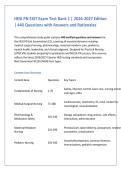
HESI PN EXIT Exam Test Bank 1 | 2026-2027 Edition
| 440 Questions with Answers and Rationales
This comprehensive study guide contains 440 verified questions and answers for
the HESI PN Exit Examination (E2), covering all essential domains including
medical-surgical nursing, pharmacology, maternal-newborn care, pediatrics,
mental health, leadership, and clinical judgment. Designed for Practical Nursing
(LPN/LVN) students preparing for graduation and NCLEX-PN success, this resource
reflects the latest 2026/2027 Elsevier HESI testing standards and incorporates
Next Generation NCLEX (NGN) item types .
Content Area Overview
Content Area Questions Key Topics
Safety, infection control, basic care, nursing proces
Fundamentals of Nursing 1-70
vital signs, ADLs
Cardiovascular, respiratory, GI, renal, endocrine,
Medical-Surgical Nursing 71-180
neurological, musculoskeletal
Pharmacology & Dosage calculations, drug actions, side effects,
181-240
Medication Safety interactions, administration
Maternal-Newborn Prenatal care, labor/delivery, postpartum, newborn
241-290
Nursing assessment, complications
Growth/development, common illnesses,
Pediatric Nursing 291-340
immunizations, pediatric emergencies
,Content Area Questions Key Topics
Psychiatric disorders, therapeutic communication,
Mental Health Nursing 341-380
medications, crisis intervention
Prioritization, delegation, legal/ethical issues,
Leadership & Delegation 381-410
management, quality improvement
Clinical Judgment (NGN- Case scenarios, unfolding cases, SATA, ordering, fill
411-440
Style) the-blank
SECTION 1: FUNDAMENTALS OF NURSING (Questions 1-70)
Question 1: The practical nurse (PN) is providing care to a client who is 1 day
postoperative following abdominal surgery. The client reports feeling nauseated.
The PN notes the client's abdomen is distended, and no bowel sounds are
auscultated. Which nursing action is most appropriate?
A) Administer an antiemetic as prescribed
B) Encourage the client to drink clear liquids
C) Insert a nasogastric tube
D) Notify the healthcare provider
Answer: D) Notify the healthcare provider
Rationale: Abdominal distention and absent bowel sounds following abdominal
surgery may indicate paralytic ileus or other complications requiring immediate
evaluation .
Question 2: The PN is reinforcing teaching to a client prescribed a low-sodium
diet for heart failure. Which food item should the PN recommend the client
avoid?
A) Fresh apples
B) Broiled chicken
,C) Canned vegetable soup
D) Brown rice
Answer: C) Canned vegetable soup
Rationale: Canned vegetable soup is typically high in sodium. Fresh fruits, broiled
chicken without added salt, and brown rice are low-sodium options .
Question 3: The PN is caring for a client who is receiving continuous enteral
feedings via a nasogastric tube. Which action should the PN take to reduce the
client's risk of aspiration?
A) Elevate the head of the bed to at least 30 degrees
B) Check gastric residual volume every 2 hours
C) Flush the tube with water before and after feedings
D) Administer feedings at room temperature
Answer: A) Elevate the head of the bed to at least 30 degrees
Rationale: Elevating the head of the bed to 30-45 degrees during enteral feedings
reduces the risk of aspiration .
Question 4: The PN is assisting a client with a warm compress application. Which
statement indicates the client understands the purpose of a warm compress?
A) "The warm compress will help to stop bleeding"
B) "The warm compress will promote healing and increase blood flow"
C) "The warm compress will prevent infection"
D) "The warm compress will reduce swelling"
Answer: B) "The warm compress will promote healing and increase blood flow"
Rationale: Warm compresses promote vasodilation, which increases blood flow
to the area and promotes healing. Cold compresses reduce swelling and bleeding .
Question 5: The PN is caring for a client with a new diagnosis of diabetes mellitus.
The client asks why it is important to monitor blood glucose levels. Which
response should the PN provide?
A) "Monitoring helps you adjust your diet and medication"
B) "Monitoring helps prevent complications"
, C) "Monitoring helps you maintain your target levels"
D) "All of the above"
Answer: D) "All of the above"
Rationale: Blood glucose monitoring helps clients manage their diabetes by
providing information to make informed decisions about diet, activity, and
medication. It also helps prevent acute and chronic complications .
Question 6: The PN is caring for a client with an indwelling urinary catheter. The
PN notes that the drainage bag contains dark, concentrated urine. Which nursing
action is most appropriate?
A) Increase the client's fluid intake
B) Irrigate the catheter with sterile water
C) Notify the healthcare provider
D) Document the finding
Answer: A) Increase the client's fluid intake
Rationale: Dark, concentrated urine may indicate dehydration. Increasing fluid
intake may help dilute the urine .
Question 7: The PN is reinforcing teaching to a client who is prescribed a
metered-dose inhaler (MDI). Which instruction is correct?
A) "Shake the inhaler before each use"
B) "Inhale while pressing down on the canister"
C) "Hold your breath for 10 seconds after inhaling"
D) "All of the above"
Answer: D) "All of the above"
Rationale: Proper MDI technique includes shaking the inhaler, inhaling slowly
while pressing the canister, and holding breath for 10 seconds to allow
medication to deposit in the lungs .
Question 8: The PN is caring for a client who is 1 day postoperative. The PN notes
that the client has not voided in 8 hours. Which nursing action is most
appropriate?
| 440 Questions with Answers and Rationales
This comprehensive study guide contains 440 verified questions and answers for
the HESI PN Exit Examination (E2), covering all essential domains including
medical-surgical nursing, pharmacology, maternal-newborn care, pediatrics,
mental health, leadership, and clinical judgment. Designed for Practical Nursing
(LPN/LVN) students preparing for graduation and NCLEX-PN success, this resource
reflects the latest 2026/2027 Elsevier HESI testing standards and incorporates
Next Generation NCLEX (NGN) item types .
Content Area Overview
Content Area Questions Key Topics
Safety, infection control, basic care, nursing proces
Fundamentals of Nursing 1-70
vital signs, ADLs
Cardiovascular, respiratory, GI, renal, endocrine,
Medical-Surgical Nursing 71-180
neurological, musculoskeletal
Pharmacology & Dosage calculations, drug actions, side effects,
181-240
Medication Safety interactions, administration
Maternal-Newborn Prenatal care, labor/delivery, postpartum, newborn
241-290
Nursing assessment, complications
Growth/development, common illnesses,
Pediatric Nursing 291-340
immunizations, pediatric emergencies
,Content Area Questions Key Topics
Psychiatric disorders, therapeutic communication,
Mental Health Nursing 341-380
medications, crisis intervention
Prioritization, delegation, legal/ethical issues,
Leadership & Delegation 381-410
management, quality improvement
Clinical Judgment (NGN- Case scenarios, unfolding cases, SATA, ordering, fill
411-440
Style) the-blank
SECTION 1: FUNDAMENTALS OF NURSING (Questions 1-70)
Question 1: The practical nurse (PN) is providing care to a client who is 1 day
postoperative following abdominal surgery. The client reports feeling nauseated.
The PN notes the client's abdomen is distended, and no bowel sounds are
auscultated. Which nursing action is most appropriate?
A) Administer an antiemetic as prescribed
B) Encourage the client to drink clear liquids
C) Insert a nasogastric tube
D) Notify the healthcare provider
Answer: D) Notify the healthcare provider
Rationale: Abdominal distention and absent bowel sounds following abdominal
surgery may indicate paralytic ileus or other complications requiring immediate
evaluation .
Question 2: The PN is reinforcing teaching to a client prescribed a low-sodium
diet for heart failure. Which food item should the PN recommend the client
avoid?
A) Fresh apples
B) Broiled chicken
,C) Canned vegetable soup
D) Brown rice
Answer: C) Canned vegetable soup
Rationale: Canned vegetable soup is typically high in sodium. Fresh fruits, broiled
chicken without added salt, and brown rice are low-sodium options .
Question 3: The PN is caring for a client who is receiving continuous enteral
feedings via a nasogastric tube. Which action should the PN take to reduce the
client's risk of aspiration?
A) Elevate the head of the bed to at least 30 degrees
B) Check gastric residual volume every 2 hours
C) Flush the tube with water before and after feedings
D) Administer feedings at room temperature
Answer: A) Elevate the head of the bed to at least 30 degrees
Rationale: Elevating the head of the bed to 30-45 degrees during enteral feedings
reduces the risk of aspiration .
Question 4: The PN is assisting a client with a warm compress application. Which
statement indicates the client understands the purpose of a warm compress?
A) "The warm compress will help to stop bleeding"
B) "The warm compress will promote healing and increase blood flow"
C) "The warm compress will prevent infection"
D) "The warm compress will reduce swelling"
Answer: B) "The warm compress will promote healing and increase blood flow"
Rationale: Warm compresses promote vasodilation, which increases blood flow
to the area and promotes healing. Cold compresses reduce swelling and bleeding .
Question 5: The PN is caring for a client with a new diagnosis of diabetes mellitus.
The client asks why it is important to monitor blood glucose levels. Which
response should the PN provide?
A) "Monitoring helps you adjust your diet and medication"
B) "Monitoring helps prevent complications"
, C) "Monitoring helps you maintain your target levels"
D) "All of the above"
Answer: D) "All of the above"
Rationale: Blood glucose monitoring helps clients manage their diabetes by
providing information to make informed decisions about diet, activity, and
medication. It also helps prevent acute and chronic complications .
Question 6: The PN is caring for a client with an indwelling urinary catheter. The
PN notes that the drainage bag contains dark, concentrated urine. Which nursing
action is most appropriate?
A) Increase the client's fluid intake
B) Irrigate the catheter with sterile water
C) Notify the healthcare provider
D) Document the finding
Answer: A) Increase the client's fluid intake
Rationale: Dark, concentrated urine may indicate dehydration. Increasing fluid
intake may help dilute the urine .
Question 7: The PN is reinforcing teaching to a client who is prescribed a
metered-dose inhaler (MDI). Which instruction is correct?
A) "Shake the inhaler before each use"
B) "Inhale while pressing down on the canister"
C) "Hold your breath for 10 seconds after inhaling"
D) "All of the above"
Answer: D) "All of the above"
Rationale: Proper MDI technique includes shaking the inhaler, inhaling slowly
while pressing the canister, and holding breath for 10 seconds to allow
medication to deposit in the lungs .
Question 8: The PN is caring for a client who is 1 day postoperative. The PN notes
that the client has not voided in 8 hours. Which nursing action is most
appropriate?


