

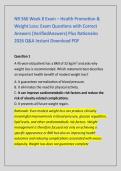
NR 566 Week 8 Exam – Health Promotion &
Weight Loss: Exam Questions with Correct
Answers (VerifiedAnswers) Plus Rationales
2026 Q&A Instant Download PDF
Question 1
A 45-year-old patient has a BMI of 32 kg/m² and asks why
weight loss is recommended. Which statement best describes
an important health benefit of modest weight loss?
A. It guarantees normalization of blood pressure.
B. It eliminates the need for physical activity.
C. It can improve cardiometabolic risk factors and reduce the
risk of obesity-related complications.
D. It prevents all future weight regain.
Rationale: Even modest weight loss can produce clinically
meaningful improvements in blood pressure, glucose regulation,
lipid levels, and other cardiometabolic risk factors. Weight
management is therefore focused not only on achieving a
specific appearance or BMI but also on improving health
outcomes and reducing complications associated with excess
adiposity. Weight loss does not guarantee complete
,normalization of a condition, eliminate the need for exercise, or
permanently prevent weight regain.
Question 2
Which measurement is most commonly used as a screening
tool to classify weight status in adults?
A. Waist-to-hip ratio alone
B. Body fat percentage alone
C. Body mass index (BMI)
D. Resting heart rate
Rationale: BMI is widely used as an initial screening measure for
weight status in adults because it relates weight to height. It is
calculated by dividing weight in kilograms by height in meters
squared. BMI does not directly measure body fat and should
therefore be interpreted in the context of the patient's overall
health, body composition, waist circumference, medical
conditions, and other risk factors.
Question 3
A patient has a BMI of 28 kg/m². How should this BMI generally
be classified in an adult?
A. Underweight
B. Normal weight
C. Overweight
D. Class III obesity
,Rationale: In adults, a BMI from 25.0 to 29.9 kg/m² is generally
categorized as overweight. A BMI below 18.5 is classified as
underweight, 18.5 to 24.9 as normal weight, and 30 kg/m² or
greater as obesity. BMI categories are screening classifications
rather than complete assessments of an individual's health.
Question 4
Which BMI range corresponds to class I obesity in adults?
A. 25.0–27.9 kg/m²
B. 27.0–29.9 kg/m²
C. 30.0–34.9 kg/m²
D. 40.0 kg/m² or greater
Rationale: Class I obesity corresponds to a BMI of 30.0–34.9
kg/m². Class II obesity is generally 35.0–39.9 kg/m², while class
III obesity is 40 kg/m² or greater. BMI classification helps
clinicians identify patients who may benefit from further
assessment and intervention but should not be used as the sole
determinant of treatment.
Question 5
Which factor is particularly important when assessing obesity-
related health risk in addition to BMI?
A. Eye color
B. Shoe size
, C. Waist circumference
D. Hair color
Rationale: Waist circumference provides information about
central or abdominal adiposity. Excess visceral fat is associated
with increased cardiometabolic risk, including type 2 diabetes,
hypertension, and cardiovascular disease. A comprehensive
assessment should consider BMI, waist circumference,
comorbidities, medications, dietary habits, physical activity,
sleep, psychosocial factors, and readiness for behavioral
change.
Question 6
A patient says, “I know I need to lose weight, but I don't think I
can change my eating habits.” Which response best
demonstrates motivational interviewing?
A. “You need to follow the diet plan exactly.”
B. “You should stop eating carbohydrates.”
C. “What changes do you feel would be realistic for you to
start with?”
D. “If you don't change, your health will get worse.”
Rationale: Motivational interviewing emphasizes collaboration,
empathy, patient autonomy, and eliciting the patient's own
reasons for change. Asking what changes feel realistic
encourages the patient to identify achievable goals rather than
imposing directives. Confrontation, fear-based counseling, and
Weight Loss: Exam Questions with Correct
Answers (VerifiedAnswers) Plus Rationales
2026 Q&A Instant Download PDF
Question 1
A 45-year-old patient has a BMI of 32 kg/m² and asks why
weight loss is recommended. Which statement best describes
an important health benefit of modest weight loss?
A. It guarantees normalization of blood pressure.
B. It eliminates the need for physical activity.
C. It can improve cardiometabolic risk factors and reduce the
risk of obesity-related complications.
D. It prevents all future weight regain.
Rationale: Even modest weight loss can produce clinically
meaningful improvements in blood pressure, glucose regulation,
lipid levels, and other cardiometabolic risk factors. Weight
management is therefore focused not only on achieving a
specific appearance or BMI but also on improving health
outcomes and reducing complications associated with excess
adiposity. Weight loss does not guarantee complete
,normalization of a condition, eliminate the need for exercise, or
permanently prevent weight regain.
Question 2
Which measurement is most commonly used as a screening
tool to classify weight status in adults?
A. Waist-to-hip ratio alone
B. Body fat percentage alone
C. Body mass index (BMI)
D. Resting heart rate
Rationale: BMI is widely used as an initial screening measure for
weight status in adults because it relates weight to height. It is
calculated by dividing weight in kilograms by height in meters
squared. BMI does not directly measure body fat and should
therefore be interpreted in the context of the patient's overall
health, body composition, waist circumference, medical
conditions, and other risk factors.
Question 3
A patient has a BMI of 28 kg/m². How should this BMI generally
be classified in an adult?
A. Underweight
B. Normal weight
C. Overweight
D. Class III obesity
,Rationale: In adults, a BMI from 25.0 to 29.9 kg/m² is generally
categorized as overweight. A BMI below 18.5 is classified as
underweight, 18.5 to 24.9 as normal weight, and 30 kg/m² or
greater as obesity. BMI categories are screening classifications
rather than complete assessments of an individual's health.
Question 4
Which BMI range corresponds to class I obesity in adults?
A. 25.0–27.9 kg/m²
B. 27.0–29.9 kg/m²
C. 30.0–34.9 kg/m²
D. 40.0 kg/m² or greater
Rationale: Class I obesity corresponds to a BMI of 30.0–34.9
kg/m². Class II obesity is generally 35.0–39.9 kg/m², while class
III obesity is 40 kg/m² or greater. BMI classification helps
clinicians identify patients who may benefit from further
assessment and intervention but should not be used as the sole
determinant of treatment.
Question 5
Which factor is particularly important when assessing obesity-
related health risk in addition to BMI?
A. Eye color
B. Shoe size
, C. Waist circumference
D. Hair color
Rationale: Waist circumference provides information about
central or abdominal adiposity. Excess visceral fat is associated
with increased cardiometabolic risk, including type 2 diabetes,
hypertension, and cardiovascular disease. A comprehensive
assessment should consider BMI, waist circumference,
comorbidities, medications, dietary habits, physical activity,
sleep, psychosocial factors, and readiness for behavioral
change.
Question 6
A patient says, “I know I need to lose weight, but I don't think I
can change my eating habits.” Which response best
demonstrates motivational interviewing?
A. “You need to follow the diet plan exactly.”
B. “You should stop eating carbohydrates.”
C. “What changes do you feel would be realistic for you to
start with?”
D. “If you don't change, your health will get worse.”
Rationale: Motivational interviewing emphasizes collaboration,
empathy, patient autonomy, and eliciting the patient's own
reasons for change. Asking what changes feel realistic
encourages the patient to identify achievable goals rather than
imposing directives. Confrontation, fear-based counseling, and


