

NR 566 Advanced Pharmacology for
Primary Care — Comprehensive Final Exam
Practice (2026)
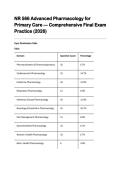
Topic Distribution Table
Table
Domain Question Count Percentage
Pharmacokinetics & Pharmacodynamics 10 6.7%
Cardiovascular Pharmacology 22 14.7%
Endocrine Pharmacology 18 12.0%
Respiratory Pharmacology 12 8.0%
Infectious Disease Pharmacology 18 12.0%
Neurology & Psychiatric Pharmacology 16 10.7%
Pain Management Pharmacology 12 8.0%
Gastrointestinal Pharmacology 10 6.7%
Women's Health Pharmacology 10 6.7%
Men's Health Pharmacology 6 4.0%
, Domain Question Count Percentage
Pediatric Pharmacology 6 4.0%
Geriatric Pharmacology & Polypharmacy 6 4.0%
Drug Interactions & Monitoring 4 2.7%
TOTAL 150 100%
CASE STUDY 1: Cardiovascular — Heart Failure with Comorbidities
CASE STUDY: Mr. J.D., 68-year-old male, presents for follow-up of chronic heart failure (HFrEF,
LVEF 35%). His current medications include lisinopril 20 mg daily, metoprolol succinate 50 mg
daily, furosemide 40 mg daily, and aspirin 81 mg daily. Vitals: BP 128/78 mmHg, HR 72 bpm, RR
18, SpO₂ 94% on room air. Labs: Na 138 mEq/L, K 4.2 mEq/L, Cr 1.1 mg/dL, eGFR 58 mL/min,
BNP 450 pg/mL. He reports mild dyspnea on exertion but no orthopnea. The NP plans to
optimize his heart failure regimen per ACC/AHA/HFSA guidelines.
Q1: Based on current ACC/AHA/HFSA guidelines, which medication should be added to Mr. J.D.'s
regimen to further reduce mortality and hospitalization in HFrEF?
A. Digoxin 0.125 mg daily
B. Hydralazine-isosorbide dinitrate
C. Spironolactone 25 mg daily
D. Diltiazem 240 mg daily
Correct Answer: C
Rationale: Spironolactone (an MRA) is a Class I recommendation for HFrEF (LVEF ≤35%) to
reduce mortality and hospitalization, per ACC/AHA/HFSA guidelines. Digoxin improves
symptoms but not mortality. Hydralazine-isosorbide is indicated for Black patients or ACE
inhibitor-intolerant patients. Diltiazem is contraindicated in HFrEF due to negative inotropy.
,Q2: Before initiating spironolactone, which laboratory parameter requires the most careful
monitoring?
A. Hemoglobin A1c
B. Serum potassium and creatinine
C. Thyroid stimulating hormone
D. Liver function tests
Correct Answer: B
Rationale: MRAs such as spironolactone carry a significant risk of hyperkalemia and worsening
renal function, especially when combined with ACE inhibitors. Baseline and follow-up
monitoring of serum potassium and creatinine is mandatory per guideline recommendations.
Q3: Mr. J.D. asks about the mechanism by which metoprolol succinate benefits his heart failure.
The NP explains that beta-blockers in HFrEF work primarily by:
A. Increasing cardiac contractility through beta-1 agonism
B. Reducing neurohormonal activation and reverse remodeling
C. Dilating coronary arteries to improve myocardial perfusion
D. Inhibiting the renin-angiotensin-aldosterone system directly
Correct Answer: B
Rationale: Beta-blockers in HFrEF reduce sympathetic tone and neurohormonal activation,
which promotes reverse remodeling and reduces mortality. They do not increase contractility
(negative inotrope), dilate coronary arteries directly, or inhibit RAAS directly.
Q4: If Mr. J.D. develops a persistent dry cough after several months on lisinopril, which
medication represents the most appropriate substitution?
A. Losartan 50 mg daily
B. Amlodipine 5 mg daily
C. Clonidine 0.1 mg twice daily
D. Doxazosin 2 mg daily
Correct Answer: A
Rationale: Losartan, an ARB, provides equivalent mortality benefit in HFrEF without the
bradykinin-mediated cough associated with ACE inhibitors. Amlodipine does not reduce
mortality in HFrEF. Clonidine and doxazosin are not first-line agents for HFrEF.
, Q5: The NP discusses SGLT2 inhibitor therapy with Mr. J.D. Which statement about dapagliflozin
in heart failure is most accurate?
A. It is only indicated in patients with concomitant type 2 diabetes
B. It reduces cardiovascular death and worsening heart failure regardless of diabetes status
C. It should be avoided in patients with eGFR below 60 mL/min
D. It works primarily by increasing cardiac contractility
Correct Answer: B
Rationale: The DAPA-HF trial demonstrated that dapagliflozin reduces cardiovascular death and
heart failure hospitalization in patients with HFrEF, with or without type 2 diabetes. SGLT2
inhibitors are now standard of care in HFrEF per ACC/AHA/HFSA guidelines.
CASE STUDY 2: Endocrine — Type 2 Diabetes with Complications
CASE STUDY: Mrs. A.R., 55-year-old female, presents for diabetes management. She has type 2
diabetes diagnosed 8 years ago, obesity (BMI 34 kg/m²), hypertension, and diabetic peripheral
neuropathy. Current medications: metformin 1000 mg twice daily, lisinopril 10 mg daily,
atorvastatin 40 mg daily, and aspirin 81 mg daily. Labs: HbA1c 8.6%, eGFR 72 mL/min, ALT 28
U/L, urine albumin-to-creatinine ratio 45 mg/g. She reports difficulty with diet adherence and
has gained 4 lbs since her last visit.
Q6: According to the ADA Standards of Care, which medication should be added to Mrs. A.R.'s
regimen given her HbA1c and clinical profile?
A. Glipizide 5 mg daily
B. Empagliflozin 10 mg daily
C. Pioglitazone 30 mg daily
D. NPH insulin 10 units at bedtime
Correct Answer: B
Rationale: Empagliflozin, an SGLT2 inhibitor, is preferred in patients with T2DM and established
ASCVD or high cardiovascular risk per ADA guidelines. It promotes weight loss, reduces
cardiovascular events (EMPA-REG OUTCOME), and offers renal protection. Glipizide causes
weight gain and hypoglycemia. Pioglitazone causes weight gain and fluid retention.
Primary Care — Comprehensive Final Exam
Practice (2026)
Topic Distribution Table
Table
Domain Question Count Percentage
Pharmacokinetics & Pharmacodynamics 10 6.7%
Cardiovascular Pharmacology 22 14.7%
Endocrine Pharmacology 18 12.0%
Respiratory Pharmacology 12 8.0%
Infectious Disease Pharmacology 18 12.0%
Neurology & Psychiatric Pharmacology 16 10.7%
Pain Management Pharmacology 12 8.0%
Gastrointestinal Pharmacology 10 6.7%
Women's Health Pharmacology 10 6.7%
Men's Health Pharmacology 6 4.0%
, Domain Question Count Percentage
Pediatric Pharmacology 6 4.0%
Geriatric Pharmacology & Polypharmacy 6 4.0%
Drug Interactions & Monitoring 4 2.7%
TOTAL 150 100%
CASE STUDY 1: Cardiovascular — Heart Failure with Comorbidities
CASE STUDY: Mr. J.D., 68-year-old male, presents for follow-up of chronic heart failure (HFrEF,
LVEF 35%). His current medications include lisinopril 20 mg daily, metoprolol succinate 50 mg
daily, furosemide 40 mg daily, and aspirin 81 mg daily. Vitals: BP 128/78 mmHg, HR 72 bpm, RR
18, SpO₂ 94% on room air. Labs: Na 138 mEq/L, K 4.2 mEq/L, Cr 1.1 mg/dL, eGFR 58 mL/min,
BNP 450 pg/mL. He reports mild dyspnea on exertion but no orthopnea. The NP plans to
optimize his heart failure regimen per ACC/AHA/HFSA guidelines.
Q1: Based on current ACC/AHA/HFSA guidelines, which medication should be added to Mr. J.D.'s
regimen to further reduce mortality and hospitalization in HFrEF?
A. Digoxin 0.125 mg daily
B. Hydralazine-isosorbide dinitrate
C. Spironolactone 25 mg daily
D. Diltiazem 240 mg daily
Correct Answer: C
Rationale: Spironolactone (an MRA) is a Class I recommendation for HFrEF (LVEF ≤35%) to
reduce mortality and hospitalization, per ACC/AHA/HFSA guidelines. Digoxin improves
symptoms but not mortality. Hydralazine-isosorbide is indicated for Black patients or ACE
inhibitor-intolerant patients. Diltiazem is contraindicated in HFrEF due to negative inotropy.
,Q2: Before initiating spironolactone, which laboratory parameter requires the most careful
monitoring?
A. Hemoglobin A1c
B. Serum potassium and creatinine
C. Thyroid stimulating hormone
D. Liver function tests
Correct Answer: B
Rationale: MRAs such as spironolactone carry a significant risk of hyperkalemia and worsening
renal function, especially when combined with ACE inhibitors. Baseline and follow-up
monitoring of serum potassium and creatinine is mandatory per guideline recommendations.
Q3: Mr. J.D. asks about the mechanism by which metoprolol succinate benefits his heart failure.
The NP explains that beta-blockers in HFrEF work primarily by:
A. Increasing cardiac contractility through beta-1 agonism
B. Reducing neurohormonal activation and reverse remodeling
C. Dilating coronary arteries to improve myocardial perfusion
D. Inhibiting the renin-angiotensin-aldosterone system directly
Correct Answer: B
Rationale: Beta-blockers in HFrEF reduce sympathetic tone and neurohormonal activation,
which promotes reverse remodeling and reduces mortality. They do not increase contractility
(negative inotrope), dilate coronary arteries directly, or inhibit RAAS directly.
Q4: If Mr. J.D. develops a persistent dry cough after several months on lisinopril, which
medication represents the most appropriate substitution?
A. Losartan 50 mg daily
B. Amlodipine 5 mg daily
C. Clonidine 0.1 mg twice daily
D. Doxazosin 2 mg daily
Correct Answer: A
Rationale: Losartan, an ARB, provides equivalent mortality benefit in HFrEF without the
bradykinin-mediated cough associated with ACE inhibitors. Amlodipine does not reduce
mortality in HFrEF. Clonidine and doxazosin are not first-line agents for HFrEF.
, Q5: The NP discusses SGLT2 inhibitor therapy with Mr. J.D. Which statement about dapagliflozin
in heart failure is most accurate?
A. It is only indicated in patients with concomitant type 2 diabetes
B. It reduces cardiovascular death and worsening heart failure regardless of diabetes status
C. It should be avoided in patients with eGFR below 60 mL/min
D. It works primarily by increasing cardiac contractility
Correct Answer: B
Rationale: The DAPA-HF trial demonstrated that dapagliflozin reduces cardiovascular death and
heart failure hospitalization in patients with HFrEF, with or without type 2 diabetes. SGLT2
inhibitors are now standard of care in HFrEF per ACC/AHA/HFSA guidelines.
CASE STUDY 2: Endocrine — Type 2 Diabetes with Complications
CASE STUDY: Mrs. A.R., 55-year-old female, presents for diabetes management. She has type 2
diabetes diagnosed 8 years ago, obesity (BMI 34 kg/m²), hypertension, and diabetic peripheral
neuropathy. Current medications: metformin 1000 mg twice daily, lisinopril 10 mg daily,
atorvastatin 40 mg daily, and aspirin 81 mg daily. Labs: HbA1c 8.6%, eGFR 72 mL/min, ALT 28
U/L, urine albumin-to-creatinine ratio 45 mg/g. She reports difficulty with diet adherence and
has gained 4 lbs since her last visit.
Q6: According to the ADA Standards of Care, which medication should be added to Mrs. A.R.'s
regimen given her HbA1c and clinical profile?
A. Glipizide 5 mg daily
B. Empagliflozin 10 mg daily
C. Pioglitazone 30 mg daily
D. NPH insulin 10 units at bedtime
Correct Answer: B
Rationale: Empagliflozin, an SGLT2 inhibitor, is preferred in patients with T2DM and established
ASCVD or high cardiovascular risk per ADA guidelines. It promotes weight loss, reduces
cardiovascular events (EMPA-REG OUTCOME), and offers renal protection. Glipizide causes
weight gain and hypoglycemia. Pioglitazone causes weight gain and fluid retention.


