

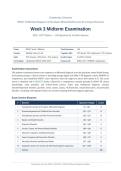
Chamberlain University
NR547: Differential Diagnosis in Psychiatric-Mental Health across the Lifespan Practicum
Week 3 Midterm Examination
Edition — 100 Questions & Verified Answers
——————————————————————————————————————————————————
Exam: NR547 Week 3 Midterm Total Questions: 100
Format: Multiple Choice (A-D) Cognitive Mix: 25% Recall / 50% Application / 25% Analysis
Style: 70% Scenario / 20% Direct / 10% Analysis Grade Target: A (100% Verified)
Curriculum: Chamberlain NR547 (2026-2027) Framework: DSM-5-TR + PMHNP Competencies
Examination Instructions
This midterm examination assesses your competency in differential diagnosis across the psychiatric-mental health lifespan.
Each question presents a clinical scenario or knowledge prompt aligned with DSM-5-TR diagnostic criteria, PMHNP-AC
competencies, and Chamberlain NR547 course objectives. Select the single best answer from options A–D. The correct
answer is identified with [CORRECT] marker, followed by a comprehensive rationale grounded in DSM-5-TR criteria,
neurobiology, safety principles, and evidence-based practice. Topics span foundational diagnostic concepts,
neurodevelopmental disorders, psychotic, mood, anxiety, trauma, OCD-spectrum, somatic/dissociative, and personality
disorders, concluding with integrated clinical case scenarios requiring differential diagnosis application.
Exam Section Blueprint
# Section Question Range Count
1 Foundational Concepts in Psychiatric Differential Diagnosis Q1 - Q12 12
2 Neurodevelopmental and Childhood-Onset Disorders Q13 - Q22 10
3 Schizophrenia Spectrum and Other Psychotic Disorders Q23 - Q32 10
4 Bipolar and Related Disorders Q33 - Q40 8
5 Depressive Disorders Q41 - Q48 8
6 Anxiety, Trauma, and Stressor-Related Disorders Q49 - Q60 12
7 Obsessive-Compulsive and Related Disorders Q61 - Q68 8
8 Somatic Symptom and Dissociative Disorders Q69 - Q76 8
9 Personality Disorders and Behavioral Health Q77 - Q86 10
10 Integrated Clinical Case Scenarios & Differential Diagnosis Application Q87 - Q100 14
TOTAL 100
Chamberlain University NR547 | 2026/2027 | PMHNP Differential Diagnosis Midterm
,NR547 Week 3 Midterm Exam - Differential Diagnosis in Psychiatric-Mental Health Page 2
Section 1: Foundational Concepts in Psychiatric Differential Diagnosis
Q1. A PMHNP candidate is reviewing the DSM-5-TR organization to prepare for a differential diagnosis case
conference. Which structural change in the DSM-5-TR best reflects the shift from the categorical multiaxial
system of DSM-IV-TR toward a dimensional, lifespan-oriented approach?
A. Removal of all diagnostic specifiers to simplify criteria application
B. Elimination of the multiaxial system and integration of personality disorders, medical conditions, and
psychosocial stressors onto a single axis [CORRECT]
C. Requirement that all disorders be diagnosed using ICD-10-CM codes exclusively
D. Mandatory use of the Global Assessment of Functioning (GAF) for every diagnostic encounter
Correct Answer: B
Rationale:
The DSM-5-TR eliminated the multiaxial system used in DSM-IV-TR, integrating formerly separate axes (clinical
disorders, personality disorders/intellectual disability, medical conditions, psychosocial stressors, GAF) into a unified
diagnostic list with non-axial documentation. This supports dimensional assessment and lifespan formulation. Specifiers
were retained (not removed, eliminating A), ICD-10-CM coding is used but is not the structural change (eliminating C), and
the GAF was actually dropped in DSM-5 (eliminating D). Chamberlain NR547 emphasizes this structural shift because it
directly affects how the PMHNP documents comorbidity, medical contributors, and cultural context in differential
diagnosis.
Q2. A 42-year-old patient presents with new-onset depression following a job loss, chronic back pain, and
family conflict. Using the biopsychosocial model taught in NR547, which formulation best demonstrates
integration of all three domains for diagnostic and treatment planning purposes?
A. Focus treatment exclusively on SSRI pharmacotherapy targeting the biological domain
B. Attribute the depression primarily to the job loss and provide brief supportive therapy only
C. Assess serotonin/dopamine pathways, cognitive appraisal of loss, pain-related disability, and family support
networks as interacting contributors requiring multimodal intervention [CORRECT]
D. Defer psychiatric diagnosis until the medical pain condition is fully resolved by the primary care provider
Correct Answer: C
Rationale:
The biopsychosocial model integrates biological (neurotransmitter function, genetics, medical comorbidity), psychological
(cognitive patterns, coping, appraisal), and social (relationships, employment, support, culture) contributors to formulate
diagnosis and treatment. Option C correctly addresses all three domains. Option A isolates biology, Option B isolates
psychology/social, and Option D inappropriately defers mental health treatment, violating integrated care principles. NR547
emphasizes that PMHNPs must operationalize this model in every formulation to avoid reductionistic diagnosis and to align
evidence-based pharmacologic and psychotherapeutic interventions with each contributing domain.
Chamberlain University NR547 | 2026/2027 | PMHNP Differential Diagnosis Midterm
,NR547 Week 3 Midterm Exam - Differential Diagnosis in Psychiatric-Mental Health Page 3
Q3. During a psychiatric evaluation, the PMHNP documents: 'Patient appears disheveled, makes poor eye
contact, speaks in a low volume with short latencies, describes mood as sad with congruent tearful affect,
thought process is linear with no looseness, thought content includes hopelessness but no SI/HI, oriented to
person/place/time, poor insight, impaired judgment.' Which MSE component is incompletely assessed based
on the documentation provided?
A. Appearance and Behavior only
B. Perception (presence/absence of hallucinations or illusions) [CORRECT]
C. Speech characteristics only
D. Cognitive assessment via MoCA
Correct Answer: B
Rationale:
The MSE includes Appearance, Behavior, Speech, Mood/Affect, Thought Process, Thought Content, Perception, Cognition,
Insight, and Judgment. The documentation covers appearance, behavior, speech, mood/affect, thought process, thought
content (hopelessness), cognition (orientation), insight, and judgment, but it does NOT explicitly state whether perception
(hallucinations, illusions, depersonalization) was assessed. Option A is incorrect because appearance and behavior are
documented. Option C is incorrect because speech is documented. Option D is incorrect because MoCA is a separate tool,
not a required MSE component. NR547 requires PMHNPs to systematically document each MSE domain, with perception
explicitly noted as assessed or denied.
Q4. A PMHNP is conducting an initial psychiatric interview with a 28-year-old reporting 'I just feel off.'
Which sequence best reflects the recommended structure of the psychiatric history taking taught in
Chamberlain NR547?
A. Family history, social history, mental status exam, chief complaint, treatment plan
B. Chief complaint, history of present illness, past psychiatric history, medical history, family history, social
history, substance use history, mental status exam [CORRECT]
C. Mental status exam first, then chief complaint, then diagnostic formulation
D. Substance use history first because it determines all subsequent differential diagnoses
Correct Answer: B
Rationale:
The standardized psychiatric interview sequence begins with identifying information and chief complaint, followed by
history of present illness (HPI), past psychiatric history (prior diagnoses, hospitalizations, medications, therapy, SI/violence
history), medical history (to rule out organic contributors), family history (genetic loading), social history (developmental,
educational, occupational, relational), substance use history (to identify substance-induced or comorbid conditions), and
concludes with the MSE. Option B reflects this sequence. Options A, C, and D disrupt the logical flow, risk missing critical
contextual data, and undermine differential diagnosis. NR547 stresses that the history informs the MSE interpretation and
diagnostic hypotheses.
Chamberlain University NR547 | 2026/2027 | PMHNP Differential Diagnosis Midterm
, NR547 Week 3 Midterm Exam - Differential Diagnosis in Psychiatric-Mental Health Page 4
Q5. A patient with auditory hallucinations responds to a low-dose second-generation antipsychotic,
supporting a dopamine hypothesis of psychosis. Which neurotransmitter pathway is most directly implicated
in the positive symptoms of psychosis that the medication targets?
A. Nigrostriatal dopamine pathway
B. Mesolimbic dopamine pathway [CORRECT]
C. Tuberoinfundibular dopamine pathway
D. Cortical serotonin pathway
Correct Answer: B
Rationale:
The mesolimbic dopamine pathway is hyperactive in psychosis and is the primary substrate for positive symptoms
(delusions, hallucinations). Antipsychotics block D2 receptors in this pathway, reducing positive symptoms. The
nigrostriatal pathway (Option A) regulates motor function; its blockade causes extrapyramidal symptoms (EPS). The
tuberoinfundibular pathway (Option C) regulates prolactin; its blockade causes hyperprolactinemia. Cortical serotonin
(Option D) is more relevant to mood and anxiety. NR547 emphasizes neurobiology literacy so PMHNPs can predict
side-effect profiles (EPS, prolactin elevation) and select agents based on mechanism, not just brand name.
Q6. A 35-year-old with major depressive disorder presents after a recent breakup and endorses passive
suicidal ideation without a plan. History reveals two prior attempts, a paternal uncle who died by suicide,
daily alcohol use, and a firearm kept at home. Using a structured suicide risk framework, which combination
best reflects the highest-weighted risk factors requiring immediate safety planning?
A. Recent breakup, passive ideation, female sex
B. Prior attempts, family history of suicide, firearm access, substance use [CORRECT]
C. Younger age, passive ideation, employment status
D. Depression diagnosis, recent breakup, female sex
Correct Answer: B
Rationale:
The most evidence-based, high-weighted suicide risk factors are prior suicide attempts (single strongest predictor), family
history of suicide (genetic/epigenetic loading), access to lethal means (firearms dramatically increase completion risk), and
substance use (disinhibition and impulsivity). The C-SSRS and NR547 risk frameworks prioritize these over demographic
factors. Options A, C, and D include lower-weight factors or non-modifiable demographics. The PMHNP must immediately
initiate means restriction (lethal-means counseling for the firearm), safety planning, and consider higher level of care given
the cumulative risk profile.
Chamberlain University NR547 | 2026/2027 | PMHNP Differential Diagnosis Midterm
NR547: Differential Diagnosis in Psychiatric-Mental Health across the Lifespan Practicum
Week 3 Midterm Examination
Edition — 100 Questions & Verified Answers
——————————————————————————————————————————————————
Exam: NR547 Week 3 Midterm Total Questions: 100
Format: Multiple Choice (A-D) Cognitive Mix: 25% Recall / 50% Application / 25% Analysis
Style: 70% Scenario / 20% Direct / 10% Analysis Grade Target: A (100% Verified)
Curriculum: Chamberlain NR547 (2026-2027) Framework: DSM-5-TR + PMHNP Competencies
Examination Instructions
This midterm examination assesses your competency in differential diagnosis across the psychiatric-mental health lifespan.
Each question presents a clinical scenario or knowledge prompt aligned with DSM-5-TR diagnostic criteria, PMHNP-AC
competencies, and Chamberlain NR547 course objectives. Select the single best answer from options A–D. The correct
answer is identified with [CORRECT] marker, followed by a comprehensive rationale grounded in DSM-5-TR criteria,
neurobiology, safety principles, and evidence-based practice. Topics span foundational diagnostic concepts,
neurodevelopmental disorders, psychotic, mood, anxiety, trauma, OCD-spectrum, somatic/dissociative, and personality
disorders, concluding with integrated clinical case scenarios requiring differential diagnosis application.
Exam Section Blueprint
# Section Question Range Count
1 Foundational Concepts in Psychiatric Differential Diagnosis Q1 - Q12 12
2 Neurodevelopmental and Childhood-Onset Disorders Q13 - Q22 10
3 Schizophrenia Spectrum and Other Psychotic Disorders Q23 - Q32 10
4 Bipolar and Related Disorders Q33 - Q40 8
5 Depressive Disorders Q41 - Q48 8
6 Anxiety, Trauma, and Stressor-Related Disorders Q49 - Q60 12
7 Obsessive-Compulsive and Related Disorders Q61 - Q68 8
8 Somatic Symptom and Dissociative Disorders Q69 - Q76 8
9 Personality Disorders and Behavioral Health Q77 - Q86 10
10 Integrated Clinical Case Scenarios & Differential Diagnosis Application Q87 - Q100 14
TOTAL 100
Chamberlain University NR547 | 2026/2027 | PMHNP Differential Diagnosis Midterm
,NR547 Week 3 Midterm Exam - Differential Diagnosis in Psychiatric-Mental Health Page 2
Section 1: Foundational Concepts in Psychiatric Differential Diagnosis
Q1. A PMHNP candidate is reviewing the DSM-5-TR organization to prepare for a differential diagnosis case
conference. Which structural change in the DSM-5-TR best reflects the shift from the categorical multiaxial
system of DSM-IV-TR toward a dimensional, lifespan-oriented approach?
A. Removal of all diagnostic specifiers to simplify criteria application
B. Elimination of the multiaxial system and integration of personality disorders, medical conditions, and
psychosocial stressors onto a single axis [CORRECT]
C. Requirement that all disorders be diagnosed using ICD-10-CM codes exclusively
D. Mandatory use of the Global Assessment of Functioning (GAF) for every diagnostic encounter
Correct Answer: B
Rationale:
The DSM-5-TR eliminated the multiaxial system used in DSM-IV-TR, integrating formerly separate axes (clinical
disorders, personality disorders/intellectual disability, medical conditions, psychosocial stressors, GAF) into a unified
diagnostic list with non-axial documentation. This supports dimensional assessment and lifespan formulation. Specifiers
were retained (not removed, eliminating A), ICD-10-CM coding is used but is not the structural change (eliminating C), and
the GAF was actually dropped in DSM-5 (eliminating D). Chamberlain NR547 emphasizes this structural shift because it
directly affects how the PMHNP documents comorbidity, medical contributors, and cultural context in differential
diagnosis.
Q2. A 42-year-old patient presents with new-onset depression following a job loss, chronic back pain, and
family conflict. Using the biopsychosocial model taught in NR547, which formulation best demonstrates
integration of all three domains for diagnostic and treatment planning purposes?
A. Focus treatment exclusively on SSRI pharmacotherapy targeting the biological domain
B. Attribute the depression primarily to the job loss and provide brief supportive therapy only
C. Assess serotonin/dopamine pathways, cognitive appraisal of loss, pain-related disability, and family support
networks as interacting contributors requiring multimodal intervention [CORRECT]
D. Defer psychiatric diagnosis until the medical pain condition is fully resolved by the primary care provider
Correct Answer: C
Rationale:
The biopsychosocial model integrates biological (neurotransmitter function, genetics, medical comorbidity), psychological
(cognitive patterns, coping, appraisal), and social (relationships, employment, support, culture) contributors to formulate
diagnosis and treatment. Option C correctly addresses all three domains. Option A isolates biology, Option B isolates
psychology/social, and Option D inappropriately defers mental health treatment, violating integrated care principles. NR547
emphasizes that PMHNPs must operationalize this model in every formulation to avoid reductionistic diagnosis and to align
evidence-based pharmacologic and psychotherapeutic interventions with each contributing domain.
Chamberlain University NR547 | 2026/2027 | PMHNP Differential Diagnosis Midterm
,NR547 Week 3 Midterm Exam - Differential Diagnosis in Psychiatric-Mental Health Page 3
Q3. During a psychiatric evaluation, the PMHNP documents: 'Patient appears disheveled, makes poor eye
contact, speaks in a low volume with short latencies, describes mood as sad with congruent tearful affect,
thought process is linear with no looseness, thought content includes hopelessness but no SI/HI, oriented to
person/place/time, poor insight, impaired judgment.' Which MSE component is incompletely assessed based
on the documentation provided?
A. Appearance and Behavior only
B. Perception (presence/absence of hallucinations or illusions) [CORRECT]
C. Speech characteristics only
D. Cognitive assessment via MoCA
Correct Answer: B
Rationale:
The MSE includes Appearance, Behavior, Speech, Mood/Affect, Thought Process, Thought Content, Perception, Cognition,
Insight, and Judgment. The documentation covers appearance, behavior, speech, mood/affect, thought process, thought
content (hopelessness), cognition (orientation), insight, and judgment, but it does NOT explicitly state whether perception
(hallucinations, illusions, depersonalization) was assessed. Option A is incorrect because appearance and behavior are
documented. Option C is incorrect because speech is documented. Option D is incorrect because MoCA is a separate tool,
not a required MSE component. NR547 requires PMHNPs to systematically document each MSE domain, with perception
explicitly noted as assessed or denied.
Q4. A PMHNP is conducting an initial psychiatric interview with a 28-year-old reporting 'I just feel off.'
Which sequence best reflects the recommended structure of the psychiatric history taking taught in
Chamberlain NR547?
A. Family history, social history, mental status exam, chief complaint, treatment plan
B. Chief complaint, history of present illness, past psychiatric history, medical history, family history, social
history, substance use history, mental status exam [CORRECT]
C. Mental status exam first, then chief complaint, then diagnostic formulation
D. Substance use history first because it determines all subsequent differential diagnoses
Correct Answer: B
Rationale:
The standardized psychiatric interview sequence begins with identifying information and chief complaint, followed by
history of present illness (HPI), past psychiatric history (prior diagnoses, hospitalizations, medications, therapy, SI/violence
history), medical history (to rule out organic contributors), family history (genetic loading), social history (developmental,
educational, occupational, relational), substance use history (to identify substance-induced or comorbid conditions), and
concludes with the MSE. Option B reflects this sequence. Options A, C, and D disrupt the logical flow, risk missing critical
contextual data, and undermine differential diagnosis. NR547 stresses that the history informs the MSE interpretation and
diagnostic hypotheses.
Chamberlain University NR547 | 2026/2027 | PMHNP Differential Diagnosis Midterm
, NR547 Week 3 Midterm Exam - Differential Diagnosis in Psychiatric-Mental Health Page 4
Q5. A patient with auditory hallucinations responds to a low-dose second-generation antipsychotic,
supporting a dopamine hypothesis of psychosis. Which neurotransmitter pathway is most directly implicated
in the positive symptoms of psychosis that the medication targets?
A. Nigrostriatal dopamine pathway
B. Mesolimbic dopamine pathway [CORRECT]
C. Tuberoinfundibular dopamine pathway
D. Cortical serotonin pathway
Correct Answer: B
Rationale:
The mesolimbic dopamine pathway is hyperactive in psychosis and is the primary substrate for positive symptoms
(delusions, hallucinations). Antipsychotics block D2 receptors in this pathway, reducing positive symptoms. The
nigrostriatal pathway (Option A) regulates motor function; its blockade causes extrapyramidal symptoms (EPS). The
tuberoinfundibular pathway (Option C) regulates prolactin; its blockade causes hyperprolactinemia. Cortical serotonin
(Option D) is more relevant to mood and anxiety. NR547 emphasizes neurobiology literacy so PMHNPs can predict
side-effect profiles (EPS, prolactin elevation) and select agents based on mechanism, not just brand name.
Q6. A 35-year-old with major depressive disorder presents after a recent breakup and endorses passive
suicidal ideation without a plan. History reveals two prior attempts, a paternal uncle who died by suicide,
daily alcohol use, and a firearm kept at home. Using a structured suicide risk framework, which combination
best reflects the highest-weighted risk factors requiring immediate safety planning?
A. Recent breakup, passive ideation, female sex
B. Prior attempts, family history of suicide, firearm access, substance use [CORRECT]
C. Younger age, passive ideation, employment status
D. Depression diagnosis, recent breakup, female sex
Correct Answer: B
Rationale:
The most evidence-based, high-weighted suicide risk factors are prior suicide attempts (single strongest predictor), family
history of suicide (genetic/epigenetic loading), access to lethal means (firearms dramatically increase completion risk), and
substance use (disinhibition and impulsivity). The C-SSRS and NR547 risk frameworks prioritize these over demographic
factors. Options A, C, and D include lower-weight factors or non-modifiable demographics. The PMHNP must immediately
initiate means restriction (lethal-means counseling for the firearm), safety planning, and consider higher level of care given
the cumulative risk profile.
Chamberlain University NR547 | 2026/2027 | PMHNP Differential Diagnosis Midterm


