

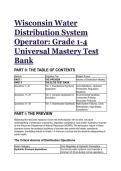
Wisconsin Water
Distribution System
Operator: Grade 1-4
Universal Mastery Test
Bank
PART 0: THE TABLE OF CONTENTS
Section Cognitive Tier Subject Focus
PART I THE PREVIEW Axioms of Distribution Mastery
PART II THE ELITE TEST BANK
Questions 1–10 Tier 1: Foundational Syntax & Core Definitions, Hydraulic
Application Thresholds, Regulatory
Baselines
Questions 11–20 Tier 2: Complex Application & Environmental Variables,
Simulation Component Failures,
Secondary Protocols
Questions 21–30 Tier 3: Grandmaster Synthesis Multi-System Failures, Crisis
Remediation, High-Stakes
Compliance
PART I: THE PREVIEW
Mastering this test bank replaces novice rote memorization with an elite, structural
understanding of distribution mechanics, regulatory compliance, and system hydraulics required
by the Wisconsin Department of Natural Resources (WDNR). The exhaustive nature of these
scenarios forces the analytical synthesis of discrete data points into holistic operational
strategies, translating directly to Grade 1-4 licensure success and the absolute safeguarding of
public health.
The Critical Axioms of Distribution Operations
Axiom Category Core Regulatory & Hydraulic Parameters
Hydraulic Pressure Imperatives Community water systems must maintain a
minimum of 35 psi during normal operations,
,Axiom Category Core Regulatory & Hydraulic Parameters
never exceeding 100 psi without localized
reduction devices, and must absolutely never
drop below 20 psi at ground level during fire
flow conditions.
Contamination Breach Protocols A loss of positive pressure affecting 25% or
more of the overall distribution system
mandates immediate WDNR notification,
emergency disinfection targeting 0.2 mg/L free
chlorine, and an automatic boil water advisory.
Biological Baselines (RTCR) Under the Revised Total Coliform Rule,
triggering two Level 1 assessments or suffering
a single E. coli Maximum Contaminant Level
(MCL) violation within a rolling 12-month period
immediately escalates the system to a
mandatory Level 2 assessment.
Structural Disinfection Law Water storage facilities require exhaustive
interior inspections every 5 years.
Post-inspection disinfection dictates precise
halogenation: a 50 ppm chlorine concentration
for 24 hours (AWWA C652 Method 1) or a 200
ppm concentrated spray applied for a minimum
of 2 hours (Method 2).
Subsurface Spatial Shielding Water mains mandate a minimum of 5 feet of
earthen cover (6.5 feet recommended) and
must maintain strict spatial isolation: 8 feet of
horizontal separation and 18 inches of vertical
separation from any sanitary sewers.
PART II: THE ELITE TEST BANK
Tier 1: Foundational Syntax & Application (Questions 1–10)
Q1: A municipal water operator is calibrating the primary pumping facilities for a community
water system to ensure compliance with the Wisconsin Administrative Code NR 810. Based on
the principles of distribution hydraulics, what are the strict minimum and maximum static
pressure parameters that MUST be maintained at ground level throughout the distribution
system under normal operating conditions? A) Minimum 20 psi; Maximum 80 psi B) Minimum 35
psi; Maximum 100 psi C) Minimum 45 psi; Maximum 120 psi D) Minimum 30 psi; Maximum 100
psi
● Answer/Respuesta/Réponse: B (Minimum 35 psi; Maximum 100 psi)
● Distractor Analysis:
○ A is incorrect: The 20 psi parameter is the absolute physical minimum permitted
strictly during emergency fire flow conditions, not during normal domestic
operations. While 80 psi is the threshold where plumbing codes often require indoor
pressure-reducing valves, the municipal system maximum is legally 100 psi.
○ C is incorrect: Maintaining 120 psi represents a legacy metric occasionally
associated with high-pressure industrial zones, but it violates the state-mandated
, maximum. Consistently operating above 100 psi drastically accelerates the fatigue
of pipe joints, leading to severe main breaks and service line ruptures.
○ D is incorrect: This represents a common analytical error where novice operators
confuse the federal recommended standards with the stricter Wisconsin state
standard, which explicitly mandates 35 psi.
The Mentor's Analysis: Hydraulic pressure serves as the primary physical barrier against
external biological intrusion. When facing daily diurnal flow fluctuations, the immediate priority is
maintaining the hydraulic gradient above the 35 psi threshold to prevent localized vacuums. By
utilizing pressure boosting zones where topography dictates, the operator bypasses the
common trap of localized low-pressure contamination while adhering to the 100 psi maximum to
preserve infrastructure lifespan. Professional/Academic Intuition: Never permit static
pressure to drop below 35 psi or rise above 100 psi without installing targeted pressure
reduction devices.
Q2: During a severe mid-winter freeze, a 12-inch cast-iron water main suffers a catastrophic
shear break. The resulting leak drains the primary storage tank rapidly, causing a complete loss
of positive pressure in an area encompassing 30% of the overall distribution system. Which
sequence of actions is the FIRST legally mandated response required by the system operator?
A) Begin unidirectional flushing at a velocity of 2.5 ft/sec to clear the shattered pipe debris. B)
Conduct a Level 1 Assessment under the Revised Total Coliform Rule to identify the sanitary
defect. C) Notify the appropriate regional office of the department no later than one working day
and initiate emergency disinfection. D) Inject a 200 ppm chlorine solution directly into the
ruptured main prior to executing the mechanical repair.
● Answer/Respuesta/Réponse: C (Notify the appropriate regional office of the department
no later than one working day and initiate emergency disinfection.)
● Distractor Analysis:
○ A is incorrect: While unidirectional flushing is technically necessary during the
recovery phase, attempting to flush before establishing a chemical disinfection
barrier and notifying regulatory authorities is an operational failure that spreads
contaminated water further into the grid.
○ B is incorrect: A Level 1 Assessment under the RTCR is triggered by routine
bacteriological monitoring failures (coliform positive samples), not by an acute
physical loss of pressure event.
○ D is incorrect: A 200 ppm solution is utilized for AWWA C652 Method 2 tank
disinfection or AWWA C651 slug method pipe disinfection. Blindly injecting highly
concentrated halogens into a live, un-isolated rupture without repairing the main
first is technically impossible and environmentally hazardous.
The Mentor's Analysis: A systemic pressure loss exceeding 25% represents a catastrophic
failure of the hydraulic barrier, virtually guaranteeing that groundwater and surrounding soil
pathogens will back-siphon into the potable supply. When facing a loss of positive pressure of
this magnitude, the immediate priority is regulatory notification and the establishment of a
chemical barrier through emergency disinfection. By executing this protocol, the operator
bypasses the novice error of attempting to hide a mechanical failure that has already evolved
into a biological crisis. Professional/Academic Intuition: A pressure loss >25% dictates an
immediate Boil Water Notice and emergency chlorination targeting 0.2 mg/L free or 1.0
mg/L combined residual.
Q3: A design engineer is drafting specifications for the installation of a new ductile iron water
main in a Wisconsin municipality. Based on standard frost depth penetration and state
regulatory minimums, what is the legally required baseline minimum depth of cover, and what is
Distribution System
Operator: Grade 1-4
Universal Mastery Test
Bank
PART 0: THE TABLE OF CONTENTS
Section Cognitive Tier Subject Focus
PART I THE PREVIEW Axioms of Distribution Mastery
PART II THE ELITE TEST BANK
Questions 1–10 Tier 1: Foundational Syntax & Core Definitions, Hydraulic
Application Thresholds, Regulatory
Baselines
Questions 11–20 Tier 2: Complex Application & Environmental Variables,
Simulation Component Failures,
Secondary Protocols
Questions 21–30 Tier 3: Grandmaster Synthesis Multi-System Failures, Crisis
Remediation, High-Stakes
Compliance
PART I: THE PREVIEW
Mastering this test bank replaces novice rote memorization with an elite, structural
understanding of distribution mechanics, regulatory compliance, and system hydraulics required
by the Wisconsin Department of Natural Resources (WDNR). The exhaustive nature of these
scenarios forces the analytical synthesis of discrete data points into holistic operational
strategies, translating directly to Grade 1-4 licensure success and the absolute safeguarding of
public health.
The Critical Axioms of Distribution Operations
Axiom Category Core Regulatory & Hydraulic Parameters
Hydraulic Pressure Imperatives Community water systems must maintain a
minimum of 35 psi during normal operations,
,Axiom Category Core Regulatory & Hydraulic Parameters
never exceeding 100 psi without localized
reduction devices, and must absolutely never
drop below 20 psi at ground level during fire
flow conditions.
Contamination Breach Protocols A loss of positive pressure affecting 25% or
more of the overall distribution system
mandates immediate WDNR notification,
emergency disinfection targeting 0.2 mg/L free
chlorine, and an automatic boil water advisory.
Biological Baselines (RTCR) Under the Revised Total Coliform Rule,
triggering two Level 1 assessments or suffering
a single E. coli Maximum Contaminant Level
(MCL) violation within a rolling 12-month period
immediately escalates the system to a
mandatory Level 2 assessment.
Structural Disinfection Law Water storage facilities require exhaustive
interior inspections every 5 years.
Post-inspection disinfection dictates precise
halogenation: a 50 ppm chlorine concentration
for 24 hours (AWWA C652 Method 1) or a 200
ppm concentrated spray applied for a minimum
of 2 hours (Method 2).
Subsurface Spatial Shielding Water mains mandate a minimum of 5 feet of
earthen cover (6.5 feet recommended) and
must maintain strict spatial isolation: 8 feet of
horizontal separation and 18 inches of vertical
separation from any sanitary sewers.
PART II: THE ELITE TEST BANK
Tier 1: Foundational Syntax & Application (Questions 1–10)
Q1: A municipal water operator is calibrating the primary pumping facilities for a community
water system to ensure compliance with the Wisconsin Administrative Code NR 810. Based on
the principles of distribution hydraulics, what are the strict minimum and maximum static
pressure parameters that MUST be maintained at ground level throughout the distribution
system under normal operating conditions? A) Minimum 20 psi; Maximum 80 psi B) Minimum 35
psi; Maximum 100 psi C) Minimum 45 psi; Maximum 120 psi D) Minimum 30 psi; Maximum 100
psi
● Answer/Respuesta/Réponse: B (Minimum 35 psi; Maximum 100 psi)
● Distractor Analysis:
○ A is incorrect: The 20 psi parameter is the absolute physical minimum permitted
strictly during emergency fire flow conditions, not during normal domestic
operations. While 80 psi is the threshold where plumbing codes often require indoor
pressure-reducing valves, the municipal system maximum is legally 100 psi.
○ C is incorrect: Maintaining 120 psi represents a legacy metric occasionally
associated with high-pressure industrial zones, but it violates the state-mandated
, maximum. Consistently operating above 100 psi drastically accelerates the fatigue
of pipe joints, leading to severe main breaks and service line ruptures.
○ D is incorrect: This represents a common analytical error where novice operators
confuse the federal recommended standards with the stricter Wisconsin state
standard, which explicitly mandates 35 psi.
The Mentor's Analysis: Hydraulic pressure serves as the primary physical barrier against
external biological intrusion. When facing daily diurnal flow fluctuations, the immediate priority is
maintaining the hydraulic gradient above the 35 psi threshold to prevent localized vacuums. By
utilizing pressure boosting zones where topography dictates, the operator bypasses the
common trap of localized low-pressure contamination while adhering to the 100 psi maximum to
preserve infrastructure lifespan. Professional/Academic Intuition: Never permit static
pressure to drop below 35 psi or rise above 100 psi without installing targeted pressure
reduction devices.
Q2: During a severe mid-winter freeze, a 12-inch cast-iron water main suffers a catastrophic
shear break. The resulting leak drains the primary storage tank rapidly, causing a complete loss
of positive pressure in an area encompassing 30% of the overall distribution system. Which
sequence of actions is the FIRST legally mandated response required by the system operator?
A) Begin unidirectional flushing at a velocity of 2.5 ft/sec to clear the shattered pipe debris. B)
Conduct a Level 1 Assessment under the Revised Total Coliform Rule to identify the sanitary
defect. C) Notify the appropriate regional office of the department no later than one working day
and initiate emergency disinfection. D) Inject a 200 ppm chlorine solution directly into the
ruptured main prior to executing the mechanical repair.
● Answer/Respuesta/Réponse: C (Notify the appropriate regional office of the department
no later than one working day and initiate emergency disinfection.)
● Distractor Analysis:
○ A is incorrect: While unidirectional flushing is technically necessary during the
recovery phase, attempting to flush before establishing a chemical disinfection
barrier and notifying regulatory authorities is an operational failure that spreads
contaminated water further into the grid.
○ B is incorrect: A Level 1 Assessment under the RTCR is triggered by routine
bacteriological monitoring failures (coliform positive samples), not by an acute
physical loss of pressure event.
○ D is incorrect: A 200 ppm solution is utilized for AWWA C652 Method 2 tank
disinfection or AWWA C651 slug method pipe disinfection. Blindly injecting highly
concentrated halogens into a live, un-isolated rupture without repairing the main
first is technically impossible and environmentally hazardous.
The Mentor's Analysis: A systemic pressure loss exceeding 25% represents a catastrophic
failure of the hydraulic barrier, virtually guaranteeing that groundwater and surrounding soil
pathogens will back-siphon into the potable supply. When facing a loss of positive pressure of
this magnitude, the immediate priority is regulatory notification and the establishment of a
chemical barrier through emergency disinfection. By executing this protocol, the operator
bypasses the novice error of attempting to hide a mechanical failure that has already evolved
into a biological crisis. Professional/Academic Intuition: A pressure loss >25% dictates an
immediate Boil Water Notice and emergency chlorination targeting 0.2 mg/L free or 1.0
mg/L combined residual.
Q3: A design engineer is drafting specifications for the installation of a new ductile iron water
main in a Wisconsin municipality. Based on standard frost depth penetration and state
regulatory minimums, what is the legally required baseline minimum depth of cover, and what is


