

Chapter 1
Two approaches of Industrial Organization:
1) Structure – conduct – performance (SCP) paradigm
Performance of a single firm and entire market can be predicted by market structure which
guides firms’ strategic conduct
2) Chicago school approach
Strong beliefs in efficient markets & rationality of market participants
Why some things happens predictions
Combining these two approaches game theory
Static models (p=MC; ST p=AC; LT): all decisions made simultaneously, time plays no part (simple, but
stylized)
Dynamic models: deal with changes over time (realistic, but complex)
Chapter 2
Firms consist of many people with different goals, capabilities and constraints. Objectives are crucial
These individuals are connected by contracts, which clarifies who has rights and who has ‘residual
control’ and ‘residual income’
explicit implicit
(written) (situational)
Residual control: power over decisions not explicit assigned (power over ‘grey’ area)
Residual income rights: when everyone has taken his part, the one with residual income rights takes the
rest (positive or/and negative rest)
Coase: Transaction cost economies; transactions on market (price) or within firms (without price
mechanism). Transaction on market has the same value as within firms
Mechanism costs have transactions costs:
Searching price/product information
Negotiating contracts
within the firm these costs do not exist
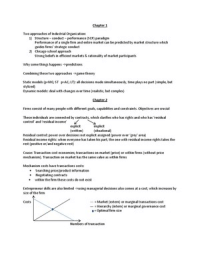
Entrepreneur skills are also limited using managerial decisions also comes at a cost, which increases by
size of the firm
Costs = Market (extern) or marginal transactions cost
= Hierarchy (intern) or marginal governance cost
= Optimal firm size
Numbers of transaction
,Focus of Coase: Transaction costs before contract is signed
Focus of Williamson: Transaction costs after contract is signed
Difficulties in detecting non – compliance (monitoring)
Difficulties in punishing non – compliance (enforcing contract)
Because most contracts are incomplete, it creates opportunities for opportunistic behavior
Possibility of opportunistic behavior increases in asset specificity:
If a tangible or intangible asset is specific to a transaction, its value in alternative transactions is
significantly lower (≠ general)
Quasi – rent = best deal – second best deal
Do you follow the contract obligations:
Feasibility; observable facts, witnessing
Observability; only observance, no prove
How to avoid opportunistic behavior?
One solution = integration (extending the boundaries of the firm to include this transaction within the
firm) = merger/takeover
Potential solution; long – term contract
Resource – based theory of the firm
Starting point: firms governs resources
1) Property – based; legally defined property rights (not allowing to make)
2) Knowledge – based; expertise (not knowing how to make)
The more unique a resource is, the higher the rent it generates
VFirm > V1 + V2 V1 = certain resource V2 = firm – specific resource
VFirm = combining V1 + V2
Structure of modern firms
Sole proprietorships (eenmanszaak) & partnerships (VOF); Owner = manager
Corporation (BV/NV); Managers (daily decisions) & board of directions (represent shareholders)
Because often there is a dominant shareholder, many board of directors delegate residual control to
managers corporate [governance] problem
who gets to decide what
Managerial objectives: maximize own utility
Problem: manager utility ≠ owner’s goals
Unclear what to maximize (revenue, perks or quiet life/little effort)
Managers could be too risk – averse (protect job) or has a minimum acceptance profit level
Several tools to keep manager maximize profits:
Incentive contract
Shareholder revolt; bad manager; shareholders selling shares because of bad management
Market for corporate control; getting majority of shares, take firm over and replace
management and change strategy
, We assume that firms maximize profits
AFC decrease in output, AVC first decrease in
output, then increase. This leads to:
For small q: Economies of scale (=
decreasing AC) (ECS)
For large q: Diseconomies of scale
(=increasing AC) (DECS)
Long – run Average Cost (LRAC): all inputs are
flexible, in short term some inputs are fixed
Can be optimized and are never higher than
SRAC
Economies of scope (SC) = C (q1,0) + C (0,q2) – C (q1,q2) q1 = home radio
SC > 0 C (q1,q2) q2 = car radio
It could relatively be cheaper to produce several of types with certain inputs than only one type
Two approaches of Industrial Organization:
1) Structure – conduct – performance (SCP) paradigm
Performance of a single firm and entire market can be predicted by market structure which
guides firms’ strategic conduct
2) Chicago school approach
Strong beliefs in efficient markets & rationality of market participants
Why some things happens predictions
Combining these two approaches game theory
Static models (p=MC; ST p=AC; LT): all decisions made simultaneously, time plays no part (simple, but
stylized)
Dynamic models: deal with changes over time (realistic, but complex)
Chapter 2
Firms consist of many people with different goals, capabilities and constraints. Objectives are crucial
These individuals are connected by contracts, which clarifies who has rights and who has ‘residual
control’ and ‘residual income’
explicit implicit
(written) (situational)
Residual control: power over decisions not explicit assigned (power over ‘grey’ area)
Residual income rights: when everyone has taken his part, the one with residual income rights takes the
rest (positive or/and negative rest)
Coase: Transaction cost economies; transactions on market (price) or within firms (without price
mechanism). Transaction on market has the same value as within firms
Mechanism costs have transactions costs:
Searching price/product information
Negotiating contracts
within the firm these costs do not exist
Entrepreneur skills are also limited using managerial decisions also comes at a cost, which increases by
size of the firm
Costs = Market (extern) or marginal transactions cost
= Hierarchy (intern) or marginal governance cost
= Optimal firm size
Numbers of transaction
,Focus of Coase: Transaction costs before contract is signed
Focus of Williamson: Transaction costs after contract is signed
Difficulties in detecting non – compliance (monitoring)
Difficulties in punishing non – compliance (enforcing contract)
Because most contracts are incomplete, it creates opportunities for opportunistic behavior
Possibility of opportunistic behavior increases in asset specificity:
If a tangible or intangible asset is specific to a transaction, its value in alternative transactions is
significantly lower (≠ general)
Quasi – rent = best deal – second best deal
Do you follow the contract obligations:
Feasibility; observable facts, witnessing
Observability; only observance, no prove
How to avoid opportunistic behavior?
One solution = integration (extending the boundaries of the firm to include this transaction within the
firm) = merger/takeover
Potential solution; long – term contract
Resource – based theory of the firm
Starting point: firms governs resources
1) Property – based; legally defined property rights (not allowing to make)
2) Knowledge – based; expertise (not knowing how to make)
The more unique a resource is, the higher the rent it generates
VFirm > V1 + V2 V1 = certain resource V2 = firm – specific resource
VFirm = combining V1 + V2
Structure of modern firms
Sole proprietorships (eenmanszaak) & partnerships (VOF); Owner = manager
Corporation (BV/NV); Managers (daily decisions) & board of directions (represent shareholders)
Because often there is a dominant shareholder, many board of directors delegate residual control to
managers corporate [governance] problem
who gets to decide what
Managerial objectives: maximize own utility
Problem: manager utility ≠ owner’s goals
Unclear what to maximize (revenue, perks or quiet life/little effort)
Managers could be too risk – averse (protect job) or has a minimum acceptance profit level
Several tools to keep manager maximize profits:
Incentive contract
Shareholder revolt; bad manager; shareholders selling shares because of bad management
Market for corporate control; getting majority of shares, take firm over and replace
management and change strategy
, We assume that firms maximize profits
AFC decrease in output, AVC first decrease in
output, then increase. This leads to:
For small q: Economies of scale (=
decreasing AC) (ECS)
For large q: Diseconomies of scale
(=increasing AC) (DECS)
Long – run Average Cost (LRAC): all inputs are
flexible, in short term some inputs are fixed
Can be optimized and are never higher than
SRAC
Economies of scope (SC) = C (q1,0) + C (0,q2) – C (q1,q2) q1 = home radio
SC > 0 C (q1,q2) q2 = car radio
It could relatively be cheaper to produce several of types with certain inputs than only one type


