

ECE 206 Language and Literacy Flashcards Part 2
ECE 206 Language and Literacy Flashcards Part 2
Study online at https://quizlet.com/_bdctly
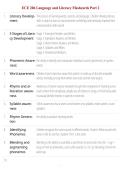
1. Literacy Develop- The process of learning words, sounds, and language. Children develop literacy
ment skills in order to learn to read and write confidently and eventually improve their
communication skills overall.
2. 5 Stages of Litera- Stage 1: Emergent Readers and Writers
cy Development Stage 2: Alphabetic Readers and Writers
Stage 3: Word Pattern Readers and Writers
Stage 4: Syllables and Affixes
Stage 5: Derivational Relations
3. Phonemic Aware- the ability to identify and manipulate individual sounds (phonemes) in spoken
ness: words.
4. Word awareness Children have to become aware that speech is made up of discrete knowable
words, mentally parsing them where one ends and the next begins.
5. Rhyme and al- Awareness of rhyme may be revealed through their enjoyment of rhyming verses
literation aware- read to them from storybooks, playful use of rhymes in songs, or from being able
ness to actually identify rhymes in speech or even text.
6. Syllable aware- Child's awareness that a word can be broken into syllables; robot speech, count
ness syllables
7. Rhyme Genera- the ability to produce rhyming words
tion
8. Identifying children recognize the same sounds in different words. Teacher: What sound is the
Phonemes same in fall, fix and fun. Student: The f is the same.
9. Blending and Blending is the ability to assemble a word from its onset and rime (/b/ + /ug/ =
segmenting bug) or from its phonemes, such as the sounds /c/ /a/ /p/ blending to form the
phonemes word cap.
10.
1/6
, ECE 206 Language and Literacy Flashcards Part 2
ECE 206 Language and Literacy Flashcards Part 2
Study online at https://quizlet.com/_bdctly
Isolating students identifying specific sounds at B, M, E of words ex; what is the first sound
phonemes in dog? /d/
11. Deleting students identify the word that remains when a phoneme is deleted ex; what word
phonemes is left when we drop the /s/ from stop?
12. Substituting students make new words by replacing a specific phonemes with another. ex; Say
phonemes: the word /bag/. Now change the /b/ to /r/ and what does it spell? rag
13. How do stu- A student repeats a set of words like "cat", "hat" and "bat" after the teacher.
dents produce
Imitation of
rhyming and sim-
ilar sounds
14. How do stu- A student can identify that in the words "cat", "bat", "sat", and "ball", the word" ball
dents recog- " does not fit the pattern.
nize rhymes
and changes in
phoneme pat-
terns
15. How do stu- A learner hears the words throw, brat, and top and can identify that top doesn't
dents identify have a blend.
phonemes in
a series, iden-
tifying begin-
ning and end-
ing sounds, and
matching initial
sounds
16. Learners tap out the different phonemes in a longer word.
2/6
ECE 206 Language and Literacy Flashcards Part 2
Study online at https://quizlet.com/_bdctly
1. Literacy Develop- The process of learning words, sounds, and language. Children develop literacy
ment skills in order to learn to read and write confidently and eventually improve their
communication skills overall.
2. 5 Stages of Litera- Stage 1: Emergent Readers and Writers
cy Development Stage 2: Alphabetic Readers and Writers
Stage 3: Word Pattern Readers and Writers
Stage 4: Syllables and Affixes
Stage 5: Derivational Relations
3. Phonemic Aware- the ability to identify and manipulate individual sounds (phonemes) in spoken
ness: words.
4. Word awareness Children have to become aware that speech is made up of discrete knowable
words, mentally parsing them where one ends and the next begins.
5. Rhyme and al- Awareness of rhyme may be revealed through their enjoyment of rhyming verses
literation aware- read to them from storybooks, playful use of rhymes in songs, or from being able
ness to actually identify rhymes in speech or even text.
6. Syllable aware- Child's awareness that a word can be broken into syllables; robot speech, count
ness syllables
7. Rhyme Genera- the ability to produce rhyming words
tion
8. Identifying children recognize the same sounds in different words. Teacher: What sound is the
Phonemes same in fall, fix and fun. Student: The f is the same.
9. Blending and Blending is the ability to assemble a word from its onset and rime (/b/ + /ug/ =
segmenting bug) or from its phonemes, such as the sounds /c/ /a/ /p/ blending to form the
phonemes word cap.
10.
1/6
, ECE 206 Language and Literacy Flashcards Part 2
ECE 206 Language and Literacy Flashcards Part 2
Study online at https://quizlet.com/_bdctly
Isolating students identifying specific sounds at B, M, E of words ex; what is the first sound
phonemes in dog? /d/
11. Deleting students identify the word that remains when a phoneme is deleted ex; what word
phonemes is left when we drop the /s/ from stop?
12. Substituting students make new words by replacing a specific phonemes with another. ex; Say
phonemes: the word /bag/. Now change the /b/ to /r/ and what does it spell? rag
13. How do stu- A student repeats a set of words like "cat", "hat" and "bat" after the teacher.
dents produce
Imitation of
rhyming and sim-
ilar sounds
14. How do stu- A student can identify that in the words "cat", "bat", "sat", and "ball", the word" ball
dents recog- " does not fit the pattern.
nize rhymes
and changes in
phoneme pat-
terns
15. How do stu- A learner hears the words throw, brat, and top and can identify that top doesn't
dents identify have a blend.
phonemes in
a series, iden-
tifying begin-
ning and end-
ing sounds, and
matching initial
sounds
16. Learners tap out the different phonemes in a longer word.
2/6


