

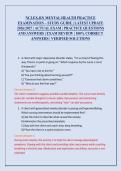
NCLEX-RN MENTAL HEALTH PRACTICE
EXAMINATION – STUDY GUIDE | LATEST UPDATE
2026/2027 | ACTUAL EXAM | PRACTICE QUESTIONS
AND ANSWERS | EXAM REVIEW | 100% CORRECT
ANSWERS | VERIFIED SOLUTIONS
1. A client with major depressive disorder states, “I’m so tired of feeling this
way. There’s no point in going on.” Which response by the nurse is most
therapeutic?
A) “You have a lot to live for.”
B) “Are you thinking about harming yourself?”
C) “Everyone feels down sometimes.”
D) “Why do you feel that way?”
Correct Answer: B
The client’s statement suggests possible suicidal ideation. The nurse must directly
assess for suicidal thoughts to ensure safety. Reassurance and minimizing
statements are nontherapeutic, and asking “why” can feel accusatory.
2. A client with generalized anxiety disorder is pacing and hyperventilating.
Which nursing intervention should be implemented first?
A) Ask the client to describe what caused the anxiety.
B) Administer the prescribed anxiolytic.
C) Stay with the client and coach slow, deep breathing.
D) Place the client in a quiet seclusion room.
Correct Answer: C
During acute anxiety, the priority is to help the client manage physiological
symptoms. Staying with the client and providing calm reassurance while coaching
breathing is the first step. Medication and exploration can follow; seclusion is not
indicated.
, 3. A client with schizophrenia tells the nurse, “The voices are telling me to
hurt my roommate.” What is the nurse’s priority action?
A) Tell the client the voices are not real.
B) Ask the client to describe the voices in detail.
C) Stay with the client and ensure the environment is safe.
D) Encourage the client to watch television to distract from the voices.
Correct Answer: C
Command hallucinations to harm others pose a safety risk. The nurse must stay
with the client and ensure safety. Dismissing the hallucination or encouraging
distraction does not address the potential for violence; detailed questioning can
wait until safety is ensured.
4. A client with bipolar disorder in the manic phase is pacing, talking rapidly,
and interfering with other clients. Which intervention is most appropriate?
A) Encourage the client to lead a group activity.
B) Engage the client in a competitive game.
C) Provide a low-stimulation environment and set firm, calm limits.
D) Tell the client to sit down and stop interrupting.
Correct Answer: C
Manic clients are easily overstimulated. A calm environment and consistent,
nonpunitive limit-setting help reduce agitation. Group and competitive activities
can worsen mania; direct commands often increase resistance.
5. A client with borderline personality disorder says, “You are the only nurse
who understands me. The others are awful.” The nurse identifies this
behavior as:
A) Splitting
B) Projection
C) Rationalization
D) Idealization only
Correct Answer: A
Splitting is the inability to integrate positive and negative qualities, causing the
, client to view people as all good or all bad. The client is splitting staff. Projection
and rationalization are different defense mechanisms; idealization is only one side
of the pattern.
6. A client with anorexia nervosa has a body mass index of 15 and refuses to
eat. Which nursing action is the priority?
A) Insert a nasogastric feeding tube immediately.
B) Weigh the client daily and record intake.
C) Develop a trusting relationship and explore fears about weight gain.
D) Restrict the client’s privileges until food is eaten.
Correct Answer: C
Establishing a therapeutic relationship and exploring the underlying fears are
foundational in caring for clients with eating disorders. NG feedings are reserved
for severe cases; daily weighing is important but not the first step; restricting
privileges is a behavioral approach that must be used carefully.
7. A client with major depressive disorder is started on fluoxetine. The nurse
should teach the client that:
A) The medication will work immediately.
B) It may take 2 to 4 weeks to see therapeutic effects.
C) The medication should be taken at bedtime.
D) Alcohol can be consumed in moderation.
Correct Answer: B
SSRIs like fluoxetine typically require 2–4 weeks for full therapeutic effect. They are
usually taken in the morning to prevent insomnia; alcohol should be avoided
because it worsens depression and increases CNS effects.
8. A client with schizophrenia is prescribed clozapine. Which laboratory value
must be monitored regularly?
A) Serum creatinine
B) Absolute neutrophil count (ANC)
C) Thyroid stimulating hormone
D) Serum potassium
EXAMINATION – STUDY GUIDE | LATEST UPDATE
2026/2027 | ACTUAL EXAM | PRACTICE QUESTIONS
AND ANSWERS | EXAM REVIEW | 100% CORRECT
ANSWERS | VERIFIED SOLUTIONS
1. A client with major depressive disorder states, “I’m so tired of feeling this
way. There’s no point in going on.” Which response by the nurse is most
therapeutic?
A) “You have a lot to live for.”
B) “Are you thinking about harming yourself?”
C) “Everyone feels down sometimes.”
D) “Why do you feel that way?”
Correct Answer: B
The client’s statement suggests possible suicidal ideation. The nurse must directly
assess for suicidal thoughts to ensure safety. Reassurance and minimizing
statements are nontherapeutic, and asking “why” can feel accusatory.
2. A client with generalized anxiety disorder is pacing and hyperventilating.
Which nursing intervention should be implemented first?
A) Ask the client to describe what caused the anxiety.
B) Administer the prescribed anxiolytic.
C) Stay with the client and coach slow, deep breathing.
D) Place the client in a quiet seclusion room.
Correct Answer: C
During acute anxiety, the priority is to help the client manage physiological
symptoms. Staying with the client and providing calm reassurance while coaching
breathing is the first step. Medication and exploration can follow; seclusion is not
indicated.
, 3. A client with schizophrenia tells the nurse, “The voices are telling me to
hurt my roommate.” What is the nurse’s priority action?
A) Tell the client the voices are not real.
B) Ask the client to describe the voices in detail.
C) Stay with the client and ensure the environment is safe.
D) Encourage the client to watch television to distract from the voices.
Correct Answer: C
Command hallucinations to harm others pose a safety risk. The nurse must stay
with the client and ensure safety. Dismissing the hallucination or encouraging
distraction does not address the potential for violence; detailed questioning can
wait until safety is ensured.
4. A client with bipolar disorder in the manic phase is pacing, talking rapidly,
and interfering with other clients. Which intervention is most appropriate?
A) Encourage the client to lead a group activity.
B) Engage the client in a competitive game.
C) Provide a low-stimulation environment and set firm, calm limits.
D) Tell the client to sit down and stop interrupting.
Correct Answer: C
Manic clients are easily overstimulated. A calm environment and consistent,
nonpunitive limit-setting help reduce agitation. Group and competitive activities
can worsen mania; direct commands often increase resistance.
5. A client with borderline personality disorder says, “You are the only nurse
who understands me. The others are awful.” The nurse identifies this
behavior as:
A) Splitting
B) Projection
C) Rationalization
D) Idealization only
Correct Answer: A
Splitting is the inability to integrate positive and negative qualities, causing the
, client to view people as all good or all bad. The client is splitting staff. Projection
and rationalization are different defense mechanisms; idealization is only one side
of the pattern.
6. A client with anorexia nervosa has a body mass index of 15 and refuses to
eat. Which nursing action is the priority?
A) Insert a nasogastric feeding tube immediately.
B) Weigh the client daily and record intake.
C) Develop a trusting relationship and explore fears about weight gain.
D) Restrict the client’s privileges until food is eaten.
Correct Answer: C
Establishing a therapeutic relationship and exploring the underlying fears are
foundational in caring for clients with eating disorders. NG feedings are reserved
for severe cases; daily weighing is important but not the first step; restricting
privileges is a behavioral approach that must be used carefully.
7. A client with major depressive disorder is started on fluoxetine. The nurse
should teach the client that:
A) The medication will work immediately.
B) It may take 2 to 4 weeks to see therapeutic effects.
C) The medication should be taken at bedtime.
D) Alcohol can be consumed in moderation.
Correct Answer: B
SSRIs like fluoxetine typically require 2–4 weeks for full therapeutic effect. They are
usually taken in the morning to prevent insomnia; alcohol should be avoided
because it worsens depression and increases CNS effects.
8. A client with schizophrenia is prescribed clozapine. Which laboratory value
must be monitored regularly?
A) Serum creatinine
B) Absolute neutrophil count (ANC)
C) Thyroid stimulating hormone
D) Serum potassium


