

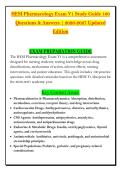
HESI Pharmacology Exam V1 Study Guide 100
Questions & Answers | 2026-2027 Updated
Edition
EXAM PREPARATION GUIDE
The HESI Pharmacology Exam V1 is a comprehensive assessment
designed for nursing students, testing knowledge across drug
classifications, mechanisms of action, adverse effects, nursing
interventions, and patient education. This guide includes 100 practice
questions with detailed rationales based on the HESI V1 blueprint for
the 2026-2027 academic year.
Key Content Areas:
• Pharmacokinetics & Pharmacodynamics: Absorption, distribution,
metabolism, excretion, receptor theory, and drug interactions
• Cardiovascular Drugs: Antihypertensives, diuretics, antiarrhythmics,
anticoagulants, and antidysrhythmics
• CNS Agents: Antidepressants, antipsychotics, anxiolytics,
anticonvulsants, and antiparkinsonian drugs
• Endocrine & Metabolic Drugs: Insulin, oral hypoglycemics, thyroid
agents, and corticosteroids
• Antimicrobials: Antibiotics, antivirals, antifungals, and antimicrobial
stewardship principles
• Special Populations: Pediatric, geriatric, and pregnancy-related
considerations
, SECTION 1: PHARMACOKINETICS &
PHARMACODYNAMICS (Questions 1-10)
1. A client asks the nurse, "What does it mean when a drug has a
high first-pass effect?" Which response is correct?
A) The drug is rapidly excreted by the kidneys
B) The drug is metabolized in the liver before reaching systemic
circulation
C) The drug is absorbed quickly through the gastrointestinal tract
D) The drug binds extensively to plasma proteins
Answer B:
Rationale: The first-pass effect refers to the metabolism of a drug in
the liver before it reaches systemic circulation. Drugs with a high first-
pass effect require higher oral doses to achieve therapeutic levels or
may need to be administered via routes that bypass the liver (e.g.,
sublingual, intravenous). ---
2. The nurse is administering a medication that is an enzyme
inducer. What effect does this have on other medications?
A) It increases the metabolism of other medications
B) It decreases the metabolism of other medications
C) It has no effect on other medications
D) It increases the absorption of other medications
Answer A:
Rationale: Enzyme inducers increase the activity of hepatic
metabolizing enzymes, leading to increased metabolism and decreased
plasma concentrations of other medications that are metabolized by
,the same enzymes. This can result in reduced therapeutic effects of the
affected medications. ---
3. A client is prescribed a medication with a volume of distribution
(Vd) that is greater than total body water. What does this
indicate?
A) The medication is primarily distributed in the plasma
B) The medication is extensively distributed into tissues
C) The medication is not absorbed
D) The medication is rapidly excreted
Answer B:
Rationale: A large volume of distribution indicates that the
medication is extensively distributed into tissues beyond the plasma
compartment. This means a higher dose may be needed to achieve
therapeutic plasma concentrations. ---
4. Which route of administration provides the most rapid onset of
action?
A) Oral
B) Subcutaneous
C) Intravenous
D) Intramuscular
Answer C:
Rationale: Intravenous (IV) administration provides the most rapid
onset of action because the medication is delivered directly into the
bloodstream, bypassing absorption barriers. This route allows for
, immediate therapeutic effects and precise control of drug levels but
also carries the highest risk for adverse reactions. ---
5. A client is taking a medication that is highly protein-bound. The
nurse understands that which factor may increase the risk of drug
toxicity?
A) Decreased liver function
B) Increased renal function
C) Administration of another highly protein-bound drug
D) Administration with food
Answer C:
Rationale: Highly protein-bound drugs compete for binding sites on
plasma proteins. When another highly protein-bound drug is
administered, it can displace the first drug, increasing the free (active)
drug concentration and the risk of toxicity. ---
6. The nurse is monitoring a client receiving a drug with a narrow
therapeutic index. What is the significance of this characteristic?
A) The drug has a wide margin of safety
B) The drug is less likely to cause side effects
C) The drug requires close monitoring of serum levels
D) The drug can be administered without concern for toxicity
Answer C:
Rationale: Drugs with a narrow therapeutic index have a small margin
between the therapeutic dose and the toxic dose. Close monitoring of
serum levels is essential to prevent toxicity while maintaining
Questions & Answers | 2026-2027 Updated
Edition
EXAM PREPARATION GUIDE
The HESI Pharmacology Exam V1 is a comprehensive assessment
designed for nursing students, testing knowledge across drug
classifications, mechanisms of action, adverse effects, nursing
interventions, and patient education. This guide includes 100 practice
questions with detailed rationales based on the HESI V1 blueprint for
the 2026-2027 academic year.
Key Content Areas:
• Pharmacokinetics & Pharmacodynamics: Absorption, distribution,
metabolism, excretion, receptor theory, and drug interactions
• Cardiovascular Drugs: Antihypertensives, diuretics, antiarrhythmics,
anticoagulants, and antidysrhythmics
• CNS Agents: Antidepressants, antipsychotics, anxiolytics,
anticonvulsants, and antiparkinsonian drugs
• Endocrine & Metabolic Drugs: Insulin, oral hypoglycemics, thyroid
agents, and corticosteroids
• Antimicrobials: Antibiotics, antivirals, antifungals, and antimicrobial
stewardship principles
• Special Populations: Pediatric, geriatric, and pregnancy-related
considerations
, SECTION 1: PHARMACOKINETICS &
PHARMACODYNAMICS (Questions 1-10)
1. A client asks the nurse, "What does it mean when a drug has a
high first-pass effect?" Which response is correct?
A) The drug is rapidly excreted by the kidneys
B) The drug is metabolized in the liver before reaching systemic
circulation
C) The drug is absorbed quickly through the gastrointestinal tract
D) The drug binds extensively to plasma proteins
Answer B:
Rationale: The first-pass effect refers to the metabolism of a drug in
the liver before it reaches systemic circulation. Drugs with a high first-
pass effect require higher oral doses to achieve therapeutic levels or
may need to be administered via routes that bypass the liver (e.g.,
sublingual, intravenous). ---
2. The nurse is administering a medication that is an enzyme
inducer. What effect does this have on other medications?
A) It increases the metabolism of other medications
B) It decreases the metabolism of other medications
C) It has no effect on other medications
D) It increases the absorption of other medications
Answer A:
Rationale: Enzyme inducers increase the activity of hepatic
metabolizing enzymes, leading to increased metabolism and decreased
plasma concentrations of other medications that are metabolized by
,the same enzymes. This can result in reduced therapeutic effects of the
affected medications. ---
3. A client is prescribed a medication with a volume of distribution
(Vd) that is greater than total body water. What does this
indicate?
A) The medication is primarily distributed in the plasma
B) The medication is extensively distributed into tissues
C) The medication is not absorbed
D) The medication is rapidly excreted
Answer B:
Rationale: A large volume of distribution indicates that the
medication is extensively distributed into tissues beyond the plasma
compartment. This means a higher dose may be needed to achieve
therapeutic plasma concentrations. ---
4. Which route of administration provides the most rapid onset of
action?
A) Oral
B) Subcutaneous
C) Intravenous
D) Intramuscular
Answer C:
Rationale: Intravenous (IV) administration provides the most rapid
onset of action because the medication is delivered directly into the
bloodstream, bypassing absorption barriers. This route allows for
, immediate therapeutic effects and precise control of drug levels but
also carries the highest risk for adverse reactions. ---
5. A client is taking a medication that is highly protein-bound. The
nurse understands that which factor may increase the risk of drug
toxicity?
A) Decreased liver function
B) Increased renal function
C) Administration of another highly protein-bound drug
D) Administration with food
Answer C:
Rationale: Highly protein-bound drugs compete for binding sites on
plasma proteins. When another highly protein-bound drug is
administered, it can displace the first drug, increasing the free (active)
drug concentration and the risk of toxicity. ---
6. The nurse is monitoring a client receiving a drug with a narrow
therapeutic index. What is the significance of this characteristic?
A) The drug has a wide margin of safety
B) The drug is less likely to cause side effects
C) The drug requires close monitoring of serum levels
D) The drug can be administered without concern for toxicity
Answer C:
Rationale: Drugs with a narrow therapeutic index have a small margin
between the therapeutic dose and the toxic dose. Close monitoring of
serum levels is essential to prevent toxicity while maintaining


