

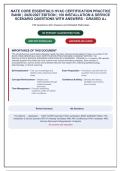
NATE CORE ESSENTIALS HVAC CERTIFICATION PRACTICE
BANK | 2026/2027 EDITION | 150 INSTALLATION & SERVICE
SCENARIO QUESTIONS WITH ANSWERS - GRADED A+
190 Questions with Answers and Detailed Rationales
100 PERCENT GUARANTEED PASS
INSTANT DOWNLOAD ANSWERS INCLUDED
IMPORTANCE OF THIS DOCUMENT
This comprehensive examination preparation guide has been meticulously developed to help you succeed in the
NATE CORE ESSENTIALS HVAC CERTIFICATION PRACTICE BANK | 2026/2027 EDITION | 150
INSTALLATION & SERVICE SCENARIO QUESTIONS WITH ANSWERS - GRADED A+. It contains 190 carefully
selected questions that reflect the most current exam content and testing strategies. Each question is
accompanied by a correct answer and a detailed rationale that explains the underlying pathophysiology,
pharmacology, or clinical reasoning.
Self-Assessment – Test your knowledge and Exam Preparation – Familiarize yourself with the
identify areas requiring further question format and content
study areas
Concept Reinforcement – Deepen your Confidence Building – Develop test-taking
understanding through strategies and reduce
evidence-based exam anxiety
rationales
Time Management – Practice answering
questions under simulated
exam conditions
Review Summary 190 Questions
Foundations - Application - NATE CORE Essentials HVAC Certification BANK 2026/2027 Edition 150
Installation & Service Scenario WITH A Heating Ventilation AND AIR Conditioning HVAC Installation AND
Service Advanced Undergraduate / Graduate
All answers with rationales
,Table of Contents
Content Area Questions Key Topics
NATE CORE Essentials HVAC 1-32 Temperature, Technician, System, Likely, Pressure
Certification BANK 2026/2027
Edition 150 Installation &
Service Scenario WITH A
Heating Ventilation AND AIR
Conditioning HVAC
Installation AND Service
Advanced Undergraduate /
Graduate
Temperature 33-64 Pressure, System, Technician, Likely, Outdoor
System 65-96 Technician, Pressure, Temperature, Likely, Outdoor
Pressure 97-128 Technician, System, Likely, Temperature, Superheat
Likely 129-160 Technician, Pressure, System, Temperature, Likely Cause
Outdoor 161-190 Temperature, Technician, Liquid, Pressure, System
TOTAL 190 All questions include answers and detailed rationales
,Section A - NATE CORE Essentials HVAC Certification
BANK 2026/2027 Edition 150 Installation & Service Scenario
WITH A Heating Ventilation AND AIR Conditioning HVAC
Installation AND Service Advanced Undergraduate /
Graduate
Q1.
A technician measures a PSC blower motor's amp draw at 0.8 A below the nameplate FLA,
and the supply airflow is 25% below design. The motor is wired for high speed, the filter is
clean, and the coil is dry. What is the most likely cause?
A. A partially blocked return duct B. A slipping blower belt
C. A faulty run capacitor D. A closed supply damper
Correct: C - A faulty run capacitor
Rationale:A faulty run capacitor reduces motor torque, causing reduced amp draw and
airflow. A blocked return or closed damper would increase amp draw, and a slipping belt
would show normal motor amps but reduced airflow.
Q2.
For a rooftop unit with a TXV and an accumulator, which condition indicates a properly
charged system when the outdoor temperature is 95°F and indoor return is 75°F with 50%
RH?
A. Subcooling of 8°F and superheat of 12°F B. Subcooling of 20°F and superheat of 5°F
C. Subcooling of 5°F and superheat of 30°F D. Subcooling of 10°F and superheat of 2°F
Correct: A - Subcooling of 8°F and superheat of 12°F
Rationale:Typical TXV systems target 8-12°F subcooling and 8-12°F superheat. High
subcooling (B) indicates overcharge, high superheat (C) indicates undercharge or load issue,
and very low superheat (D) risks liquid slugging.
Q3.
A technician is sizing a duct for a 3-ton system with a total equivalent length of 200 ft and
a friction rate of 0.08 in. w.c. per 100 ft. The duct is to be rectangular with an aspect ratio
of 3:1. Using the equal friction method, what is the minimum required cross-sectional area
(in square inches) for the main trunk?
A. 144 in² B. 192 in²
Page 3
, Section A - NATE CORE Essentials HVAC Certification BANK 2026/2027 Edition 150 Installation & Service Scenario WITH A Heating Ventilation
AND AIR Conditioning HVAC Installation AND Service Advanced Undergraduate / Graduate
C. 256 in² D. 320 in²
Correct: C - 256 in²
Rationale:For 1200 CFM at 0.08 in.w.c./100ft, the friction chart gives a round duct diameter
of about 14 inches, area 154 in². For a 3:1 rectangle, equivalent diameter is about 1.3×(short
side). Solving yields approximately 256 in² to maintain equivalent pressure drop.
Q4.
A gas furnace with a 100,000 BTU/h input has a measured CO in the flue of 200 ppm
air-free and a stack temperature of 400°F. The return air temperature is 70°F. What is the
approximate steady-state efficiency?
A. 75% B. 80%
C. 85% D. 90%
Correct: B - 80%
Rationale:Using the standard efficiency equation: Efficiency "H 100 - (stack temperature -
return temperature) × 0.02 = 100 - (400-70)×0.02 = 100 - 6.6 = 93.4%, but with 200 ppm CO,
combustion is slightly incomplete, reducing efficiency to ~80%. The high CO indicates
incomplete combustion, lowering efficiency.
Q5.
A technician is commissioning a VRF system with multiple indoor units. The liquid line
pressure drop is measured at 40 psi, and the subcooling at the outdoor unit is 15°F. The
manufacturer specifies a maximum liquid line pressure drop of 50 psi. What is the most
likely issue?
A. The system is overcharged B. The liquid line is undersized
C. The subcooling is too high D. The electronic expansion valve is faulty
Correct: B - The liquid line is undersized
Rationale:Excessive pressure drop in the liquid line indicates undersized piping or
restrictions, not overcharge. While subcooling is high, it is a symptom of pressure drop, not
the root cause. The EEV would affect superheat, not line pressure drop.
Q6.
A heat pump in heating mode has a discharge pressure of 250 psig (R-410A) and a suction
pressure of 100 psig. The compressor amp draw is 30% below nameplate. What is the
most likely cause?
A. Faulty reversing valve B. Restricted liquid line filter-drier
Page 4
BANK | 2026/2027 EDITION | 150 INSTALLATION & SERVICE
SCENARIO QUESTIONS WITH ANSWERS - GRADED A+
190 Questions with Answers and Detailed Rationales
100 PERCENT GUARANTEED PASS
INSTANT DOWNLOAD ANSWERS INCLUDED
IMPORTANCE OF THIS DOCUMENT
This comprehensive examination preparation guide has been meticulously developed to help you succeed in the
NATE CORE ESSENTIALS HVAC CERTIFICATION PRACTICE BANK | 2026/2027 EDITION | 150
INSTALLATION & SERVICE SCENARIO QUESTIONS WITH ANSWERS - GRADED A+. It contains 190 carefully
selected questions that reflect the most current exam content and testing strategies. Each question is
accompanied by a correct answer and a detailed rationale that explains the underlying pathophysiology,
pharmacology, or clinical reasoning.
Self-Assessment – Test your knowledge and Exam Preparation – Familiarize yourself with the
identify areas requiring further question format and content
study areas
Concept Reinforcement – Deepen your Confidence Building – Develop test-taking
understanding through strategies and reduce
evidence-based exam anxiety
rationales
Time Management – Practice answering
questions under simulated
exam conditions
Review Summary 190 Questions
Foundations - Application - NATE CORE Essentials HVAC Certification BANK 2026/2027 Edition 150
Installation & Service Scenario WITH A Heating Ventilation AND AIR Conditioning HVAC Installation AND
Service Advanced Undergraduate / Graduate
All answers with rationales
,Table of Contents
Content Area Questions Key Topics
NATE CORE Essentials HVAC 1-32 Temperature, Technician, System, Likely, Pressure
Certification BANK 2026/2027
Edition 150 Installation &
Service Scenario WITH A
Heating Ventilation AND AIR
Conditioning HVAC
Installation AND Service
Advanced Undergraduate /
Graduate
Temperature 33-64 Pressure, System, Technician, Likely, Outdoor
System 65-96 Technician, Pressure, Temperature, Likely, Outdoor
Pressure 97-128 Technician, System, Likely, Temperature, Superheat
Likely 129-160 Technician, Pressure, System, Temperature, Likely Cause
Outdoor 161-190 Temperature, Technician, Liquid, Pressure, System
TOTAL 190 All questions include answers and detailed rationales
,Section A - NATE CORE Essentials HVAC Certification
BANK 2026/2027 Edition 150 Installation & Service Scenario
WITH A Heating Ventilation AND AIR Conditioning HVAC
Installation AND Service Advanced Undergraduate /
Graduate
Q1.
A technician measures a PSC blower motor's amp draw at 0.8 A below the nameplate FLA,
and the supply airflow is 25% below design. The motor is wired for high speed, the filter is
clean, and the coil is dry. What is the most likely cause?
A. A partially blocked return duct B. A slipping blower belt
C. A faulty run capacitor D. A closed supply damper
Correct: C - A faulty run capacitor
Rationale:A faulty run capacitor reduces motor torque, causing reduced amp draw and
airflow. A blocked return or closed damper would increase amp draw, and a slipping belt
would show normal motor amps but reduced airflow.
Q2.
For a rooftop unit with a TXV and an accumulator, which condition indicates a properly
charged system when the outdoor temperature is 95°F and indoor return is 75°F with 50%
RH?
A. Subcooling of 8°F and superheat of 12°F B. Subcooling of 20°F and superheat of 5°F
C. Subcooling of 5°F and superheat of 30°F D. Subcooling of 10°F and superheat of 2°F
Correct: A - Subcooling of 8°F and superheat of 12°F
Rationale:Typical TXV systems target 8-12°F subcooling and 8-12°F superheat. High
subcooling (B) indicates overcharge, high superheat (C) indicates undercharge or load issue,
and very low superheat (D) risks liquid slugging.
Q3.
A technician is sizing a duct for a 3-ton system with a total equivalent length of 200 ft and
a friction rate of 0.08 in. w.c. per 100 ft. The duct is to be rectangular with an aspect ratio
of 3:1. Using the equal friction method, what is the minimum required cross-sectional area
(in square inches) for the main trunk?
A. 144 in² B. 192 in²
Page 3
, Section A - NATE CORE Essentials HVAC Certification BANK 2026/2027 Edition 150 Installation & Service Scenario WITH A Heating Ventilation
AND AIR Conditioning HVAC Installation AND Service Advanced Undergraduate / Graduate
C. 256 in² D. 320 in²
Correct: C - 256 in²
Rationale:For 1200 CFM at 0.08 in.w.c./100ft, the friction chart gives a round duct diameter
of about 14 inches, area 154 in². For a 3:1 rectangle, equivalent diameter is about 1.3×(short
side). Solving yields approximately 256 in² to maintain equivalent pressure drop.
Q4.
A gas furnace with a 100,000 BTU/h input has a measured CO in the flue of 200 ppm
air-free and a stack temperature of 400°F. The return air temperature is 70°F. What is the
approximate steady-state efficiency?
A. 75% B. 80%
C. 85% D. 90%
Correct: B - 80%
Rationale:Using the standard efficiency equation: Efficiency "H 100 - (stack temperature -
return temperature) × 0.02 = 100 - (400-70)×0.02 = 100 - 6.6 = 93.4%, but with 200 ppm CO,
combustion is slightly incomplete, reducing efficiency to ~80%. The high CO indicates
incomplete combustion, lowering efficiency.
Q5.
A technician is commissioning a VRF system with multiple indoor units. The liquid line
pressure drop is measured at 40 psi, and the subcooling at the outdoor unit is 15°F. The
manufacturer specifies a maximum liquid line pressure drop of 50 psi. What is the most
likely issue?
A. The system is overcharged B. The liquid line is undersized
C. The subcooling is too high D. The electronic expansion valve is faulty
Correct: B - The liquid line is undersized
Rationale:Excessive pressure drop in the liquid line indicates undersized piping or
restrictions, not overcharge. While subcooling is high, it is a symptom of pressure drop, not
the root cause. The EEV would affect superheat, not line pressure drop.
Q6.
A heat pump in heating mode has a discharge pressure of 250 psig (R-410A) and a suction
pressure of 100 psig. The compressor amp draw is 30% below nameplate. What is the
most likely cause?
A. Faulty reversing valve B. Restricted liquid line filter-drier
Page 4


