

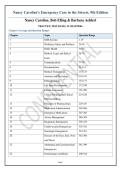
Nancy Caroline's Emergency Care in the Streets, 9th Edition
Nancy Caroline, Bob Elling & Barbara Aehlert
PRACTICE TEST BANK | 53 CHAPTERS
Chapter Coverage and Question Ranges
Chapter Topic Question Range
1 EMS Systems 1-19
2 Workforce Safety and Wellness 20-38
3 Public Health 39-57
4 Medical, Legal, and Ethical 58-76
Issues
5 Communications 77-95
6 Documentation 96-114
7 Medical Terminology 115-133
8 Anatomy and Physiology 134-152
9 Pathophysiology 153-171
10 Life Span Development 172-190
11 Patient Assessment 191-209
12 Critical Thinking and Clinical 210-228
Decision Making
13 Principles of Pharmacology 229-247
14 Medication Administration 248-266
15 Emergency Medications 267-285
16 Airway Management 286-304
17 Respiratory Emergencies 305-323
18 Cardiovascular Emergencies 324-342
19 Neurologic Emergencies 343-361
20 Diseases of the Eyes, Ears, Nose 362-380
and Throat
21 Abdominal and Gastrointestinal 381-399
Emergencies
22 Genitourinary and Renal 400-418
Page 1
,Chapter Topic Question Range
Emergencies
23 Gynecologic Emergencies 419-437
24 Endocrine Emergencies 438-456
25 Hematologic Emergencies 457-475
26 Immunologic Emergencies 476-494
27 Infectious Diseases 495-513
28 Toxicology 514-532
29 Psychiatric Emergencies 533-551
30 Trauma Systems and Mechanism 552-570
of Injury
31 Bleeding 571-589
32 Soft-Tissue Trauma 590-608
33 Burns 609-627
34 Face and Neck Trauma 628-646
35 Head and Spine Trauma 647-665
36 Chest Trauma 666-684
37 Abdominal and Genitourinary 685-703
Trauma
38 Orthopaedic Trauma 704-722
39 Environmental Emergencies 723-741
40 Responding to the Field Code 742-760
41 Management and Resuscitation of 761-779
the Critical Patient
42 Obstetrics 780-798
43 Neonatal Care 799-817
44 Pediatric Emergencies 818-836
45 Geriatric Emergencies 837-855
46 Patients with Special Challenges 856-874
47 Transport Operations 875-892
48 Incident Management and Mass- 893-910
Casualty Incidents
49 Vehicle Extrication and Special 911-928
Page 2
,Chapter Topic Question Range
Rescue
50 Hazardous Materials 929-946
51 Terrorism Response 947-964
52 Disaster Response 965-982
53 Crime Scene Awareness 983-1000
Page 3
, Chapter 1: EMS Systems | Questions 1-19
1. When managing a patient in this chapter's type of emergency, which principle should guide the first
actions?
A. Transport without reassessment
B. Complete paperwork before assessment
C. Identify and treat immediate threats to airway, breathing, and circulation before lower-priority problems
D. Delay treatment until every diagnosis is confirmed
Correct Answer: C | Rationale: Emergency care prioritizes immediate threats to life, followed by focused
assessment, treatment, and reassessment. Option C is the best answer because “Identify and treat immediate
threats to airway, breathing, and circulation before lower-priority problems” directly applies the concept,
priority, or action tested in the stem. The other choices either address a different concept or are less
appropriate for this specific situation. Recognizing this distinction supports safer prehospital assessment,
treatment, and transport decisions.
2. Which practice best supports safe prehospital decision making?
A. Treat every patient identically
B. Ignore changes during transport
C. Rely on one initial impression only
D. Use scene information, focused history/exam, vital-sign trends, protocols, and repeated reassessment
Correct Answer: D | Rationale: EMS care depends on integrated assessment, protocol-guided treatment,
and reassessment. Option D is the best answer because “Use scene information, focused history/exam, vital-
sign trends, protocols, and repeated reassessment” directly applies the concept, priority, or action tested in
the stem. The other choices either address a different concept or are less appropriate for this specific
situation. Recognizing this distinction supports safer prehospital assessment, treatment, and transport
decisions.
3. What is the best reason to document important findings and interventions during emergency care?
A. To avoid verbal handoff
B. To record only billing information
C. To replace patient assessment
D. To communicate the patient's condition, treatment, response, and timeline accurately
Correct Answer: D | Rationale: Clear documentation supports continuity, quality, and legal accountability
by recording what was found and done. Option D is the best answer because “To communicate the patient's
condition, treatment, response, and timeline accurately” directly applies the concept, priority, or action tested
in the stem. The other choices either address a different concept or are less appropriate for this specific
Page 4
Nancy Caroline, Bob Elling & Barbara Aehlert
PRACTICE TEST BANK | 53 CHAPTERS
Chapter Coverage and Question Ranges
Chapter Topic Question Range
1 EMS Systems 1-19
2 Workforce Safety and Wellness 20-38
3 Public Health 39-57
4 Medical, Legal, and Ethical 58-76
Issues
5 Communications 77-95
6 Documentation 96-114
7 Medical Terminology 115-133
8 Anatomy and Physiology 134-152
9 Pathophysiology 153-171
10 Life Span Development 172-190
11 Patient Assessment 191-209
12 Critical Thinking and Clinical 210-228
Decision Making
13 Principles of Pharmacology 229-247
14 Medication Administration 248-266
15 Emergency Medications 267-285
16 Airway Management 286-304
17 Respiratory Emergencies 305-323
18 Cardiovascular Emergencies 324-342
19 Neurologic Emergencies 343-361
20 Diseases of the Eyes, Ears, Nose 362-380
and Throat
21 Abdominal and Gastrointestinal 381-399
Emergencies
22 Genitourinary and Renal 400-418
Page 1
,Chapter Topic Question Range
Emergencies
23 Gynecologic Emergencies 419-437
24 Endocrine Emergencies 438-456
25 Hematologic Emergencies 457-475
26 Immunologic Emergencies 476-494
27 Infectious Diseases 495-513
28 Toxicology 514-532
29 Psychiatric Emergencies 533-551
30 Trauma Systems and Mechanism 552-570
of Injury
31 Bleeding 571-589
32 Soft-Tissue Trauma 590-608
33 Burns 609-627
34 Face and Neck Trauma 628-646
35 Head and Spine Trauma 647-665
36 Chest Trauma 666-684
37 Abdominal and Genitourinary 685-703
Trauma
38 Orthopaedic Trauma 704-722
39 Environmental Emergencies 723-741
40 Responding to the Field Code 742-760
41 Management and Resuscitation of 761-779
the Critical Patient
42 Obstetrics 780-798
43 Neonatal Care 799-817
44 Pediatric Emergencies 818-836
45 Geriatric Emergencies 837-855
46 Patients with Special Challenges 856-874
47 Transport Operations 875-892
48 Incident Management and Mass- 893-910
Casualty Incidents
49 Vehicle Extrication and Special 911-928
Page 2
,Chapter Topic Question Range
Rescue
50 Hazardous Materials 929-946
51 Terrorism Response 947-964
52 Disaster Response 965-982
53 Crime Scene Awareness 983-1000
Page 3
, Chapter 1: EMS Systems | Questions 1-19
1. When managing a patient in this chapter's type of emergency, which principle should guide the first
actions?
A. Transport without reassessment
B. Complete paperwork before assessment
C. Identify and treat immediate threats to airway, breathing, and circulation before lower-priority problems
D. Delay treatment until every diagnosis is confirmed
Correct Answer: C | Rationale: Emergency care prioritizes immediate threats to life, followed by focused
assessment, treatment, and reassessment. Option C is the best answer because “Identify and treat immediate
threats to airway, breathing, and circulation before lower-priority problems” directly applies the concept,
priority, or action tested in the stem. The other choices either address a different concept or are less
appropriate for this specific situation. Recognizing this distinction supports safer prehospital assessment,
treatment, and transport decisions.
2. Which practice best supports safe prehospital decision making?
A. Treat every patient identically
B. Ignore changes during transport
C. Rely on one initial impression only
D. Use scene information, focused history/exam, vital-sign trends, protocols, and repeated reassessment
Correct Answer: D | Rationale: EMS care depends on integrated assessment, protocol-guided treatment,
and reassessment. Option D is the best answer because “Use scene information, focused history/exam, vital-
sign trends, protocols, and repeated reassessment” directly applies the concept, priority, or action tested in
the stem. The other choices either address a different concept or are less appropriate for this specific
situation. Recognizing this distinction supports safer prehospital assessment, treatment, and transport
decisions.
3. What is the best reason to document important findings and interventions during emergency care?
A. To avoid verbal handoff
B. To record only billing information
C. To replace patient assessment
D. To communicate the patient's condition, treatment, response, and timeline accurately
Correct Answer: D | Rationale: Clear documentation supports continuity, quality, and legal accountability
by recording what was found and done. Option D is the best answer because “To communicate the patient's
condition, treatment, response, and timeline accurately” directly applies the concept, priority, or action tested
in the stem. The other choices either address a different concept or are less appropriate for this specific
Page 4


