

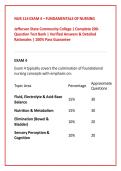
NUR 114 EXAM 4 – FUNDAMENTALS OF NURSING
Jefferson State Community College | Complete 200-
Question Test Bank | Verified Answers & Detailed
Rationales | 100% Pass Guarantee
EXAM 4
Exam 4 typically covers the culmination of foundational
nursing concepts with emphasis on:
Approximate
Topic Area Percentage
Questions
Fluid, Electrolyte & Acid-Base
15% 30
Balance
Nutrition & Metabolism 15% 30
Elimination (Bowel &
10% 20
Bladder)
Sensory Perception &
10% 20
Cognition
, Approximate
Topic Area Percentage
Questions
Oxygenation & Respiratory
10% 20
Function
Perioperative &
10% 20
Postoperative Care
Pain Management & End-of-
10% 20
Life Care
Clinical Judgment &
10% 20
Prioritization
NGN Case Scenarios
10% 20
(Integrated)
SECTION 1: FLUID, ELECTROLYTE & ACID-BASE BALANCE
(Questions 1–30)
1. A patient has a serum potassium of 6.8 mEq/L. Which
intervention is priority?
,A) Administer IV calcium gluconate
B) Givesodiumpolystyrenesulfonate(Kayexalate)
C) Prepareforemergent hemodialysis
D) Restrictdietarypotassium
Answer: A) Administer IV calciumgluconate
Rationale: Severehyperkalemia(>6.5 mEq/L) requires
immediate IV calcium gluconate to stabilizecardiac
membranes and preventlife-threatening dysrhythmias.
Kayexalate(B) works slowly; hemodialysis (C) requires
setup time; dietary restriction (D) is notemergent.
2. The nurse is caringforapatientwith hypokalemia. Which
ECG change would the nurse expect?
A) Peaked T waves
B) Flattened Twaves and prominent Uwaves
C) Prolonged PR interval
D) ST-segmentelevation
Answer: B) Flattened Twaves and prominent Uwaves
Rationale: Hypokalemia causes flattened Twaves and
prominent Uwaves. Peaked Twaves (A) areseen in
hyperkalemia. Prolonged PR interval (C) and STelevation
(D) arenot classic findings of hypokalemia.
, 3. Apatientwith heartfailure is prescribed furosemide
(Lasix). Which electrolyteimbalance should the nurse
monitor for?
A) Hyperkalemia
B) Hypokalemia
C) Hypernatremia
D) Hypermagnesemia
Answer: B) Hypokalemia
Rationale: Furosemide is a loop diureticthat causes
potassium wasting. Thenurse should monitorserum
potassiumlevels and assess forsigns of hypokalemia
(muscleweakness, dysrhythmias).
4. The nurse is assessing apatientforsigns of dehydration.
Which finding is most concerning?
A) Dry mucous membranes
B) Decreasedurineoutput
C) Sunkenfontanel (in infants)
D) All of the above
Answer: D) All of the above
Rationale: All of thesefindingsindicate dehydration and
Jefferson State Community College | Complete 200-
Question Test Bank | Verified Answers & Detailed
Rationales | 100% Pass Guarantee
EXAM 4
Exam 4 typically covers the culmination of foundational
nursing concepts with emphasis on:
Approximate
Topic Area Percentage
Questions
Fluid, Electrolyte & Acid-Base
15% 30
Balance
Nutrition & Metabolism 15% 30
Elimination (Bowel &
10% 20
Bladder)
Sensory Perception &
10% 20
Cognition
, Approximate
Topic Area Percentage
Questions
Oxygenation & Respiratory
10% 20
Function
Perioperative &
10% 20
Postoperative Care
Pain Management & End-of-
10% 20
Life Care
Clinical Judgment &
10% 20
Prioritization
NGN Case Scenarios
10% 20
(Integrated)
SECTION 1: FLUID, ELECTROLYTE & ACID-BASE BALANCE
(Questions 1–30)
1. A patient has a serum potassium of 6.8 mEq/L. Which
intervention is priority?
,A) Administer IV calcium gluconate
B) Givesodiumpolystyrenesulfonate(Kayexalate)
C) Prepareforemergent hemodialysis
D) Restrictdietarypotassium
Answer: A) Administer IV calciumgluconate
Rationale: Severehyperkalemia(>6.5 mEq/L) requires
immediate IV calcium gluconate to stabilizecardiac
membranes and preventlife-threatening dysrhythmias.
Kayexalate(B) works slowly; hemodialysis (C) requires
setup time; dietary restriction (D) is notemergent.
2. The nurse is caringforapatientwith hypokalemia. Which
ECG change would the nurse expect?
A) Peaked T waves
B) Flattened Twaves and prominent Uwaves
C) Prolonged PR interval
D) ST-segmentelevation
Answer: B) Flattened Twaves and prominent Uwaves
Rationale: Hypokalemia causes flattened Twaves and
prominent Uwaves. Peaked Twaves (A) areseen in
hyperkalemia. Prolonged PR interval (C) and STelevation
(D) arenot classic findings of hypokalemia.
, 3. Apatientwith heartfailure is prescribed furosemide
(Lasix). Which electrolyteimbalance should the nurse
monitor for?
A) Hyperkalemia
B) Hypokalemia
C) Hypernatremia
D) Hypermagnesemia
Answer: B) Hypokalemia
Rationale: Furosemide is a loop diureticthat causes
potassium wasting. Thenurse should monitorserum
potassiumlevels and assess forsigns of hypokalemia
(muscleweakness, dysrhythmias).
4. The nurse is assessing apatientforsigns of dehydration.
Which finding is most concerning?
A) Dry mucous membranes
B) Decreasedurineoutput
C) Sunkenfontanel (in infants)
D) All of the above
Answer: D) All of the above
Rationale: All of thesefindingsindicate dehydration and


