

NUR 114 EXAM 3 – FUNDAMENTALS OF NURSING
Jefferson State Community College | Complete 200-Question
Test Bank | Verified Answers & Detailed Rationales | 100%
Pass Guarantee
EXAM 3
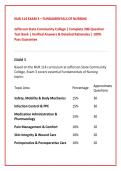
Based on the NUR 114 curriculum at Jefferson State Community
College, Exam 3 covers essential Fundamentals of Nursing
topics:
Approximate
Topic Area Percentage
Questions
Safety, Mobility & Body Mechanics 15% 30
Infection Control & PPE 15% 30
Medication Administration &
15% 30
Pharmacology
Pain Management & Comfort 10% 20
Skin Integrity & Wound Care 10% 20
Perioperative & Postoperative Care 10% 20
, Approximate
Topic Area Percentage
Questions
Fluid, Electrolyte & Acid-Base
10% 20
Balance
Clinical Judgment & Prioritization 10% 20
NGN Case Scenarios (Integrated) 5% 10
SECTION 1: SAFETY, MOBILITY & BODY MECHANICS (Questions
1–30)
1. A nurse is preparing to transfer a patient from the bed to a
chair. Which action ensures proper body mechanics?
A) Bending at the waist to lift the patient
B) Keeping feet close together for stability
C) Positioning the chair at a 90-degree angle to the bed
D) Using a gait belt and pivoting on the foot farthest from the
chair
Answer: D) Using a gait belt and pivoting on the foot farthest
from the chair
Rationale: Proper body mechanics include maintaining a wide
base of support, using a gait belt, and pivoting on the foot
,farthest from the destination to protect the nurse's back.
Bending at the waist (A) increases injury risk. Feet should be
shoulder-width apart for stability (B).
2. A patient has been on bed rest for 3 days. Which
complication is the nurse most concerned about preventing?
A) Urinary retention
B) Constipation
C) Deep vein thrombosis (DVT)
D) Pressure injury
Answer: C) Deep vein thrombosis (DVT)
Rationale: Immobility increases venous stasis and risk of DVT.
While pressure injuries (D) are a concern, DVT can lead to
pulmonary embolism, making it a higher immediate priority.
3. The nurse is applying wrist restraints to a confused patient.
Which action is correct?
A) Tie the restraints to the side rail
B) Apply restraints tightly to prevent movement
C) Tie a quick-release knot to the bed frame
D) Leave restraints on for 8 hours before checking
Answer: C) Tie a quick-release knot to the bed frame
Rationale: Restraints must be tied to a movable part of the bed
frame (not the side rail) using a quick-release knot. Two fingers
, should fitbetweentherestraint and the patient's skin. Patients in
restraints should be assessed every 2 hours, notevery 8 hours.
4. Whichpatient is atthehighestriskforfalling?
A) 65-year-old with mildarthritis
B) 45-year-old postoperative day 1
C) 70-year-old taking antihypertensive medication
D) 30-year-old with a broken ankle using crutches
Answer: C) 70-year-old takingantihypertensive medication
Rationale: Antihypertensives can cause orthostatic hypotension,
dizziness, and falls. Age, incontinence, and bifocals arerisks, but
medication-induced hypotension is a high-priority modifiable
risk.
5. A postoperative patientneeds to belogrolled. Whichaction by
the nursing assistant requires immediateintervention?
A) Placingapillowbetweenthepatient's knees
B) Turningthe patient's head and shoulders first, then hips
C) Usingadraw sheet to turn thepatient asa unit
D) Crossingthe patient's arms overthechest
Answer: B) Turning the patient's head and shoulders first, then
hips
Rationale: Logrolling requires turningthe entire bodyasone unit
Jefferson State Community College | Complete 200-Question
Test Bank | Verified Answers & Detailed Rationales | 100%
Pass Guarantee
EXAM 3
Based on the NUR 114 curriculum at Jefferson State Community
College, Exam 3 covers essential Fundamentals of Nursing
topics:
Approximate
Topic Area Percentage
Questions
Safety, Mobility & Body Mechanics 15% 30
Infection Control & PPE 15% 30
Medication Administration &
15% 30
Pharmacology
Pain Management & Comfort 10% 20
Skin Integrity & Wound Care 10% 20
Perioperative & Postoperative Care 10% 20
, Approximate
Topic Area Percentage
Questions
Fluid, Electrolyte & Acid-Base
10% 20
Balance
Clinical Judgment & Prioritization 10% 20
NGN Case Scenarios (Integrated) 5% 10
SECTION 1: SAFETY, MOBILITY & BODY MECHANICS (Questions
1–30)
1. A nurse is preparing to transfer a patient from the bed to a
chair. Which action ensures proper body mechanics?
A) Bending at the waist to lift the patient
B) Keeping feet close together for stability
C) Positioning the chair at a 90-degree angle to the bed
D) Using a gait belt and pivoting on the foot farthest from the
chair
Answer: D) Using a gait belt and pivoting on the foot farthest
from the chair
Rationale: Proper body mechanics include maintaining a wide
base of support, using a gait belt, and pivoting on the foot
,farthest from the destination to protect the nurse's back.
Bending at the waist (A) increases injury risk. Feet should be
shoulder-width apart for stability (B).
2. A patient has been on bed rest for 3 days. Which
complication is the nurse most concerned about preventing?
A) Urinary retention
B) Constipation
C) Deep vein thrombosis (DVT)
D) Pressure injury
Answer: C) Deep vein thrombosis (DVT)
Rationale: Immobility increases venous stasis and risk of DVT.
While pressure injuries (D) are a concern, DVT can lead to
pulmonary embolism, making it a higher immediate priority.
3. The nurse is applying wrist restraints to a confused patient.
Which action is correct?
A) Tie the restraints to the side rail
B) Apply restraints tightly to prevent movement
C) Tie a quick-release knot to the bed frame
D) Leave restraints on for 8 hours before checking
Answer: C) Tie a quick-release knot to the bed frame
Rationale: Restraints must be tied to a movable part of the bed
frame (not the side rail) using a quick-release knot. Two fingers
, should fitbetweentherestraint and the patient's skin. Patients in
restraints should be assessed every 2 hours, notevery 8 hours.
4. Whichpatient is atthehighestriskforfalling?
A) 65-year-old with mildarthritis
B) 45-year-old postoperative day 1
C) 70-year-old taking antihypertensive medication
D) 30-year-old with a broken ankle using crutches
Answer: C) 70-year-old takingantihypertensive medication
Rationale: Antihypertensives can cause orthostatic hypotension,
dizziness, and falls. Age, incontinence, and bifocals arerisks, but
medication-induced hypotension is a high-priority modifiable
risk.
5. A postoperative patientneeds to belogrolled. Whichaction by
the nursing assistant requires immediateintervention?
A) Placingapillowbetweenthepatient's knees
B) Turningthe patient's head and shoulders first, then hips
C) Usingadraw sheet to turn thepatient asa unit
D) Crossingthe patient's arms overthechest
Answer: B) Turning the patient's head and shoulders first, then
hips
Rationale: Logrolling requires turningthe entire bodyasone unit


