

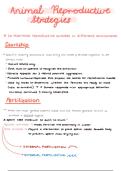
Animal Reproductive
strategies
* to maximize reproductive success in different environments.
Courtship
>
specific mating behaviours that bring the
3 females together the
-
males at
correct time .
adults
mature
only
·
.
Both co-operate to the behaviour .
must
recognise
·
Attracts opposite b reduces potential
aggression
·
sex .
Promotes hormonal responses
·
that prepare the bodies for reproductive success.
·
used by males to determine whether the females are
ready to mate
Cable to conceive) >
-
if female responds with appropriate behaviour
courtship continues3 takes place.
mating
Fertilization
>
the male
-
When
gamete (sperm) fuses with the female
gamete (ovum) to
produce a diploid zygote
* Sperm need moisture to swim to ovum !
aquatic animals -
> males fertilize in
ovd
externally water .
land female's
animals & require a mechanism to place sperm inside body
to
prevent sperm from drying out
* INTERNAL FERTILIZATION
* EXTERNAL FERTILIZATION SC
,·
RNALFERTIATO
female lays ova.
male releases sperm on /near them .
gamete wastage (currents/eaten) .
1 ots of
gametes produced (increased chance of fertilization) .
INTERNAL FERTILIZATION
terrestrial animals transfer without being exposed
·
must sperm
to air .
most animals =
penis . sperm fluid = semen
4
insects= indirect transfer (spermatophore) transport
have ↳ contains
reptiles =
males 3 females a muscular nutrients
(digestive
↳ chemicals
cloaca , urinary + reproductive opening) activate sperm
↳ ↳ alkaline
during mating the male puts his cloaca to neutralize
acidity in
vagina .
against the female's to transfer sperm .
& antibiotic prevents infection .
birds =
cloaca Iducks have penises)
mammals =
penis
, Protection of the
embryo
growt h,
Diploid zygote embryo
·
I must be protected .
1
Ovipary)
.
female
·
releases eggs into environment
terrestrial animals enclose their in shell
drying
·
eggs a to prevent .
out
·
internal fertilization happens before shell is formed .
·
REPTILES & BIRDS are oviparous
*
leathery shell hard brittle chalky shell
-
*
-
.
, ,
laid in hole in soil shell is porous (gaseous exchange
- -
covered with soil large (holds food for embryo
-
-
-
warm Sun > incubation
- ↳ albumen =
protein + water
↳
embryos hatch Yolk fats vitamins nutrients
-
mature =
, .
,
fend for themselves parents sit
-
for
-
on
eggs incubation .
vulnerable predators
-
to
egg is closed limit to size 3 nutrients that be received .
·
can
, 2 .
Ouovipary
·
female incubates egg inside her body
.
·
soft shell , constant temperature .
·
Fish , Amphibians ,
Lizards 3 Snakes are ovoviparous .
embryo relies on the food inside the
egg.
·
·
hatch inside the parents body 3 then leave .
fend for themselves .
young
·
.
3
Vivipary
inside female's
young embryo develops the uterus .
·
embryo covered
by membranes.
·
all nutrients obtained via the placenta of
well as
exchange gasses.
·
are as
·
most mammals .
>
egg-laying mammals .
Monotremes but
·
> oviparous female produces milk for the babies
(platypus once
they have hatched .
spiny anteaters)
strategies
* to maximize reproductive success in different environments.
Courtship
>
specific mating behaviours that bring the
3 females together the
-
males at
correct time .
adults
mature
only
·
.
Both co-operate to the behaviour .
must
recognise
·
Attracts opposite b reduces potential
aggression
·
sex .
Promotes hormonal responses
·
that prepare the bodies for reproductive success.
·
used by males to determine whether the females are
ready to mate
Cable to conceive) >
-
if female responds with appropriate behaviour
courtship continues3 takes place.
mating
Fertilization
>
the male
-
When
gamete (sperm) fuses with the female
gamete (ovum) to
produce a diploid zygote
* Sperm need moisture to swim to ovum !
aquatic animals -
> males fertilize in
ovd
externally water .
land female's
animals & require a mechanism to place sperm inside body
to
prevent sperm from drying out
* INTERNAL FERTILIZATION
* EXTERNAL FERTILIZATION SC
,·
RNALFERTIATO
female lays ova.
male releases sperm on /near them .
gamete wastage (currents/eaten) .
1 ots of
gametes produced (increased chance of fertilization) .
INTERNAL FERTILIZATION
terrestrial animals transfer without being exposed
·
must sperm
to air .
most animals =
penis . sperm fluid = semen
4
insects= indirect transfer (spermatophore) transport
have ↳ contains
reptiles =
males 3 females a muscular nutrients
(digestive
↳ chemicals
cloaca , urinary + reproductive opening) activate sperm
↳ ↳ alkaline
during mating the male puts his cloaca to neutralize
acidity in
vagina .
against the female's to transfer sperm .
& antibiotic prevents infection .
birds =
cloaca Iducks have penises)
mammals =
penis
, Protection of the
embryo
growt h,
Diploid zygote embryo
·
I must be protected .
1
Ovipary)
.
female
·
releases eggs into environment
terrestrial animals enclose their in shell
drying
·
eggs a to prevent .
out
·
internal fertilization happens before shell is formed .
·
REPTILES & BIRDS are oviparous
*
leathery shell hard brittle chalky shell
-
*
-
.
, ,
laid in hole in soil shell is porous (gaseous exchange
- -
covered with soil large (holds food for embryo
-
-
-
warm Sun > incubation
- ↳ albumen =
protein + water
↳
embryos hatch Yolk fats vitamins nutrients
-
mature =
, .
,
fend for themselves parents sit
-
for
-
on
eggs incubation .
vulnerable predators
-
to
egg is closed limit to size 3 nutrients that be received .
·
can
, 2 .
Ouovipary
·
female incubates egg inside her body
.
·
soft shell , constant temperature .
·
Fish , Amphibians ,
Lizards 3 Snakes are ovoviparous .
embryo relies on the food inside the
egg.
·
·
hatch inside the parents body 3 then leave .
fend for themselves .
young
·
.
3
Vivipary
inside female's
young embryo develops the uterus .
·
embryo covered
by membranes.
·
all nutrients obtained via the placenta of
well as
exchange gasses.
·
are as
·
most mammals .
>
egg-laying mammals .
Monotremes but
·
> oviparous female produces milk for the babies
(platypus once
they have hatched .
spiny anteaters)


