

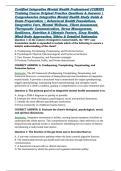
Certified Integrative Mental Health Professional (CIMHP)
Training Course Original Practice Questions & Answers |
Comprehensive Integrative Mental Health Study Guide &
Exam Preparation | Behavioral Health Foundations,
Integrative Care, Mental Wellness, Client Assessment,
Therapeutic Communication, Stress Management,
Resilience, Nutrition & Lifestyle Factors, Sleep Health,
Mind-Body Approaches, Ethics & Detailed Rationales
Question 1: In the context of integrative mental health, the "4Ps" case
formulation model is expanded to include which of the following to ensure a
holistic understanding of the client?
A. Predisposing, Precipitating, Perpetuating, and Protective factors
B. Psychological, Physical, Pharmacological, and Psycho-social factors
C. Past, Present, Prospective, and Preventive strategies
D. Personal, Professional, Public, and Private determinants
CORRECT ANSWER: A. Predisposing, Precipitating, Perpetuating, and
Protective factors
Rationale: The 4Ps framework (Predisposing, Precipitating, Perpetuating, and
Protective factors) is a cornerstone of biopsychosocial case formulation in integrative
mental health. It provides a structured way to understand the origins (predisposing),
triggers (precipitating), maintaining factors (perpetuating), and strengths/assets
(protective) of a client's condition, guiding a comprehensive, root-cause treatment plan.
Question 2: The primary goal of an integrative mental health assessment is to:
A. Assign a DSM-5 diagnosis as quickly as possible.
B. Evaluate the client's biological, psychological, social, and spiritual dimensions.
C. Identify the most effective psychotropic medication.
D. Focus exclusively on childhood trauma history.
CORRECT ANSWER: B. Evaluate the client's biological, psychological, social,
and spiritual dimensions.
Rationale: Integrative assessment is holistic, moving beyond symptom checklists to
understand the whole person. This comprehensive evaluation, often referred to as the
biopsychosocial-spiritual model, is essential for identifying the root causes of distress
and planning a multi-modal intervention .
Question 3: The function of the gut-brain axis is best described as:
A. A one-way communication pathway where the brain controls digestive function.
B. The relationship between gut health and brain function through bidirectional
communication.
C. A theoretical concept with no clinical relevance.
D. The mechanism by which the spinal cord regulates intestinal motility.
,CORRECT ANSWER: B. The relationship between gut health and brain function
through bidirectional communication.
Rationale: The gut-brain axis represents the complex, bidirectional communication
system between the gastrointestinal tract and the central nervous system . This link is
mediated by neural pathways (e.g., the vagus nerve), the immune system, and the
microbiome, playing a critical role in mood, cognition, and mental health.
Question 4: A client with a homozygous MTHFR C677T mutation would most
likely benefit from supplementation with:
A. Folic acid
B. Calcium carbonate
C. Methyl-folate (5-MTHF)
D. Vitamin K
CORRECT ANSWER: C. Methyl-folate (5-MTHF)
Rationale: The MTHFR C677T variant significantly impairs the enzyme's ability to
convert folic acid into its active, methylated form (5-MTHF) . Supplementing with the
active form, methyl-folate, bypasses this enzymatic block, ensuring adequate levels of
this crucial nutrient for neurotransmitter synthesis and methylation pathways.
Question 5: Which of the following best describes the concept of "root-cause"
treatment planning in integrative mental health?
A. Prescribing an SSRI for all clients presenting with depressive symptoms.
B. Identifying and addressing the underlying lifestyle, physiological, and psychological
contributors to a client's condition.
C. Focusing solely on cognitive restructuring techniques to change negative thought
patterns.
D. Using short-term crisis counseling to stabilize acute symptoms.
CORRECT ANSWER: B. Identifying and addressing the underlying lifestyle,
physiological, and psychological contributors to a client's condition.
Rationale: Root-cause treatment planning is a fundamental principle of integrative
care. It moves beyond symptom suppression to investigate and correct the foundational
imbalances—such as chronic inflammation, sleep deprivation, nutritional deficiencies, or
unresolved trauma—that are driving the client's mental health challenges .
Question 6: The "Relaxation Response," as described by Herbert Benson, is
characterized by:
A. An increase in sympathetic nervous system activity.
B. A physiological state of deep rest that opposes the 'fight-or-flight' response.
C. The release of dopamine and endorphins.
D. A state of heightened alertness and awareness.
,CORRECT ANSWER: B. A physiological state of deep rest that opposes the
'fight-or-flight' response.
Rationale: The Relaxation Response is the physiologic counterpart to the stress
response, first described by Dr. Herbert Benson . It is a state of profound rest mediated
by the parasympathetic nervous system, characterized by decreased heart rate, blood
pressure, and stress hormone (cortisol, catecholamine) output .
Question 7: Docosahexaenoic acid (DHA) is particularly critical for brain
health because it:
A. Is the primary precursor for serotonin.
B. Enhances glucose metabolism in the brain.
C. Is a major structural component of neuronal membranes, influencing membrane
fluidity.
D. Acts as a powerful antioxidant, reducing oxidative stress.
CORRECT ANSWER: C. Is a major structural component of neuronal
membranes, influencing membrane fluidity.
Rationale: DHA, an omega-3 fatty acid, is highly concentrated in the brain and is a
critical structural component of neuronal membranes . Its presence in the phospholipid
bilayer is essential for membrane fluidity, receptor function, and signal transduction, all
vital for proper neural communication and cognitive function.
Question 8: Motivational Interviewing (MI) is a therapeutic approach
specifically designed to address:
A. Delusional thinking in psychotic disorders.
B. Ambivalence and enhance a client's motivation for change.
C. Severe emotional dysregulation in borderline personality disorder.
D. Unconscious conflicts from childhood.
CORRECT ANSWER: B. Ambivalence and enhance a client's motivation for
change.
Rationale: Motivational Interviewing is a client-centered, directive method for
enhancing intrinsic motivation to change by exploring and resolving ambivalence . It
uses techniques like OARS (Open-ended questions, Affirmations, Reflective listening,
Summaries) to elicit "change talk" and strengthen the client's own reasons for change .
Question 9: Exposure and Response Prevention (ERP) is the gold-standard
evidence-based psychotherapy for which condition?
A. Major Depressive Disorder
B. Generalized Anxiety Disorder
C. Obsessive-Compulsive Disorder (OCD)
D. Post-Traumatic Stress Disorder
CORRECT ANSWER: C. Obsessive-Compulsive Disorder (OCD)
, Rationale: Exposure and Response Prevention (ERP) is a specific type of Cognitive
Behavioral Therapy (CBT) and is considered the first-line, gold-standard
psychotherapeutic treatment for OCD . It involves systematically exposing the client to
fear-inducing stimuli while preventing the compulsive ritual that usually reduces the
anxiety, thereby breaking the OCD cycle.
Question 10: In the context of integrative care, a comprehensive evaluation for
heavy metal exposure would typically include testing for:
A. Sodium, Potassium, and Calcium
B. Lead, Mercury, and Arsenic
C. Vitamin D, B12, and Folate
D. Cortisol, DHEA, and ACTH
CORRECT ANSWER: B. Lead, Mercury, and Arsenic
Rationale: Lead, mercury, and arsenic are the most prevalent neurotoxic heavy metals
linked to a range of neuropsychiatric symptoms . An integrative assessment may include
screening for these metals, especially in cases of chronic, treatment-resistant depression,
cognitive impairment, or when environmental exposure is suspected.
Question 11: Which of the following mineral deficiencies is most commonly
associated with symptoms of irritability, anxiety, and depression?
A. Calcium
B. Magnesium
C. Zinc
D. Iron
CORRECT ANSWER: B. Magnesium
Rationale: Magnesium plays a crucial role in calming the nervous system and is a co-
factor for the synthesis of GABA, the primary inhibitory neurotransmitter . Deficiency is
frequently linked to increased irritability, anxiety, depressive symptoms, and sleep
disturbances.
Question 12: St. John's Wort is a herbal supplement used for mild-to-moderate
depression but requires monitoring for a specific, well-known side effect:
A. Hypertension
B. Hepatotoxicity
C. Photosensitivity
D. Hyperglycemia
CORRECT ANSWER: C. Photosensitivity
Rationale: St. John's Wort is known to cause photosensitivity in some individuals,
where the skin becomes more sensitive to sunlight and UV radiation, leading to an
increased risk of sunburn or rashes . This is a recognized side effect that requires clinical
monitoring and client education.
Training Course Original Practice Questions & Answers |
Comprehensive Integrative Mental Health Study Guide &
Exam Preparation | Behavioral Health Foundations,
Integrative Care, Mental Wellness, Client Assessment,
Therapeutic Communication, Stress Management,
Resilience, Nutrition & Lifestyle Factors, Sleep Health,
Mind-Body Approaches, Ethics & Detailed Rationales
Question 1: In the context of integrative mental health, the "4Ps" case
formulation model is expanded to include which of the following to ensure a
holistic understanding of the client?
A. Predisposing, Precipitating, Perpetuating, and Protective factors
B. Psychological, Physical, Pharmacological, and Psycho-social factors
C. Past, Present, Prospective, and Preventive strategies
D. Personal, Professional, Public, and Private determinants
CORRECT ANSWER: A. Predisposing, Precipitating, Perpetuating, and
Protective factors
Rationale: The 4Ps framework (Predisposing, Precipitating, Perpetuating, and
Protective factors) is a cornerstone of biopsychosocial case formulation in integrative
mental health. It provides a structured way to understand the origins (predisposing),
triggers (precipitating), maintaining factors (perpetuating), and strengths/assets
(protective) of a client's condition, guiding a comprehensive, root-cause treatment plan.
Question 2: The primary goal of an integrative mental health assessment is to:
A. Assign a DSM-5 diagnosis as quickly as possible.
B. Evaluate the client's biological, psychological, social, and spiritual dimensions.
C. Identify the most effective psychotropic medication.
D. Focus exclusively on childhood trauma history.
CORRECT ANSWER: B. Evaluate the client's biological, psychological, social,
and spiritual dimensions.
Rationale: Integrative assessment is holistic, moving beyond symptom checklists to
understand the whole person. This comprehensive evaluation, often referred to as the
biopsychosocial-spiritual model, is essential for identifying the root causes of distress
and planning a multi-modal intervention .
Question 3: The function of the gut-brain axis is best described as:
A. A one-way communication pathway where the brain controls digestive function.
B. The relationship between gut health and brain function through bidirectional
communication.
C. A theoretical concept with no clinical relevance.
D. The mechanism by which the spinal cord regulates intestinal motility.
,CORRECT ANSWER: B. The relationship between gut health and brain function
through bidirectional communication.
Rationale: The gut-brain axis represents the complex, bidirectional communication
system between the gastrointestinal tract and the central nervous system . This link is
mediated by neural pathways (e.g., the vagus nerve), the immune system, and the
microbiome, playing a critical role in mood, cognition, and mental health.
Question 4: A client with a homozygous MTHFR C677T mutation would most
likely benefit from supplementation with:
A. Folic acid
B. Calcium carbonate
C. Methyl-folate (5-MTHF)
D. Vitamin K
CORRECT ANSWER: C. Methyl-folate (5-MTHF)
Rationale: The MTHFR C677T variant significantly impairs the enzyme's ability to
convert folic acid into its active, methylated form (5-MTHF) . Supplementing with the
active form, methyl-folate, bypasses this enzymatic block, ensuring adequate levels of
this crucial nutrient for neurotransmitter synthesis and methylation pathways.
Question 5: Which of the following best describes the concept of "root-cause"
treatment planning in integrative mental health?
A. Prescribing an SSRI for all clients presenting with depressive symptoms.
B. Identifying and addressing the underlying lifestyle, physiological, and psychological
contributors to a client's condition.
C. Focusing solely on cognitive restructuring techniques to change negative thought
patterns.
D. Using short-term crisis counseling to stabilize acute symptoms.
CORRECT ANSWER: B. Identifying and addressing the underlying lifestyle,
physiological, and psychological contributors to a client's condition.
Rationale: Root-cause treatment planning is a fundamental principle of integrative
care. It moves beyond symptom suppression to investigate and correct the foundational
imbalances—such as chronic inflammation, sleep deprivation, nutritional deficiencies, or
unresolved trauma—that are driving the client's mental health challenges .
Question 6: The "Relaxation Response," as described by Herbert Benson, is
characterized by:
A. An increase in sympathetic nervous system activity.
B. A physiological state of deep rest that opposes the 'fight-or-flight' response.
C. The release of dopamine and endorphins.
D. A state of heightened alertness and awareness.
,CORRECT ANSWER: B. A physiological state of deep rest that opposes the
'fight-or-flight' response.
Rationale: The Relaxation Response is the physiologic counterpart to the stress
response, first described by Dr. Herbert Benson . It is a state of profound rest mediated
by the parasympathetic nervous system, characterized by decreased heart rate, blood
pressure, and stress hormone (cortisol, catecholamine) output .
Question 7: Docosahexaenoic acid (DHA) is particularly critical for brain
health because it:
A. Is the primary precursor for serotonin.
B. Enhances glucose metabolism in the brain.
C. Is a major structural component of neuronal membranes, influencing membrane
fluidity.
D. Acts as a powerful antioxidant, reducing oxidative stress.
CORRECT ANSWER: C. Is a major structural component of neuronal
membranes, influencing membrane fluidity.
Rationale: DHA, an omega-3 fatty acid, is highly concentrated in the brain and is a
critical structural component of neuronal membranes . Its presence in the phospholipid
bilayer is essential for membrane fluidity, receptor function, and signal transduction, all
vital for proper neural communication and cognitive function.
Question 8: Motivational Interviewing (MI) is a therapeutic approach
specifically designed to address:
A. Delusional thinking in psychotic disorders.
B. Ambivalence and enhance a client's motivation for change.
C. Severe emotional dysregulation in borderline personality disorder.
D. Unconscious conflicts from childhood.
CORRECT ANSWER: B. Ambivalence and enhance a client's motivation for
change.
Rationale: Motivational Interviewing is a client-centered, directive method for
enhancing intrinsic motivation to change by exploring and resolving ambivalence . It
uses techniques like OARS (Open-ended questions, Affirmations, Reflective listening,
Summaries) to elicit "change talk" and strengthen the client's own reasons for change .
Question 9: Exposure and Response Prevention (ERP) is the gold-standard
evidence-based psychotherapy for which condition?
A. Major Depressive Disorder
B. Generalized Anxiety Disorder
C. Obsessive-Compulsive Disorder (OCD)
D. Post-Traumatic Stress Disorder
CORRECT ANSWER: C. Obsessive-Compulsive Disorder (OCD)
, Rationale: Exposure and Response Prevention (ERP) is a specific type of Cognitive
Behavioral Therapy (CBT) and is considered the first-line, gold-standard
psychotherapeutic treatment for OCD . It involves systematically exposing the client to
fear-inducing stimuli while preventing the compulsive ritual that usually reduces the
anxiety, thereby breaking the OCD cycle.
Question 10: In the context of integrative care, a comprehensive evaluation for
heavy metal exposure would typically include testing for:
A. Sodium, Potassium, and Calcium
B. Lead, Mercury, and Arsenic
C. Vitamin D, B12, and Folate
D. Cortisol, DHEA, and ACTH
CORRECT ANSWER: B. Lead, Mercury, and Arsenic
Rationale: Lead, mercury, and arsenic are the most prevalent neurotoxic heavy metals
linked to a range of neuropsychiatric symptoms . An integrative assessment may include
screening for these metals, especially in cases of chronic, treatment-resistant depression,
cognitive impairment, or when environmental exposure is suspected.
Question 11: Which of the following mineral deficiencies is most commonly
associated with symptoms of irritability, anxiety, and depression?
A. Calcium
B. Magnesium
C. Zinc
D. Iron
CORRECT ANSWER: B. Magnesium
Rationale: Magnesium plays a crucial role in calming the nervous system and is a co-
factor for the synthesis of GABA, the primary inhibitory neurotransmitter . Deficiency is
frequently linked to increased irritability, anxiety, depressive symptoms, and sleep
disturbances.
Question 12: St. John's Wort is a herbal supplement used for mild-to-moderate
depression but requires monitoring for a specific, well-known side effect:
A. Hypertension
B. Hepatotoxicity
C. Photosensitivity
D. Hyperglycemia
CORRECT ANSWER: C. Photosensitivity
Rationale: St. John's Wort is known to cause photosensitivity in some individuals,
where the skin becomes more sensitive to sunlight and UV radiation, leading to an
increased risk of sunburn or rashes . This is a recognized side effect that requires clinical
monitoring and client education.


