

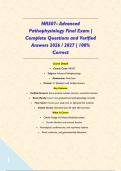
Course Details
• Course Code: NR507
• Subject: Advanced Pathophysiology
• Assessment: Final Exam
• Format: 51 Questions with Verified Answers
Key Features
• Verified Answers: Every question includes accurate, researched answers.
• Exam Ready: Covers core graduate-level pathophysiology concepts.
• Time Saver: Focuses your study time on high-yield test material.
• Instant Access: Download your file right after purchase.
What It Covers
• Cellular biology and altered fluids/electrolytes
• Genetic disorders and immune function
• Neurological, cardiovascular, and respiratory systems
• Renal, endocrine, and gastrointestinal alterations
1
, Quiz_________________?
Actions of Insulin -
Answer✅
Insulin promotes glucose uptake mostly in the liver, muscle and adipose tissue
Quiz_________________?
Acute Pyelonephritis -
Answer✅
Diagnosing by clinical symptoms alone can be difficult; can be similar to cystitis
Diagnosis established by:
-Urine culture
-Urinalysis (WBC casts indicates pyelonephritis, but may not always be present)
-Signs/Symptoms
-Complicated pyelonephritis requires blood cultures and urinary tract imaging
Quiz_________________?
Acute renal failure -
Answer✅
Reversible
Determining prognosis- kidneys respond to diuretic with good output; this indicates that
kidneys are functioning well
2
, Quiz_________________?
Adrenal Crisis- Hypocortisolism -
Answer✅
Onset of adrenal crisis is signified by hypotension
Hypotension can progress to complete vascular collapse and shock. This is known as
adrenal crisis or addisonian crisis and develops with undiagnosed disease, acute withdrawal
of glucocorticoid therapy or the occurrence of infection or other comorbid stressful events
Quiz_________________?
Alzheimer's Disease -
Answer✅
Decreased short-term memory occurs with mild cognitive decline as a result of a reduced
hippocampus size
Quiz_________________?
Autonomic Neuropathy-Complication of Diabetes -
Answer✅
Autonomic Neuropathy includes:
GI Symptoms:
--Decreased esophageal motility
--Gastroparesis
--Delayed gastric emptying
Quiz_________________?
Bacterial Meningitis -
3
• Course Code: NR507
• Subject: Advanced Pathophysiology
• Assessment: Final Exam
• Format: 51 Questions with Verified Answers
Key Features
• Verified Answers: Every question includes accurate, researched answers.
• Exam Ready: Covers core graduate-level pathophysiology concepts.
• Time Saver: Focuses your study time on high-yield test material.
• Instant Access: Download your file right after purchase.
What It Covers
• Cellular biology and altered fluids/electrolytes
• Genetic disorders and immune function
• Neurological, cardiovascular, and respiratory systems
• Renal, endocrine, and gastrointestinal alterations
1
, Quiz_________________?
Actions of Insulin -
Answer✅
Insulin promotes glucose uptake mostly in the liver, muscle and adipose tissue
Quiz_________________?
Acute Pyelonephritis -
Answer✅
Diagnosing by clinical symptoms alone can be difficult; can be similar to cystitis
Diagnosis established by:
-Urine culture
-Urinalysis (WBC casts indicates pyelonephritis, but may not always be present)
-Signs/Symptoms
-Complicated pyelonephritis requires blood cultures and urinary tract imaging
Quiz_________________?
Acute renal failure -
Answer✅
Reversible
Determining prognosis- kidneys respond to diuretic with good output; this indicates that
kidneys are functioning well
2
, Quiz_________________?
Adrenal Crisis- Hypocortisolism -
Answer✅
Onset of adrenal crisis is signified by hypotension
Hypotension can progress to complete vascular collapse and shock. This is known as
adrenal crisis or addisonian crisis and develops with undiagnosed disease, acute withdrawal
of glucocorticoid therapy or the occurrence of infection or other comorbid stressful events
Quiz_________________?
Alzheimer's Disease -
Answer✅
Decreased short-term memory occurs with mild cognitive decline as a result of a reduced
hippocampus size
Quiz_________________?
Autonomic Neuropathy-Complication of Diabetes -
Answer✅
Autonomic Neuropathy includes:
GI Symptoms:
--Decreased esophageal motility
--Gastroparesis
--Delayed gastric emptying
Quiz_________________?
Bacterial Meningitis -
3


