

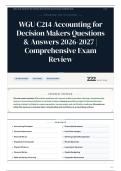
WGU C214 ACCOUNTING FOR DECISION MAKERS QUESTIONS & ANSWERS 2026… EXAM
P R O F E S S I O N A L P R A C T I C E M AT E R I A L S
WGU C214 Accounting for
Decision Makers Questions
& Answers 2026-2027 |
Comprehensive Exam
Review
Verified Answers Exam Ready With Rationales
222 QUESTIONS
DOCUMENT OVERVIEW
This document contains 222 verified questions with correct answers provided, offering a comprehensive
review of accounting principles for decision makers. It covers essential concepts in financial decision-
making, making it suitable for exam preparation, course review, and certification readiness. Students can
utilize this resource to enhance their understanding and confidence in accounting practices.
CONTENTS
• Accounting Principles • Financial Instruments
• Financial Statements • Cash Flow Analysis
• Risk and Return • Working Capital Management
• Regulatory Frameworks • Market Dynamics
• Market Efficiency • Investment Valuation
• Financial Ratios • Capital Budgeting
• Debt and Equity Financing • Corporate Governance
Page 1
, E XA M Q U EST I O N S
Q1 QUESTION 1 OF 222
Trading on the NYSE is executed without a specialist (i.e. a market maker). (T/F)
CORRECT ANSWER
F
Q2 QUESTION 2 OF 222
How do you calculate the change in Retained Earnings?
a. Ending Retained Earnings - Change in Cash
b. EBIT divided by Total Assets + Dividends
c. EBIT - Change in Cash - Dividends
d. Net Income - Dividends
CORRECT ANSWER
d
Q3 QUESTION 3 OF 222
Which of the following is generally true?
a. Gross Profit and Operating Income are the same
b. Cost of Goods Sold + Operating Expenses = Net Income
c. Operating Income and EBIT are the same
d. EBIT + Income Taxes = Net income
CORRECT ANSWER
c
Q4 QUESTION 4 OF 222
Which components are part of total assets?
a. Cash, Accounts Receivable, Short Term Debt
b. Cash Accounts Receivable, Inventory, Long Term Assets
c. Accounts Payable, Long Term Assets, Long Term Debt
d. Accounts Payable, Net Income, Equity
Page 2
, CORRECT ANSWER
b
Q5 QUESTION 5 OF 222
Which components are part of current assets?
a. Cash, Accounts Receivable, Property Plant & Equipment
b. Accounts Receivable, Accounts Payable, Inventory
c. Long Term Debt, Property Plant & Equipment, Common Stock
d. Inventory, Cash, Accounts Receivable, Short Term Investments
CORRECT ANSWER
d
Q6 QUESTION 6 OF 222
Which components are part of Total Liabilities?
a. Accounts Payable, Accounts Receivable, Short Term Debt
b. Long Term Debt, Common Stock, Retained Earnings
c. Bonds, Accounts Payable, Mortgage
d. Common Stock, Long Term Debt, Short Term Investments
CORRECT ANSWER
c
Q7 QUESTION 7 OF 222
Why would a company be interested in the TAT(Total Asset Turnover) ratio?
a. How efficient assets are at producing income
b. What the turnover of sales is to liabilities
c. How efficient assets are at producing sales
d. How efficient assets are to liabilities and equity
CORRECT ANSWER
c
Page 3
, Q8 QUESTION 8 OF 222
Why is the NPV preferred over the IRR? Pick Two
a. It has a higher dollar value
b. It measures the dollar value
c. It is more reliable
d. It is harder to calculate
CORRECT ANSWER
b, c
Q9 QUESTION 9 OF 222
What does the Degree of Financial Leverage indicate?
a. The firms cash balance
b. The cost of financed assets
c. The reliance on debt
d. The reliance on assets
CORRECT ANSWER
c
Q10 QUESTION 10 OF 222
If a company has a high degree of financial leverage, what does that tell us about the firm's risk profile?
a. Low Risk
b. Appropriate Risk
c. Higher ability to pay debt
d. Higher profits to shareholders
CORRECT ANSWER
d
Q11 QUESTION 11 OF 222
What would be a source of information to determine Replacement Cost?
a. Building Appraisal
b. Accumulated Depreciation Expense
c. Stock price
d. Statement of Cash Flows
Page 4
P R O F E S S I O N A L P R A C T I C E M AT E R I A L S
WGU C214 Accounting for
Decision Makers Questions
& Answers 2026-2027 |
Comprehensive Exam
Review
Verified Answers Exam Ready With Rationales
222 QUESTIONS
DOCUMENT OVERVIEW
This document contains 222 verified questions with correct answers provided, offering a comprehensive
review of accounting principles for decision makers. It covers essential concepts in financial decision-
making, making it suitable for exam preparation, course review, and certification readiness. Students can
utilize this resource to enhance their understanding and confidence in accounting practices.
CONTENTS
• Accounting Principles • Financial Instruments
• Financial Statements • Cash Flow Analysis
• Risk and Return • Working Capital Management
• Regulatory Frameworks • Market Dynamics
• Market Efficiency • Investment Valuation
• Financial Ratios • Capital Budgeting
• Debt and Equity Financing • Corporate Governance
Page 1
, E XA M Q U EST I O N S
Q1 QUESTION 1 OF 222
Trading on the NYSE is executed without a specialist (i.e. a market maker). (T/F)
CORRECT ANSWER
F
Q2 QUESTION 2 OF 222
How do you calculate the change in Retained Earnings?
a. Ending Retained Earnings - Change in Cash
b. EBIT divided by Total Assets + Dividends
c. EBIT - Change in Cash - Dividends
d. Net Income - Dividends
CORRECT ANSWER
d
Q3 QUESTION 3 OF 222
Which of the following is generally true?
a. Gross Profit and Operating Income are the same
b. Cost of Goods Sold + Operating Expenses = Net Income
c. Operating Income and EBIT are the same
d. EBIT + Income Taxes = Net income
CORRECT ANSWER
c
Q4 QUESTION 4 OF 222
Which components are part of total assets?
a. Cash, Accounts Receivable, Short Term Debt
b. Cash Accounts Receivable, Inventory, Long Term Assets
c. Accounts Payable, Long Term Assets, Long Term Debt
d. Accounts Payable, Net Income, Equity
Page 2
, CORRECT ANSWER
b
Q5 QUESTION 5 OF 222
Which components are part of current assets?
a. Cash, Accounts Receivable, Property Plant & Equipment
b. Accounts Receivable, Accounts Payable, Inventory
c. Long Term Debt, Property Plant & Equipment, Common Stock
d. Inventory, Cash, Accounts Receivable, Short Term Investments
CORRECT ANSWER
d
Q6 QUESTION 6 OF 222
Which components are part of Total Liabilities?
a. Accounts Payable, Accounts Receivable, Short Term Debt
b. Long Term Debt, Common Stock, Retained Earnings
c. Bonds, Accounts Payable, Mortgage
d. Common Stock, Long Term Debt, Short Term Investments
CORRECT ANSWER
c
Q7 QUESTION 7 OF 222
Why would a company be interested in the TAT(Total Asset Turnover) ratio?
a. How efficient assets are at producing income
b. What the turnover of sales is to liabilities
c. How efficient assets are at producing sales
d. How efficient assets are to liabilities and equity
CORRECT ANSWER
c
Page 3
, Q8 QUESTION 8 OF 222
Why is the NPV preferred over the IRR? Pick Two
a. It has a higher dollar value
b. It measures the dollar value
c. It is more reliable
d. It is harder to calculate
CORRECT ANSWER
b, c
Q9 QUESTION 9 OF 222
What does the Degree of Financial Leverage indicate?
a. The firms cash balance
b. The cost of financed assets
c. The reliance on debt
d. The reliance on assets
CORRECT ANSWER
c
Q10 QUESTION 10 OF 222
If a company has a high degree of financial leverage, what does that tell us about the firm's risk profile?
a. Low Risk
b. Appropriate Risk
c. Higher ability to pay debt
d. Higher profits to shareholders
CORRECT ANSWER
d
Q11 QUESTION 11 OF 222
What would be a source of information to determine Replacement Cost?
a. Building Appraisal
b. Accumulated Depreciation Expense
c. Stock price
d. Statement of Cash Flows
Page 4


