

Written by students who passed Immediately available after payment Read online or as PDF Wrong document? Swap it for free 4.6 TrustPilot
logo-home
Document preview thumbnail
Preview 3 out of 25 pages
Exam (elaborations)

English 12A End of Semester Test 2026/2027: 30+ Questions, Beowulf, Shakespeare, Metaphysical Poetry & British Literature, PLATO

Document preview thumbnail
Preview 3 out of 25 pages

This 25-page English 12A End of Semester Test review contains 30+ questions with answers covering major works, authors, literary movements, historical contexts, and analytical skills from British literature. The material begins with the development of modern English and medieval literature, including the influence of invading languages, Beowulf, the warrior code, Sir Gawain and the Green Knight, archetypes, Chaucer's The Canterbury Tales, and the morality play Everyman. The review then moves through the English Reformation and Renaissance, including Henry VIII's separation from the Catholic Church, Martin Luther's Ninety-Five Theses, Shakespeare's sonnets, Elizabethan theater, and Shakespearean drama. Questions on Hamlet examine themes of disease, decay, revenge, indecision, and tragic downfall, while Twelfth Night focuses on appearance versus reality, disguise, mistaken identity, love, gender, and alleged madness. The document also covers metaphysical poetry, including the use of wit and colloquial language in works by John Donne and Andrew Marvell. Additional seventeenth-century literature includes Ben Jonson's poetry, John Bunyan's The Pilgrim's Progress, and John Milton's Paradise Lost, with questions addressing religious devotion, Satan's motivations, blank verse, and major poetic themes. Later sections examine Restoration and eighteenth-century literature through Samuel Pepys's diary, John Dryden's Annus Mirabilis, and Jonathan Swift's A Modest Proposal. The Swift questions focus on satire, social criticism, landlord exploitation, and the political and economic conditions of eighteenth-century Ireland. This resource is particularly useful for reviewing literary analysis, characterization, archetypes, themes, tone, historical context, poetic form, figurative meaning, dramatic conventions, and the relationship between literature and its social context. The questions are presented in an answer-inclusive format, making the document suitable for self-testing, rapid revision, and end-of-semester exam preparation. Reference context: The uploaded document identifies the course as English 12A (PLATO) and the assessment as an End of Semester Test for 2026/2027. The literary works represented in the material can be academically cross-referenced with standard editions of Beowulf, Sir Gawain and the Green Knight, Chaucer's The Canterbury Tales, Everyman, Shakespeare's plays and sonnets, Donne's poetry, Bunyan's The Pilgrim's Progress, Milton's Paradise Lost, Dryden's Annus Mirabilis, Pepys's Diary, and Swift's A Modest Proposal. The uploaded document itself should remain the primary reference for the specific questions and answers included in this study resource. Relevant students: This document is most relevant to PLATO English 12A students preparing for an end-of-semester assessment or comprehensive British literature review. It is also useful for high-school seniors studying medieval, Renaissance, Elizabethan, metaphysical, seventeenth-century, Restoration, and eighteenth-century British literature, particularly students reviewing Shakespeare, Chaucer, Beowulf, Milton, Donne, Bunyan, Dryden, Pepys, and Swift. Keywords: English 12A, English 12A End of Semester Test, English 12A Exam Questions, English 12A Exam Answers, PLATO English 12A, British literature exam, British literature questions, British literature answers, Beowulf, Beowulf analysis, warrior code, Anglo-Saxon literature, Old English, Sir Gawain and the Green Knight, medieval romance, archetypes, trickster, temptress, hero on a quest, Canterbury Tales, Nun's Priest's Tale, Chaucer, Everyman, morality play, English Reformation, Henry VIII, Martin Luther, Ninety-Five Theses, Shakespeare, Shakespeare sonnets, Sonnet 126, Sonnet 150, Elizabethan literature, Elizabethan theater, modern theater, Hamlet, Hamlet themes, Hamlet tragedy, disease imagery, decay imagery, Twelfth Night, appearance versus reality, disguise, mistaken identity, Olivia, Viola, metaphysical poetry, John Donne, Andrew Marvell, wit, colloquial language, Ben Jonson, The Pilgrim's Progress, John Bunyan, Paradise Lost, John Milton, Satan, blank verse, Samuel Pepys, Pepys diary, John Dryden, Annus Mirabilis, Great Fire of London, Jonathan Swift, A Modest Proposal, satire, eighteenth-century literature, Irish poverty, literary analysis, literary movements, English literature exam prep

Content preview

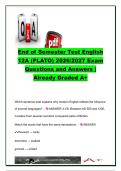
End of Semester Test English
12A (PLATO) 2026/2027 Exam
Questions and Answers |
Already Graded A+


Which sentence best explains why modern English reflects the influence

of several languages? - ANSWER ✔✔B. Between AD 500 and 1200,

invaders from several countries conquered parts of Britain.


Match the words that have the same denotations. - ANSWER

✔✔favored → lucky


drenched → soaked

grinned → smiled

,scoffed → mocked

elated → happy


What is the reason for the tragic end of the hero Beowulf? - ANSWER

✔✔B. hubris


Which three parts of this excerpt from Beowulf relate to a warrior code?


Beowulf answered, Ecgtheow's son:

"Grieve not, O wise one! for each it is better,

[His friend to avenge than with vehemence wail him;]

[Each of us must the end-day abide of]

His earthly existence; who is able accomplish


[Glory ere death!] [To battle-thane noble

Lifeless lying, 'tis at last most fitting.]

Arise, O king, [quick let us hasten

To look at the footprint of the kinsman of Grendel!]

, I promise thee this now: to his place he'll escape not, . . ." - ANSWER

✔✔His friend to avenge than with vehemence wail him;


Glory ere death!


& To battle-thane noble

Lifeless lying, 'tis at last most fitting.

What do these lines from Sir Gawain and the Green Knight reveal about

the character of Sir Gawain?


That no host under heaven is hardier of will,

Nor better brothers-in-arms where battle is joined;


I am the weakest, well I know, and of wit feeblest; - ANSWER ✔✔B.

He is modest.

Medieval romances abounded in archetypes. Most characters in

romances fit into a certain archetypal mold. Match the characters from

Sir Gawain and the Green Knight to the archetypes they represent. -

ANSWER ✔✔the trickster → Morgan Le Faye

3
COPYRIGHT©JOSHCLAY 2025/2026. YEAR PUBLISHED 2026. COMPANY REGISTRATION NUMBER: 619652435. TERMS OF USE. PRIVACY
STATEMENT. ALL RIGHTS RESERVED


Document information

Uploaded on
August 15, 2026
Number of pages
25
Written in
2026/2027
Type
Exam (elaborations)
Contains
Questions & answers
$18.99

Wrong document? Swap it for free Within 14 days of purchase and before downloading, you can choose a different document. You can simply spend the amount again.
Written by students who passed
Immediately available after payment
Read online or as PDF

Seller avatar
Reputation scores are based on the amount of documents a seller has sold for a fee and the reviews they have received for those documents. There are three levels: Bronze, Silver and Gold. The better the reputation, the more your can rely on the quality of the sellers work.
JOSHCLAY
3.5
(82)
Sold
383
Followers
16
Items
20324
Last sold
2 days ago


Why students choose Stuvia

Created by fellow students, verified by reviews

Quality you can trust: written by students who passed their tests and reviewed by others who've used these notes.

Didn't get what you expected? Choose another document

No worries! You can instantly pick a different document that better fits what you're looking for.

Pay as you like, start learning right away

No subscription, no commitments. Pay the way you're used to via credit card and download your PDF document instantly.

Student with book image

“Bought, downloaded, and aced it. It really can be that simple.”

Alisha Student

Working on your references?

Create accurate citations in APA, MLA and Harvard with our free citation generator.

Working on your references?

Frequently asked questions
