Page 1 of 53
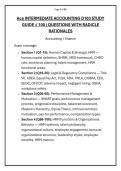
Ace INTERMEDIATE ACCOUNTING D103 STUDY
GUIDE :( 100 ) QUESTIONS WITH RADICLE
RATIONALES
Accounting / finance
Exam coverage:
• Section 1 (Q1-15): Human Capital & Strategic HRM —
human capital definition, SHRM, VRIO framework, CHRO
role, workforce planning, talent management, HRM
functional areas.
• Section 2 (Q16-35): Legal & Regulatory Compliance — Title
VII, ADEA, Equal Pay Act, FLSA, ADA, FMLA, COBRA, EEO,
EEOC, OFCCP, adverse impact, negligent hiring, OSHA,
workplace safety.
• Section 3 (Q36-65): Performance Management &
Motivation — SMART goals, performance management
process, progressive discipline, balanced scorecard,
Maslow's Hierarchy, Equity Theory, intrinsic/extrinsic
motivation, pay-for-performance, compensation types.
• Section 4 (Q66-100): HRM Functions & Organizational
Behavior — HRM systems, talent philosophy,
organizational culture, employee engagement, turnover,
organizational structure, leadership styles, employee
benefits, HRM metrics.
, Page 2 of 53
SECTION 1: THEORETICAL FRAMEWORK AND CONCEPTUAL
FOUNDATIONS (Questions 1–35)
1. Which of the following represents the primary objective of
financial reporting according to the FASB conceptual
framework?
• A. To provide information that is useful for making
investment and credit decisions
• B. To maximize the company's stock price and shareholder
value
• C. To ensure compliance with all tax regulations and
reporting requirements
• D. To provide information exclusively for internal
management use
• CORRECT: A. RATIONALE: The primary objective of
financial reporting is to provide financial information about
the reporting entity that is useful to existing and potential
investors, lenders, and other creditors in making decisions
about providing resources to the entity. This is established
in the FASB Conceptual Framework as the foundation for
all accounting standards.
2. Which of the following is a fundamental qualitative
characteristic of useful financial information?
• A. Comparability
, Page 3 of 53
• B. Relevance
• C. Timeliness
• D. Verifiability
• CORRECT: B. RATIONALE: The two fundamental
qualitative characteristics are relevance and faithful
representation. Comparability, verifiability, timeliness, and
understandability are enhancing qualitative
characteristics. Relevance means information is capable
of making a difference in a decision.
3. Which of the following best describes faithful
representation as a fundamental qualitative characteristic?
• A. Information that is available to decision-makers before it
loses its capacity to influence decisions
• B. Information that is complete, neutral, and free from
error
• C. Information that is capable of making a difference in a
decision
• D. Information that is confirmed by independent observers
• CORRECT: B. RATIONALE: Faithful representation
requires that financial information be complete (includes
all necessary information), neutral (unbiased), and free
from error (accurate). This ensures that the numbers and
descriptions represent what really existed or happened.
4. Which of the following describes the enhancing
qualitative characteristic of comparability?
, Page 4 of 53
• A. The ability to confirm information through independent
sources
• B. The ability to identify similarities and differences
between two sets of economic phenomena
• C. The ability to have information available in time to
influence decisions
• D. The ability to perceive the significance of financial
information
• CORRECT: B. RATIONALE: Comparability enables users to
identify and understand similarities and differences among
items. Consistency, a related concept, refers to the use of
the same methods for the same items from period to
period. Both are enhancing qualitative characteristics.
5. Which of the following is an assumption of the conceptual
framework?
• A. Fair value principle
• B. Revenue recognition principle
• C. Monetary unit assumption
• D. Full disclosure principle
• CORRECT: C. RATIONALE: The basic assumptions in
accounting include the monetary unit assumption,
periodicity assumption, going concern assumption, and
economic entity assumption. The monetary unit
assumption states that money is the common
denominator of economic activity and provides an
appropriate basis for accounting measurement.
Ace INTERMEDIATE ACCOUNTING D103 STUDY
GUIDE :( 100 ) QUESTIONS WITH RADICLE
RATIONALES
Accounting / finance
Exam coverage:
• Section 1 (Q1-15): Human Capital & Strategic HRM —
human capital definition, SHRM, VRIO framework, CHRO
role, workforce planning, talent management, HRM
functional areas.
• Section 2 (Q16-35): Legal & Regulatory Compliance — Title
VII, ADEA, Equal Pay Act, FLSA, ADA, FMLA, COBRA, EEO,
EEOC, OFCCP, adverse impact, negligent hiring, OSHA,
workplace safety.
• Section 3 (Q36-65): Performance Management &
Motivation — SMART goals, performance management
process, progressive discipline, balanced scorecard,
Maslow's Hierarchy, Equity Theory, intrinsic/extrinsic
motivation, pay-for-performance, compensation types.
• Section 4 (Q66-100): HRM Functions & Organizational
Behavior — HRM systems, talent philosophy,
organizational culture, employee engagement, turnover,
organizational structure, leadership styles, employee
benefits, HRM metrics.
, Page 2 of 53
SECTION 1: THEORETICAL FRAMEWORK AND CONCEPTUAL
FOUNDATIONS (Questions 1–35)
1. Which of the following represents the primary objective of
financial reporting according to the FASB conceptual
framework?
• A. To provide information that is useful for making
investment and credit decisions
• B. To maximize the company's stock price and shareholder
value
• C. To ensure compliance with all tax regulations and
reporting requirements
• D. To provide information exclusively for internal
management use
• CORRECT: A. RATIONALE: The primary objective of
financial reporting is to provide financial information about
the reporting entity that is useful to existing and potential
investors, lenders, and other creditors in making decisions
about providing resources to the entity. This is established
in the FASB Conceptual Framework as the foundation for
all accounting standards.
2. Which of the following is a fundamental qualitative
characteristic of useful financial information?
• A. Comparability
, Page 3 of 53
• B. Relevance
• C. Timeliness
• D. Verifiability
• CORRECT: B. RATIONALE: The two fundamental
qualitative characteristics are relevance and faithful
representation. Comparability, verifiability, timeliness, and
understandability are enhancing qualitative
characteristics. Relevance means information is capable
of making a difference in a decision.
3. Which of the following best describes faithful
representation as a fundamental qualitative characteristic?
• A. Information that is available to decision-makers before it
loses its capacity to influence decisions
• B. Information that is complete, neutral, and free from
error
• C. Information that is capable of making a difference in a
decision
• D. Information that is confirmed by independent observers
• CORRECT: B. RATIONALE: Faithful representation
requires that financial information be complete (includes
all necessary information), neutral (unbiased), and free
from error (accurate). This ensures that the numbers and
descriptions represent what really existed or happened.
4. Which of the following describes the enhancing
qualitative characteristic of comparability?
, Page 4 of 53
• A. The ability to confirm information through independent
sources
• B. The ability to identify similarities and differences
between two sets of economic phenomena
• C. The ability to have information available in time to
influence decisions
• D. The ability to perceive the significance of financial
information
• CORRECT: B. RATIONALE: Comparability enables users to
identify and understand similarities and differences among
items. Consistency, a related concept, refers to the use of
the same methods for the same items from period to
period. Both are enhancing qualitative characteristics.
5. Which of the following is an assumption of the conceptual
framework?
• A. Fair value principle
• B. Revenue recognition principle
• C. Monetary unit assumption
• D. Full disclosure principle
• CORRECT: C. RATIONALE: The basic assumptions in
accounting include the monetary unit assumption,
periodicity assumption, going concern assumption, and
economic entity assumption. The monetary unit
assumption states that money is the common
denominator of economic activity and provides an
appropriate basis for accounting measurement.