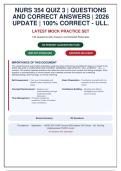
NURS 354 QUIZ 3 | QUESTIONS
AND CORRECT ANSWERS | 2026
UPDATE | 100% CORRECT - ULL.
LATEST MOCK PRACTICE SET
130 Questions with Answers and Detailed Rationales
100 PERCENT GUARANTEED PASS
INSTANT DOWNLOAD ANSWERS INCLUDED
IMPORTANCE OF THIS DOCUMENT
This comprehensive examination preparation guide has been meticulously developed to help you succeed in the
NURS 354 QUIZ 3 | QUESTIONS AND CORRECT ANSWERS | 2026 UPDATE | 100% CORRECT - ULL.. It
contains 130 carefully selected questions that reflect the most current exam content and testing strategies. Each
question is accompanied by a correct answer and a detailed rationale that explains the underlying
pathophysiology, pharmacology, or clinical reasoning.
Self-Assessment – Test your knowledge and Exam Preparation – Familiarize yourself with the
identify areas requiring further question format and content
study areas
Concept Reinforcement – Deepen your Confidence Building – Develop test-taking
understanding through strategies and reduce
evidence-based exam anxiety
rationales
Time Management – Practice answering
questions under simulated
exam conditions
Review Summary 130 Questions
Foundations - Application - NURS 354 3 AND Correct 2026 Update 100 Correct - ULL Nursing
Undergraduate YEAR 3 Junior
All answers with rationales
,Table of Contents
Content Area Questions Key Topics
Health Promotion AND 1-22 Prescribed, Laboratory, Finding, Mechanism, Indicates
Maintenance
Psychosocial Integrity 23-44 Finding, Prescribed, Receiving, Indicates, Warfarin
Basic CARE AND Comfort 45-66 Prescribed, Finding, Requires, Appropriate, Adverse Effect
Pharmacological Therapies 67-88 Prescribed, Acute, Receiving, Finding, Disease
Reduction OF RISK Potential 89-110 Prescribed, Medication, Finding, Blood, Weeks Gestation
Physiological Adaptation 111-130 Indicates, Prescribed, Teaching, Model, Further
TOTAL 130 All questions include answers and detailed rationales
,Section A - Health Promotion AND Maintenance
Q1.
A patient with heart failure is prescribed both an ACE inhibitor and a potassium-sparing
diuretic. Which laboratory finding would most warrant withholding the next dose of the
ACE inhibitor?
A. Serum potassium 5.8 mEq/L B. Serum creatinine 1.2 mg/dL
C. Blood urea nitrogen 20 mg/dL D. Serum sodium 135 mEq/L
Correct: A - Serum potassium 5.8 mEq/L
Rationale:Hyperkalemia (K+ >5.5 mEq/L) is a contraindication to ACE inhibitors due to risk of
arrhythmias. The other values are within normal limits and do not require withholding.
Q2.
A patient with type 2 diabetes is started on metformin. Which mechanism of action
distinguishes metformin from sulfonylureas?
A. It increases insulin secretion from B. It decreases hepatic glucose production
pancreatic beta cells. and improves insulin sensitivity.
C. It delays carbohydrate absorption from D. It activates PPAR-gamma receptors in
the gastrointestinal tract. adipose tissue.
Correct: B - It decreases hepatic glucose production and improves insulin sensitivity.
Rationale:Metformin primarily reduces hepatic gluconeogenesis and enhances peripheral
insulin sensitivity. Sulfonylureas stimulate insulin release; alpha-glucosidase inhibitors delay
carbohydrate absorption; thiazolidinediones activate PPAR-gamma.
Q3.
A patient with severe sepsis is prescribed norepinephrine. Which assessment finding
indicates the desired therapeutic effect?
A. Decreased heart rate B. Increased mean arterial pressure (MAP)
65 mm Hg
C. Decreased central venous pressure D. Increased urine output to >100 mL/hr
Correct: B - Increased mean arterial pressure (MAP) 65 mm Hg
Rationale:Norepinephrine is a vasopressor used to maintain MAP "e65 mm Hg in septic
shock. It may cause reflex bradycardia but the target is MAP improvement. Urine output is a
secondary indicator not the direct effect.
Page 3
, Section A - Health Promotion AND Maintenance
Q4.
Which laboratory value is most indicative of acute kidney injury (AKI) in a patient
receiving vancomycin and piperacillin-tazobactam?
A. Serum creatinine rise of 0.3 mg/dL within B. Blood urea nitrogen to creatinine ratio of
48 hours 20:1
C. Urine specific gravity of 1.010 D. Fractional excretion of sodium less than
1%
Correct: A - Serum creatinine rise of 0.3 mg/dL within 48 hours
Rationale:The KDIGO criteria define AKI as an increase in SCr "e0.3 mg/dL within 48 hours. A
BUN:Cr ratio of 20:1 suggests prerenal azotemia, not necessarily AKI. Urine specific gravity
and FENa are supportive but not diagnostic alone.
Q5.
A patient is prescribed enoxaparin 1 mg/kg every 12 hours. Which laboratory test should
be monitored to assess for excessive anticoagulation?
A. Activated partial thromboplastin time B. Prothrombin time (PT/INR)
(aPTT)
C. Anti-factor Xa assay D. Thrombin time
Correct: C - Anti-factor Xa assay
Rationale:Enoxaparin is a low-molecular-weight heparin that primarily inhibits factor Xa;
anti-Xa levels are used to monitor its effect. aPTT and PT/INR are for unfractionated heparin
and warfarin, respectively. Thrombin time is less specific.
Q6.
A patient with chronic obstructive pulmonary disease (COPD) is prescribed tiotropium.
Which statement best explains its bronchodilator mechanism?
A. It stimulates beta-2 adrenergic receptors B. It blocks muscarinic receptors, reducing
in bronchial smooth muscle. cholinergic bronchoconstriction.
C. It inhibits phosphodiesterase-4, reducing D. It stabilizes mast cells, preventing
inflammation. histamine release.
Correct: B - It blocks muscarinic receptors, reducing cholinergic bronchoconstriction.
Rationale:Tiotropium is a long-acting muscarinic antagonist (LAMA) that blocks acetylcholine
at M3 receptors, reducing bronchoconstriction. Beta-2 agonists stimulate receptors; PDE4
inhibitors are roflumilast; mast cell stabilizers are cromolyn.
Page 4
AND CORRECT ANSWERS | 2026
UPDATE | 100% CORRECT - ULL.
LATEST MOCK PRACTICE SET
130 Questions with Answers and Detailed Rationales
100 PERCENT GUARANTEED PASS
INSTANT DOWNLOAD ANSWERS INCLUDED
IMPORTANCE OF THIS DOCUMENT
This comprehensive examination preparation guide has been meticulously developed to help you succeed in the
NURS 354 QUIZ 3 | QUESTIONS AND CORRECT ANSWERS | 2026 UPDATE | 100% CORRECT - ULL.. It
contains 130 carefully selected questions that reflect the most current exam content and testing strategies. Each
question is accompanied by a correct answer and a detailed rationale that explains the underlying
pathophysiology, pharmacology, or clinical reasoning.
Self-Assessment – Test your knowledge and Exam Preparation – Familiarize yourself with the
identify areas requiring further question format and content
study areas
Concept Reinforcement – Deepen your Confidence Building – Develop test-taking
understanding through strategies and reduce
evidence-based exam anxiety
rationales
Time Management – Practice answering
questions under simulated
exam conditions
Review Summary 130 Questions
Foundations - Application - NURS 354 3 AND Correct 2026 Update 100 Correct - ULL Nursing
Undergraduate YEAR 3 Junior
All answers with rationales
,Table of Contents
Content Area Questions Key Topics
Health Promotion AND 1-22 Prescribed, Laboratory, Finding, Mechanism, Indicates
Maintenance
Psychosocial Integrity 23-44 Finding, Prescribed, Receiving, Indicates, Warfarin
Basic CARE AND Comfort 45-66 Prescribed, Finding, Requires, Appropriate, Adverse Effect
Pharmacological Therapies 67-88 Prescribed, Acute, Receiving, Finding, Disease
Reduction OF RISK Potential 89-110 Prescribed, Medication, Finding, Blood, Weeks Gestation
Physiological Adaptation 111-130 Indicates, Prescribed, Teaching, Model, Further
TOTAL 130 All questions include answers and detailed rationales
,Section A - Health Promotion AND Maintenance
Q1.
A patient with heart failure is prescribed both an ACE inhibitor and a potassium-sparing
diuretic. Which laboratory finding would most warrant withholding the next dose of the
ACE inhibitor?
A. Serum potassium 5.8 mEq/L B. Serum creatinine 1.2 mg/dL
C. Blood urea nitrogen 20 mg/dL D. Serum sodium 135 mEq/L
Correct: A - Serum potassium 5.8 mEq/L
Rationale:Hyperkalemia (K+ >5.5 mEq/L) is a contraindication to ACE inhibitors due to risk of
arrhythmias. The other values are within normal limits and do not require withholding.
Q2.
A patient with type 2 diabetes is started on metformin. Which mechanism of action
distinguishes metformin from sulfonylureas?
A. It increases insulin secretion from B. It decreases hepatic glucose production
pancreatic beta cells. and improves insulin sensitivity.
C. It delays carbohydrate absorption from D. It activates PPAR-gamma receptors in
the gastrointestinal tract. adipose tissue.
Correct: B - It decreases hepatic glucose production and improves insulin sensitivity.
Rationale:Metformin primarily reduces hepatic gluconeogenesis and enhances peripheral
insulin sensitivity. Sulfonylureas stimulate insulin release; alpha-glucosidase inhibitors delay
carbohydrate absorption; thiazolidinediones activate PPAR-gamma.
Q3.
A patient with severe sepsis is prescribed norepinephrine. Which assessment finding
indicates the desired therapeutic effect?
A. Decreased heart rate B. Increased mean arterial pressure (MAP)
65 mm Hg
C. Decreased central venous pressure D. Increased urine output to >100 mL/hr
Correct: B - Increased mean arterial pressure (MAP) 65 mm Hg
Rationale:Norepinephrine is a vasopressor used to maintain MAP "e65 mm Hg in septic
shock. It may cause reflex bradycardia but the target is MAP improvement. Urine output is a
secondary indicator not the direct effect.
Page 3
, Section A - Health Promotion AND Maintenance
Q4.
Which laboratory value is most indicative of acute kidney injury (AKI) in a patient
receiving vancomycin and piperacillin-tazobactam?
A. Serum creatinine rise of 0.3 mg/dL within B. Blood urea nitrogen to creatinine ratio of
48 hours 20:1
C. Urine specific gravity of 1.010 D. Fractional excretion of sodium less than
1%
Correct: A - Serum creatinine rise of 0.3 mg/dL within 48 hours
Rationale:The KDIGO criteria define AKI as an increase in SCr "e0.3 mg/dL within 48 hours. A
BUN:Cr ratio of 20:1 suggests prerenal azotemia, not necessarily AKI. Urine specific gravity
and FENa are supportive but not diagnostic alone.
Q5.
A patient is prescribed enoxaparin 1 mg/kg every 12 hours. Which laboratory test should
be monitored to assess for excessive anticoagulation?
A. Activated partial thromboplastin time B. Prothrombin time (PT/INR)
(aPTT)
C. Anti-factor Xa assay D. Thrombin time
Correct: C - Anti-factor Xa assay
Rationale:Enoxaparin is a low-molecular-weight heparin that primarily inhibits factor Xa;
anti-Xa levels are used to monitor its effect. aPTT and PT/INR are for unfractionated heparin
and warfarin, respectively. Thrombin time is less specific.
Q6.
A patient with chronic obstructive pulmonary disease (COPD) is prescribed tiotropium.
Which statement best explains its bronchodilator mechanism?
A. It stimulates beta-2 adrenergic receptors B. It blocks muscarinic receptors, reducing
in bronchial smooth muscle. cholinergic bronchoconstriction.
C. It inhibits phosphodiesterase-4, reducing D. It stabilizes mast cells, preventing
inflammation. histamine release.
Correct: B - It blocks muscarinic receptors, reducing cholinergic bronchoconstriction.
Rationale:Tiotropium is a long-acting muscarinic antagonist (LAMA) that blocks acetylcholine
at M3 receptors, reducing bronchoconstriction. Beta-2 agonists stimulate receptors; PDE4
inhibitors are roflumilast; mast cell stabilizers are cromolyn.
Page 4