

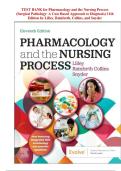
Test Bank for Pharmacology and the Nursing Process by Lilley, Rainforth Collins & Snyder – Product Description
Test Bank for Pharmacology and the Nursing Process by Lilley, Rainforth Collins & Snyder – Product Description The Test Bank for Pharmacology and the Nursing Process by Lilley, Rainforth Collins, and Snyder is a comprehensive study companion designed to help nursing students strengthen their understanding of pharmacology concepts through structured practice questions and clinically focused review. Pharmacology is one of the most challenging subjects in nursing education because it requires students to understand medication classifications, mechanisms of action, therapeutic uses, nursing considerations, patient education, dosage principles, and safe medication administration. This resource provides an organized way to reinforce classroom learning and prepare for quizzes, exams, and clinical practice. Built around the core concepts presented in Pharmacology and the Nursing Process, this study resource emphasizes applying pharmacology knowledge to realistic nursing scenarios rather than relying solely on memorization. Students can review important medication principles while developing the critical-thinking skills needed to make safe and effective nursing decisions in a variety of healthcare settings. One of the greatest challenges in pharmacology is understanding how medications affect the human body. This resource helps learners review essential concepts related to pharmacokinetics, pharmacodynamics, drug absorption, distribution, metabolism, and excretion. Understanding these foundational principles makes it easier to recognize why medications produce therapeutic effects, how individual patient factors influence medication responses, and why nurses must carefully monitor for desired outcomes and potential complications. The material also reinforces the nursing process as it relates to medication administration. Students can review assessment, nursing diagnoses, planning, implementation, and evaluation while connecting each step to safe medication practices. Rather than viewing medications as isolated facts, learners can appreciate how pharmacology fits into comprehensive patient-centered nursing care. Medication safety remains a central focus throughout nursing education, and this resource helps reinforce essential safety principles. Students can review topics such as medication rights, dosage accuracy, documentation, patient identification, monitoring, adverse reactions, contraindications, precautions, and patient education. Developing confidence in medication safety can help students prepare for both classroom assessments and supervised clinical experiences. The resource covers numerous medication classifications commonly encountered in nursing programs. Learners can strengthen their understanding of cardiovascular medications, respiratory drugs, endocrine agents, gastrointestinal medications, neurological medications, psychiatric medications, antimicrobial agents, pain management medications, and many other therapeutic categories. Reviewing these classifications together helps students recognize similarities, differences, and common nursing considerations across drug groups. Patient education is another important component of medication administration. Nurses frequently explain medication purposes, administration instructions, potential side effects, lifestyle considerations, and adherence strategies. This study resource highlights the importance of communicating medication information clearly while considering individual patient needs, health literacy, and cultural factors. Clinical application is one of the most valuable aspects of pharmacology education. Rather than memorizing long lists of medications, students benefit from practicing how to prioritize nursing interventions, interpret patient assessment findings, recognize medication-related problems, and identify appropriate nursing responses. Scenario-based practice encourages learners to apply knowledge in ways that resemble clinical decision-making. The resource also supports understanding of dosage calculations and medication administration principles. Accurate calculations are essential for safe nursing practice, particularly when administering medications to pediatric, adult, and older adult populations. Reviewing calculation concepts alongside pharmacology principles can help reinforce safe medication practices during nursing education. Another important topic is adverse drug reactions and medication monitoring. Students can review how nurses observe therapeutic effects, recognize unexpected patient responses, identify potential complications, and communicate important findings to the healthcare team. Understanding the relationship between assessment and medication monitoring strengthens clinical reasoning and patient safety awareness. Special population considerations are also important. Medication responses may differ among children, pregnant patients, older adults, and individuals with chronic health conditions. Learners can review why dosage adjustments, monitoring requirements, and patient education strategies may vary depending on the individual's circumstances. This resource can be particularly valuable for students preparing for nursing school examinations, pharmacology quizzes, cumulative assessments, and NCLEX-style practice. Pharmacology questions often require application of clinical judgment rather than simple recall. Practicing medication-related questions helps students become more comfortable interpreting clinical scenarios, identifying priorities, and selecting appropriate nursing actions. For nursing instructors and educators, structured practice questions can complement classroom instruction by encouraging active learning and reinforcing important pharmacology concepts. Students may also find the material helpful for independent study, group review sessions, and organized exam preparation. The content encourages learners to build confidence gradually by reviewing medication concepts systematically. Instead of attempting to memorize every medication individually, students can focus on recognizing drug classifications, common nursing considerations, patient education priorities, monitoring responsibilities, and safe administration practices. This organized approach can make pharmacology more manageable and easier to retain throughout nursing school. Whether studying for weekly quizzes, midterm examinations, final assessments, or clinical preparation, this pharmacology study companion provides a structured review experience that supports nursing education. It serves as a useful supplement to lectures, official textbooks, instructor guidance, and current evidence-based nursing practice. It is important to remember that this resource is intended for educational and study purposes. It should complement—not replace—the official Pharmacology and the Nursing Process textbook, instructor materials, institutional policies, and current clinical guidelines. Medication administration decisions should always be based on qualified professional judgment, current evidence, and patient-specific circumstances. Key Benefits Comprehensive pharmacology study companion for nursing students Reinforces pharmacology concepts through structured practice Connects medication knowledge with the nursing process Reviews pharmacokinetics and pharmacodynamics Covers major medication classifications Supports medication safety principles Reinforces dosage calculation concepts Highlights adverse drug reactions and monitoring Includes patient education and nursing intervention concepts Encourages clinical reasoning and application Helpful for nursing coursework and independent study Supports NCLEX-style pharmacology preparation Useful for quizzes, exams, and clinical review Complements official textbook learning
Document information
- Uploaded on
- August 14, 2026
- Number of pages
- 337
- Written in
- 2026/2027
- Type
- Exam (elaborations)
- Contains
- Questions & answers


