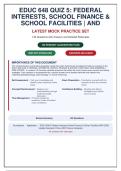
EDUC 648 QUIZ 5: FEDERAL
INTERESTS, SCHOOL FINANCE &
SCHOOL FACILITIES | AND
LATEST MOCK PRACTICE SET
140 Questions with Answers and Detailed Rationales
100 PERCENT GUARANTEED PASS
INSTANT DOWNLOAD ANSWERS INCLUDED
IMPORTANCE OF THIS DOCUMENT
This comprehensive examination preparation guide has been meticulously developed to help you succeed in the
EDUC 648 QUIZ 5: FEDERAL INTERESTS, SCHOOL FINANCE & SCHOOL FACILITIES | AND ANSWERS |
2026 UPDATE.. It contains 140 carefully selected questions that reflect the most current exam content and testing
strategies. Each question is accompanied by a correct answer and a detailed rationale that explains the
underlying pathophysiology, pharmacology, or clinical reasoning.
Self-Assessment – Test your knowledge and Exam Preparation – Familiarize yourself with the
identify areas requiring further question format and content
study areas
Concept Reinforcement – Deepen your Confidence Building – Develop test-taking
understanding through strategies and reduce
evidence-based exam anxiety
rationales
Time Management – Practice answering
questions under simulated
exam conditions
Review Summary 140 Questions
Foundations - Application - EDUC 648 5 Federal Interests School Finance & School Facilities AND 2026
Update Education Policy AND Finance Graduate
All answers with rationales
,Table of Contents
Content Area Questions Key Topics
Federal ROLE IN Education 1-24 School, District, State, Funding, Federal
Federal Education 25-48 State, School, Federal, District, Funds
Legislation AND Policy
School Finance Sources AND 49-72 School, State, District, Federal, Funding
Distribution
Equity AND Adequacy IN 73-96 School, District, State, Funding, Formula
School Funding
School Facilities Planning 97-120 State, School, Federal, Funding, District
AND Maintenance
Facilities AND Student 121-140 Federal, School, State, District, Funding
Achievement
TOTAL 140 All questions include answers and detailed rationales
,Section A - Federal ROLE IN Education
Q1.
In a state where the foundation formula guarantees a base per-pupil amount, a district
with high property wealth receives a lower state aid payment than a low-wealth district.
Which fiscal principle does this differential most directly illustrate?
A. Adequacy B. Vertical equity
C. Wealth neutrality D. Cost-effectiveness
Correct: C - Wealth neutrality
Rationale:Wealth neutrality requires that the quality of a student's education should not
depend on the property wealth of their district. The foundation formula with higher aid to
low-wealth districts directly equalizes fiscal capacity, illustrating wealth neutrality. Adequacy
relates to absolute funding levels, vertical equity to different needs, and cost-effectiveness to
efficient use of funds.
Q2.
A state is considering a weighted student funding formula. Which weights would best
reflect current research on cost differentials?
A. Higher weight for English learners and B. Equal weight for all categories to ensure
low-income students, lower for gifted horizontal equity
C. Higher weight for students in affluent D. Weight based solely on prior-year test
suburbs, lower for urban poor scores
Correct: A - Higher weight for English learners and low-income students, lower for gifted
Rationale:Research shows that English learners and low-income students require additional
resources to achieve the same educational outcomes, justifying higher weights. Equal
weights ignore differential needs, affluent weights are inequitable, and test-score weights are
unstable and misaligned with needs.
Q3.
A school district plans to issue bonds for a new facility. Which combination of federal tax
law and local referendum requirements is most likely to affect the bond's feasibility?
A. Tax-exempt status requires voter B. Federal law prohibits voter approval, but
approval in most states, and arbitrage rules mandates green building standards.
limit investment returns.
C. Bonds are always taxable, and no local D. The federal government directly funds all
approval is needed. school construction, bypassing local bonds.
Page 3
, Section A - Federal ROLE IN Education
Correct: A - Tax-exempt status requires voter approval in most states, and arbitrage rules
limit investment returns.
Rationale:Municipal bonds for school facilities are typically tax-exempt, but many states
require voter approval for issuance. Arbitrage rules under federal tax law restrict how bond
proceeds can be invested. Federal law does not prohibit voter approval, bonds can be taxable
or tax-exempt, and the federal government does not directly fund all construction.
Q4.
In a state school finance system, a district's revenue cap is set as a fixed percentage of its
property tax base. Which of the following is the most likely consequence of this cap?
A. It ensures equal spending across all B. It perpetuates disparities because
districts. high-wealth districts can raise more revenue
at the same tax rate.
C. It encourages districts to increase tax D. It eliminates the need for state
rates to maximize state aid. equalization aid.
Correct: B - It perpetuates disparities because high-wealth districts can raise more
revenue at the same tax rate.
Rationale:A cap tied to property tax base means that districts with a larger base can raise
more revenue even at the same rate, thus perpetuating disparities. It does not ensure equal
spending, it does not incentivize rate increases (since revenue is capped), and it does not
eliminate the need for equalization aid.
Q5.
Which of the following best describes the federal role in school facility funding under
current law?
A. The federal government provides B. The federal government primarily
substantial direct funding for school influences facilities through tax policy and
construction. targeted grants like Impact Aid.
C. The federal government has no role in D. The federal government mandates
school facilities. specific building codes for all schools.
Correct: B - The federal government primarily influences facilities through tax policy and
targeted grants like Impact Aid.
Rationale:Federal involvement in school facilities is indirect, through tax-exempt bond
financing and programs like Impact Aid that assist districts with federal property. No
substantial direct construction funding exists, and the federal government does not mandate
building codes (state and local do).
Page 4
INTERESTS, SCHOOL FINANCE &
SCHOOL FACILITIES | AND
LATEST MOCK PRACTICE SET
140 Questions with Answers and Detailed Rationales
100 PERCENT GUARANTEED PASS
INSTANT DOWNLOAD ANSWERS INCLUDED
IMPORTANCE OF THIS DOCUMENT
This comprehensive examination preparation guide has been meticulously developed to help you succeed in the
EDUC 648 QUIZ 5: FEDERAL INTERESTS, SCHOOL FINANCE & SCHOOL FACILITIES | AND ANSWERS |
2026 UPDATE.. It contains 140 carefully selected questions that reflect the most current exam content and testing
strategies. Each question is accompanied by a correct answer and a detailed rationale that explains the
underlying pathophysiology, pharmacology, or clinical reasoning.
Self-Assessment – Test your knowledge and Exam Preparation – Familiarize yourself with the
identify areas requiring further question format and content
study areas
Concept Reinforcement – Deepen your Confidence Building – Develop test-taking
understanding through strategies and reduce
evidence-based exam anxiety
rationales
Time Management – Practice answering
questions under simulated
exam conditions
Review Summary 140 Questions
Foundations - Application - EDUC 648 5 Federal Interests School Finance & School Facilities AND 2026
Update Education Policy AND Finance Graduate
All answers with rationales
,Table of Contents
Content Area Questions Key Topics
Federal ROLE IN Education 1-24 School, District, State, Funding, Federal
Federal Education 25-48 State, School, Federal, District, Funds
Legislation AND Policy
School Finance Sources AND 49-72 School, State, District, Federal, Funding
Distribution
Equity AND Adequacy IN 73-96 School, District, State, Funding, Formula
School Funding
School Facilities Planning 97-120 State, School, Federal, Funding, District
AND Maintenance
Facilities AND Student 121-140 Federal, School, State, District, Funding
Achievement
TOTAL 140 All questions include answers and detailed rationales
,Section A - Federal ROLE IN Education
Q1.
In a state where the foundation formula guarantees a base per-pupil amount, a district
with high property wealth receives a lower state aid payment than a low-wealth district.
Which fiscal principle does this differential most directly illustrate?
A. Adequacy B. Vertical equity
C. Wealth neutrality D. Cost-effectiveness
Correct: C - Wealth neutrality
Rationale:Wealth neutrality requires that the quality of a student's education should not
depend on the property wealth of their district. The foundation formula with higher aid to
low-wealth districts directly equalizes fiscal capacity, illustrating wealth neutrality. Adequacy
relates to absolute funding levels, vertical equity to different needs, and cost-effectiveness to
efficient use of funds.
Q2.
A state is considering a weighted student funding formula. Which weights would best
reflect current research on cost differentials?
A. Higher weight for English learners and B. Equal weight for all categories to ensure
low-income students, lower for gifted horizontal equity
C. Higher weight for students in affluent D. Weight based solely on prior-year test
suburbs, lower for urban poor scores
Correct: A - Higher weight for English learners and low-income students, lower for gifted
Rationale:Research shows that English learners and low-income students require additional
resources to achieve the same educational outcomes, justifying higher weights. Equal
weights ignore differential needs, affluent weights are inequitable, and test-score weights are
unstable and misaligned with needs.
Q3.
A school district plans to issue bonds for a new facility. Which combination of federal tax
law and local referendum requirements is most likely to affect the bond's feasibility?
A. Tax-exempt status requires voter B. Federal law prohibits voter approval, but
approval in most states, and arbitrage rules mandates green building standards.
limit investment returns.
C. Bonds are always taxable, and no local D. The federal government directly funds all
approval is needed. school construction, bypassing local bonds.
Page 3
, Section A - Federal ROLE IN Education
Correct: A - Tax-exempt status requires voter approval in most states, and arbitrage rules
limit investment returns.
Rationale:Municipal bonds for school facilities are typically tax-exempt, but many states
require voter approval for issuance. Arbitrage rules under federal tax law restrict how bond
proceeds can be invested. Federal law does not prohibit voter approval, bonds can be taxable
or tax-exempt, and the federal government does not directly fund all construction.
Q4.
In a state school finance system, a district's revenue cap is set as a fixed percentage of its
property tax base. Which of the following is the most likely consequence of this cap?
A. It ensures equal spending across all B. It perpetuates disparities because
districts. high-wealth districts can raise more revenue
at the same tax rate.
C. It encourages districts to increase tax D. It eliminates the need for state
rates to maximize state aid. equalization aid.
Correct: B - It perpetuates disparities because high-wealth districts can raise more
revenue at the same tax rate.
Rationale:A cap tied to property tax base means that districts with a larger base can raise
more revenue even at the same rate, thus perpetuating disparities. It does not ensure equal
spending, it does not incentivize rate increases (since revenue is capped), and it does not
eliminate the need for equalization aid.
Q5.
Which of the following best describes the federal role in school facility funding under
current law?
A. The federal government provides B. The federal government primarily
substantial direct funding for school influences facilities through tax policy and
construction. targeted grants like Impact Aid.
C. The federal government has no role in D. The federal government mandates
school facilities. specific building codes for all schools.
Correct: B - The federal government primarily influences facilities through tax policy and
targeted grants like Impact Aid.
Rationale:Federal involvement in school facilities is indirect, through tax-exempt bond
financing and programs like Impact Aid that assist districts with federal property. No
substantial direct construction funding exists, and the federal government does not mandate
building codes (state and local do).
Page 4