

Written by students who passed Immediately available after payment Read online or as PDF Wrong document? Swap it for free 4.6 TrustPilot
logo-home
Document preview thumbnail
Preview 2 out of 13 pages
Exam (elaborations)

CALT Exam 2026/2027 Questions & Answers | 100+ Questions | Dyslexia, Phonics, Phonology, Language Domains & Reading Development

Document preview thumbnail
Preview 2 out of 13 pages

This comprehensive CALT Exam 2026/2027 study resource contains 100+ exam-focused questions, definitions, and answers designed to support preparation for Certified Academic Language Therapist–related coursework and assessment. The material provides detailed coverage of alphabetic language and the alphabetic principle, analytic and synthetic phonics, auditory discrimination, decoding and encoding, graphemes, phonemes, phonemic awareness, phonological awareness, phonetics, phonology, orthography, morphology, semantics, syntax, pragmatics, structural analysis, sound-symbol correspondence, and rapid automatized naming (RAN). A major focus is structured literacy and the processes underlying effective reading and spelling instruction. The document distinguishes analytic from synthetic phonics, examines multisensory and kinesthetic approaches, and reviews irregular words, morphemes, prefixes, suffixes, diphthongs, trigraphs, quadrigraphs, schwa, voiced and unvoiced sounds, and English orthographic conventions. It also covers decoding as the use of sound-symbol relationships and structural analysis for reading unfamiliar words, while encoding is addressed in relation to spelling. The resource provides substantial coverage of language and literacy development. It reviews the domains of language—phonology, morphology, syntax, semantics, and pragmatics—along with receptive and expressive language and the progression from oral receptive language through speaking, reading, spelling, and writing. Jeanne Chall's reading-development framework is covered from Stage 0 pre-reading through Stage 5 construction and reconstruction, while spelling and written-language development are addressed from early prephonetic and imitation stages through increasingly sophisticated, personalized writing. Additional exam material addresses dyslexia-related terminology and associated language or learning conditions, including Samuel Orton's concept of strephosymbolia, dyscalculia, dysarthria, dyspraxia, apraxia, dysphasia, aphasia, alexia, echolalia, and otitis media. Concepts such as the Matthew Effect, metalinguistic awareness, compensatory approaches, Dolch high-frequency words, cross or mixed dominance, invented spelling, and the historical development of reading instruction are also included. This resource is most relevant for CALT candidates, Academic Language Therapists, dyslexia therapists, structured literacy practitioners, reading specialists, literacy interventionists, special education teachers, elementary educators, educational diagnosticians, and students studying reading science, literacy education, special education, language development, dyslexia intervention, or related fields. It can be used for exam review, terminology reinforcement, concept recall, and focused practice across major literacy and language-development topics. The uploaded document does not identify a specific university or formal course code, so these details are marked as unspecified rather than inventing unsupported information. Keywords: CALT Exam 2026, CALT Exam 2027, CALT exam questions and answers, Certified Academic Language Therapist, CALT certification exam, CALT practice questions, CALT study guide, academic language therapy, dyslexia, dyslexia therapy, structured literacy, science of reading, alphabetic principle, analytic phonics, synthetic phonics, phonics instruction, phonological awareness, phonemic awareness, phonological processing, phonetics, phonology, graphemes, phonemes, decoding, encoding, sound symbol correspondence, orthography, morphology, semantics, syntax, pragmatics, language domains, receptive language, expressive language, rapid automatized naming, RAN, reading development, Chall reading stages, spelling development, writing development, structural analysis, dyscalculia, dysarthria, dyspraxia, apraxia, aphasia, alexia, Matthew Effect, multisensory reading instruction, reading intervention

Content preview

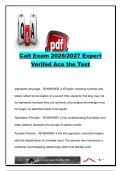
Calt Exam 2026/2027 Expert
Verifed Ace the Test


alphabetic language - ANSWER ✔✔English; meaning symbols and

letters reflect pronunciation of a sound; ESL students' first lang may not

be alphabetic because they use symbols; phonological knowledge must

be taught, so alphabet needs to be taught


Alphabetic Principle - ANSWER ✔✔an understanding that letters and

letter patterns represent the sounds of spoken words.


Analytic Phonics - ANSWER ✔✔In this approach, instruction begins

with the identification of a familiar word. The teacher then introduces a

particular sound/spelling relationship within that familiar word

, Synthetic Phonics - ANSWER ✔✔In this systematic and explicit

approach, students learn to transform letters and letter combinations into

sounds and then the sounds together to form recognizable words. Teach

individual parts and build to whole


auditory discrimination - ANSWER ✔✔The ability to hear differences

in sounds


auditory span - ANSWER ✔✔the number of words, numbers, or

sounds a student can hold in his working memory. Can limit dictation or

note taking.


blend - ANSWER ✔✔two or more sounds that are frequently grouped

together- each sound can be separated into its individual components


cedilla - ANSWER ✔✔a diacritical mark (,) placed below the letter c

to indicate that it is pronounced as an s


circumflex - ANSWER ✔✔the code marked placed over vowels to

indicate an unusual pronunciation


compensatory approach - ANSWER ✔✔one does not attempt to

remediate the problem but instead recommends modifications within the

learning environment which allows the student to be successful

Document information

Uploaded on
August 14, 2026
Number of pages
13
Written in
2026/2027
Type
Exam (elaborations)
Contains
Questions & answers
$18.99

Wrong document? Swap it for free Within 14 days of purchase and before downloading, you can choose a different document. You can simply spend the amount again.
Written by students who passed
Immediately available after payment
Read online or as PDF

Seller avatar
Reputation scores are based on the amount of documents a seller has sold for a fee and the reviews they have received for those documents. There are three levels: Bronze, Silver and Gold. The better the reputation, the more your can rely on the quality of the sellers work.
NinjaNerd
3.4
(76)
Sold
401
Followers
6
Items
15349
Last sold
1 day ago


Why students choose Stuvia

Created by fellow students, verified by reviews

Quality you can trust: written by students who passed their tests and reviewed by others who've used these notes.

Didn't get what you expected? Choose another document

No worries! You can instantly pick a different document that better fits what you're looking for.

Pay as you like, start learning right away

No subscription, no commitments. Pay the way you're used to via credit card and download your PDF document instantly.

Student with book image

“Bought, downloaded, and aced it. It really can be that simple.”

Alisha Student

Working on your references?

Create accurate citations in APA, MLA and Harvard with our free citation generator.

Working on your references?

Frequently asked questions

