

Written by students who passed Immediately available after payment Read online or as PDF Wrong document? Swap it for free 4.6 TrustPilot
logo-home
Document preview thumbnail
Preview 2 out of 13 pages
Exam (elaborations)

HESI Health Assessment Exam V1 2026/2027 | 80+ Questions & Answers | Physical Assessment, Cardiac, Respiratory, Neurological, Abdominal & Musculoskeletal | HESI

Document preview thumbnail
Preview 2 out of 13 pages

This comprehensive HESI Health Assessment Exam V1 2026/2027 is a 13-page nursing exam-preparation resource containing 80+ questions and answers focused on essential health-assessment knowledge and clinical examination skills. The document covers head-to-toe assessment, inspection, palpation, percussion and auscultation, cardiovascular and peripheral vascular assessment, respiratory examination, neurological and cranial nerve testing, abdominal and genitourinary assessment, musculoskeletal examination, skin and breast assessment, nutrition, hearing and vision, mental-status assessment, pain evaluation, cultural competence and therapeutic communication. The first page explicitly identifies the resource as HESI Health Assessment Exam V1 Questions and Answers 2026/2027 and begins with assessment scenarios involving atelectasis, head-to-toe examination and abdominal aortic palpation. The general physical-assessment and health-history material reviews systematic head-to-toe examination, objective versus subjective findings, family medical history and techniques for improving the accuracy of patient interviews. Students practice recognizing appropriate nursing actions before abdominal examination, documenting physical appearance and posture as objective data, assessing a patient's self-perception of health and allowing adequate silence when a patient pauses during an interview. The questions emphasize combining patient history with physical findings rather than interpreting assessment data in isolation. A major section focuses on cardiovascular and peripheral vascular assessment. Students review auscultation for mitral stenosis and aortic regurgitation, identification of cardiac friction rubs, assessment of split S2, pulse deficits, orthostatic vital signs and peripheral edema associated with heart failure. The resource also addresses diminished peripheral circulation through findings such as cool skin and reduced leg hair. Lower-extremity edema assessment includes bilateral ankle-circumference measurement, while pulse-deficit assessment requires comparison of apical and peripheral pulses. The respiratory assessment content examines lung auscultation, percussion and thoracic inspection. Students review the dull percussion note associated with lower-lobe atelectasis, locations for hearing lower and middle-lobe lung sounds, pleural friction rub with painful inspiration, and the barrel-chest appearance associated with chronic asthma and pulmonary hyperinflation. Bronchitis assessment includes productive cough, phlegm and wheezing, while respiratory-rate interpretation includes recognition of bradypnea at 8 breaths per minute. The neurological, cranial nerve and mental-status material provides detailed review of clinically important assessment techniques. The document explains the Glasgow Coma Scale (GCS) as an assessment of eye opening, verbal response and motor response, with possible scores ranging from 3 to 15. Students review cranial nerve I through odor identification, cranial nerve VII through facial movement and cranial nerve VIII through the Weber and Rinne tests. Remote and short-term memory, Mini-Mental State Examination techniques and level-of-consciousness assessment are also included. The musculoskeletal examination section covers active and passive range of motion, the Thomas test, scoliosis screening, rotator-cuff assessment and related joint evaluation. Students distinguish positive and negative Thomas-test findings, review spinal observation while the patient is standing and bending forward, and recognize inability to slowly lower an abducted arm as an important finding associated with rotator-cuff dysfunction. The document also addresses age-related concerns such as height loss that may warrant evaluation for osteoporosis. Skin, breast and lymphatic assessment receive substantial attention. Questions cover skin hydration and turgor, diaphoresis, scaling, inflammation in dark skin, scabies, lentigines, lymphedema and Wood's lamp examination. Breast-assessment material includes fibroadenoma characteristics, axillary palpation and attention to the upper outer quadrant during breast self-awareness or examination. Post-mastectomy lymphedema is represented by unilateral arm swelling and non-pitting edema. The abdominal and genitourinary assessment material reviews palpation of the abdominal aorta, spleen examination, liver assessment, kidney palpation, bladder percussion, bowel sounds and visible peristalsis. Students encounter findings associated with urinary retention and questions on urinary incontinence in older adults. The resource also emphasizes correct preparation for abdominal assessment, including asking the patient to empty the bladder before examination. The resource integrates hearing, vision, mouth and pharyngeal assessment throughout its questions. Audiometry is identified as a reliable hearing assessment, while Weber and Rinne testing are connected with the vestibulocochlear nerve. Eye-assessment topics include cataracts, pupillary accommodation and abnormal ocular firmness. Oral and pharyngeal examination includes tongue-depressor technique and evaluation of the gag reflex. These topics make the document useful for students reviewing a complete head-to-toe assessment rather than a single body system. Another important component is cultural competence and patient-centered communication. Students review naturalistic beliefs about illness, culturally respectful interpretations of eye contact, appropriate use of professional interpreters and communication with patients experiencing hearing loss. One scenario specifically addresses respecting a Muslim male patient's request regarding examination by a female nurse. The document also includes alcohol-use assessment through the CAGE questionnaire and therapeutic questioning about drinking behavior. Nutrition and health-risk assessment are incorporated through 24-hour dietary recall, unexpected weight loss, vitamin and iron supplementation, waist circumference and chronic-disease risk. Additional questions connect clinical history with colon-cancer risk, hydration status and gout-related symptoms. Together, these items reinforce the nursing principle that health assessment incorporates physical findings, patient history, lifestyle factors and risk identification. Relevant students: This document is particularly relevant to nursing students preparing for the HESI Health Assessment Exam V1, including ADN, BSN and practical nursing students completing health-assessment or physical-assessment courses. It is especially useful for learners preparing for HESI-style questions involving head-to-toe assessment, cardiovascular and respiratory examination, cranial nerves, neurological assessment, abdominal examination, musculoskeletal tests, skin assessment, mental status, therapeutic communication and cultural competence. No university, college or nursing school is identified in the uploaded document, so an institution has not been invented for the title. The topics correspond broadly with standard nursing assessment references such as Carolyn Jarvis's Physical Examination & Health Assessment, which addresses health-history collection, cultural assessment, physical examination techniques and systematic assessment of major body systems. The document should nevertheless be treated as an exam-practice and active-recall resource, with individual answers verified against the student's current HESI materials, assigned health-assessment textbook and instructor guidance, particularly where examination techniques or clinical recommendations may differ. Keywords: HESI Health Assessment Exam V1, HESI Health Assessment 2026, HESI Health Assessment 2027, HESI Health Assessment questions and answers, HESI Health Assessment practice test, HESI nursing exam, HESI V1 questions, nursing health assessment, physical assessment nursing, head to toe assessment, health history nursing, inspection palpation percussion auscultation, cardiovascular assessment, cardiac auscultation, peripheral vascular assessment, pulse deficit, orthostatic vital signs, respiratory assessment, lung auscultation, lung percussion, atelectasis assessment, pleural friction rub, bradypnea, neurological assessment, cranial nerve assessment, Glasgow Coma Scale, GCS nursing, Weber test, Rinne test, MMSE, mental status examination, abdominal assessment, spleen assessment, liver assessment, kidney assessment, bladder percussion, musculoskeletal assessment, Thomas test, scoliosis assessment, rotator cuff assessment, skin assessment, breast assessment, lymphedema, hearing assessment, eye assessment, cultural competence nursing, CAGE questionnaire, therapeutic communication, nutritional assessment, HESI exam preparation

Content preview

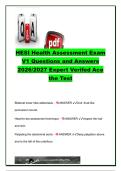
HESI Health Assessment Exam
V1 Questions and Answers
2026/2027 Expert Verifed Ace
the Test


Bilateral lower lobe atelectasis - ANSWER ✔✔Dull, thud-like

percussion sound.


Head-to-toe assessment technique - ANSWER ✔✔Inspect the hair

and skin.


Palpating the abdominal aorta - ANSWER ✔✔Deep palpation above

and to the left of the umbilicus.

, Family medical history documentation - ANSWER ✔✔Document at

least 3 generations of the client's family medical history.


Normal internal rotation of the shoulder - ANSWER ✔✔Range of 90

degrees when the hands are placed at the small of the back.


Objective examination for rash - ANSWER ✔✔Inspect the scalp

looking for nits.


Positive Thomas test - ANSWER ✔✔A flexion deformity when the

client cannot keep the thigh on the table.


Skin lesions assessment - ANSWER ✔✔Have you noticed any

irregular bleeding?


Communication with hearing loss client - ANSWER ✔✔Face the

client so the client can see the RN's mouth, check if the client's hearing

aids are working properly, reduce environmental noise surrounding the

client.


Lymphedema post-mastectomy - ANSWER ✔✔Swelling of the left

arm and non-pitting edema.


Orthostatic vital signs procedure - ANSWER ✔✔Position the client

lying.

Document information

Uploaded on
August 14, 2026
Number of pages
13
Written in
2026/2027
Type
Exam (elaborations)
Contains
Questions & answers
$18.99

Wrong document? Swap it for free Within 14 days of purchase and before downloading, you can choose a different document. You can simply spend the amount again.
Written by students who passed
Immediately available after payment
Read online or as PDF

Seller avatar
Reputation scores are based on the amount of documents a seller has sold for a fee and the reviews they have received for those documents. There are three levels: Bronze, Silver and Gold. The better the reputation, the more your can rely on the quality of the sellers work.
JOSHCLAY
3.5
(82)
Sold
383
Followers
16
Items
20324
Last sold
2 days ago


Why students choose Stuvia

Created by fellow students, verified by reviews

Quality you can trust: written by students who passed their tests and reviewed by others who've used these notes.

Didn't get what you expected? Choose another document

No worries! You can instantly pick a different document that better fits what you're looking for.

Pay as you like, start learning right away

No subscription, no commitments. Pay the way you're used to via credit card and download your PDF document instantly.

Student with book image

“Bought, downloaded, and aced it. It really can be that simple.”

Alisha Student

Working on your references?

Create accurate citations in APA, MLA and Harvard with our free citation generator.

Working on your references?

Frequently asked questions

