

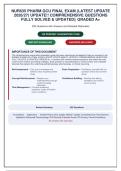
NUR635 PHARM GCU FINAL EXAM (LATEST UPDATE
2026/27) UPDATE!! COMPREHENSIVE QUESTIONS
FULLY SOLVED & UPDATED|| GRADED A+
230 Questions with Answers and Detailed Rationales
100 PERCENT GUARANTEED PASS
INSTANT DOWNLOAD ANSWERS INCLUDED
IMPORTANCE OF THIS DOCUMENT
This comprehensive examination preparation guide has been meticulously developed to help you succeed in the
NUR635 PHARM GCU FINAL EXAM (LATEST UPDATE 2026/27) UPDATE!! COMPREHENSIVE QUESTIONS
FULLY SOLVED & UPDATED|| GRADED A+. It contains 230 carefully selected questions that reflect the most
current exam content and testing strategies. Each question is accompanied by a correct answer and a detailed
rationale that explains the underlying pathophysiology, pharmacology, or clinical reasoning.
Self-Assessment – Test your knowledge and Exam Preparation – Familiarize yourself with the
identify areas requiring further question format and content
study areas
Concept Reinforcement – Deepen your Confidence Building – Develop test-taking
understanding through strategies and reduce
evidence-based exam anxiety
rationales
Time Management – Practice answering
questions under simulated
exam conditions
Review Summary 230 Questions
Foundations - Application - Nur635 Pharm GCU Update 2026/27 Update Comprehensive Fully Solved &
Updated A Advanced Pharmacology FOR Nursing Graduate Doctor OF Nursing / Nurse Practitioner
All answers with rationales
,Table of Contents
Content Area Questions Key Topics
Nur635 Pharm GCU Update 1-39 Therapy, Requires, Interaction, Likely, Chronic
2026/27 Update
Comprehensive Fully Solved
& Updated A Advanced
Pharmacology FOR Nursing
Graduate Doctor OF Nursing
/ Nurse Practitioner
Chronic 40-78 Prescribed, Requires, Effect, Medication, Started
Requires 79-117 Develops, Kidney, Started, Therapy, Phenytoin
Appropriate 118-156 Chronic, Interaction, Warfarin, Kidney, Develops
Prescribed 157-195 Effect, Chronic, Mechanism, Disease, Requires
Therapy 196-230 Develops, Mechanism, Pharmacologic, Likely, Explains
TOTAL 230 All questions include answers and detailed rationales
,Section A - Nur635 Pharm GCU Update 2026/27 Update
Comprehensive Fully Solved & Updated A Advanced
Pharmacology FOR Nursing Graduate Doctor OF Nursing /
Nurse Practitioner
Q1.
A patient on warfarin for mechanical heart valve requires antibiotic therapy. Which agent's
pharmacodynamic interaction with warfarin is most likely to cause an unpredictable rise in
INR due to inhibition of vitamin K-dependent clotting factor synthesis?
A. Ciprofloxacin B. Azithromycin
C. Cephalexin D. Clindamycin
Correct: A - Ciprofloxacin
Rationale:Ciprofloxacin inhibits CYP1A2 and also disrupts gut flora, reducing vitamin K
synthesis, which potentiates warfarin's anticoagulant effect. Azithromycin has minimal CYP
inhibition, cephalexin rarely affects INR, and clindamycin's interaction is less predictable.
Q2.
A patient with chronic kidney disease (eGFR 25 mL/min) and type 2 diabetes needs an
antihyperglycemic agent. Which medication's dose must be reduced by 50% when eGFR
is below 30 mL/min due to its renal clearance?
A. Metformin B. Sitagliptin
C. Empagliflozin D. Pioglitazone
Correct: B - Sitagliptin
Rationale:Sitagliptin is renally cleared and requires dose adjustment at eGFR <30. Metformin
is contraindicated below 30, empagliflozin is not recommended below 30, and pioglitazone is
hepatically metabolized with no renal adjustment.
Q3.
Which pharmacogenetic variant significantly increases the risk of severe
myelosuppression with azathioprine due to reduced enzyme activity that inactivates the
drug's active metabolite?
A. CYP2D6 poor metabolizer B. TPMT low activity
C. CYP2C19 ultrarapid metabolizer D. UGT1A1*28 variant
Correct: B - TPMT low activity
Page 3
, Section A - Nur635 Pharm GCU Update 2026/27 Update Comprehensive Fully Solved & Updated A Advanced Pharmacology FOR Nursing
Graduate Doctor OF Nursing / Nurse Practitioner
Rationale: TPMT deficiency leads to accumulation of 6-thioguanine nucleotides, causing
severe bone marrow suppression. CYP2D6, CYP2C19, and UGT1A1 variants affect other
drugs, not azathioprine.
Q4.
A patient on digoxin and furosemide develops hypokalemia. How does this electrolyte
imbalance alter digoxin's mechanism of action at the Na+/K+-ATPase pump?
A. Hypokalemia increases digoxin binding to B. Hypokalemia reduces digoxin's renal
the pump, enhancing inotropic effect clearance, raising serum levels
C. Hypokalemia decreases the pump's D. Hypokalemia has no effect on digoxin
affinity for digoxin, reducing effect action
Correct: A - Hypokalemia increases digoxin binding to the pump, enhancing inotropic
effect
Rationale:Hypokalemia increases Na+/K+-ATPase affinity for digoxin, increasing binding and
toxicity risk. It does not primarily affect renal clearance or reduce binding; rather, it potentiates
digoxin's effects.
Q5.
A patient with severe sepsis and acute kidney injury requires antibiotic therapy. Which
agent's bactericidal activity is concentration-dependent and its dosing interval should be
extended to minimize nephrotoxicity?
A. Vancomycin B. Ceftriaxone
C. Ciprofloxacin D. Gentamicin
Correct: D - Gentamicin
Rationale:Aminoglycosides like gentamicin exhibit concentration-dependent killing and
post-antibiotic effect, allowing once-daily dosing to reduce toxicity. Vancomycin is
time-dependent, ceftriaxone is time-dependent, and ciprofloxacin is concentration-dependent
but not nephrotoxic.
Q6.
Which drug's active metabolite is responsible for the majority of its analgesic effect, and
its efficacy varies significantly due to CYP2D6 polymorphisms that convert the prodrug?
A. Morphine B. Codeine
C. Tramadol D. Oxycodone
Correct: B - Codeine
Page 4
2026/27) UPDATE!! COMPREHENSIVE QUESTIONS
FULLY SOLVED & UPDATED|| GRADED A+
230 Questions with Answers and Detailed Rationales
100 PERCENT GUARANTEED PASS
INSTANT DOWNLOAD ANSWERS INCLUDED
IMPORTANCE OF THIS DOCUMENT
This comprehensive examination preparation guide has been meticulously developed to help you succeed in the
NUR635 PHARM GCU FINAL EXAM (LATEST UPDATE 2026/27) UPDATE!! COMPREHENSIVE QUESTIONS
FULLY SOLVED & UPDATED|| GRADED A+. It contains 230 carefully selected questions that reflect the most
current exam content and testing strategies. Each question is accompanied by a correct answer and a detailed
rationale that explains the underlying pathophysiology, pharmacology, or clinical reasoning.
Self-Assessment – Test your knowledge and Exam Preparation – Familiarize yourself with the
identify areas requiring further question format and content
study areas
Concept Reinforcement – Deepen your Confidence Building – Develop test-taking
understanding through strategies and reduce
evidence-based exam anxiety
rationales
Time Management – Practice answering
questions under simulated
exam conditions
Review Summary 230 Questions
Foundations - Application - Nur635 Pharm GCU Update 2026/27 Update Comprehensive Fully Solved &
Updated A Advanced Pharmacology FOR Nursing Graduate Doctor OF Nursing / Nurse Practitioner
All answers with rationales
,Table of Contents
Content Area Questions Key Topics
Nur635 Pharm GCU Update 1-39 Therapy, Requires, Interaction, Likely, Chronic
2026/27 Update
Comprehensive Fully Solved
& Updated A Advanced
Pharmacology FOR Nursing
Graduate Doctor OF Nursing
/ Nurse Practitioner
Chronic 40-78 Prescribed, Requires, Effect, Medication, Started
Requires 79-117 Develops, Kidney, Started, Therapy, Phenytoin
Appropriate 118-156 Chronic, Interaction, Warfarin, Kidney, Develops
Prescribed 157-195 Effect, Chronic, Mechanism, Disease, Requires
Therapy 196-230 Develops, Mechanism, Pharmacologic, Likely, Explains
TOTAL 230 All questions include answers and detailed rationales
,Section A - Nur635 Pharm GCU Update 2026/27 Update
Comprehensive Fully Solved & Updated A Advanced
Pharmacology FOR Nursing Graduate Doctor OF Nursing /
Nurse Practitioner
Q1.
A patient on warfarin for mechanical heart valve requires antibiotic therapy. Which agent's
pharmacodynamic interaction with warfarin is most likely to cause an unpredictable rise in
INR due to inhibition of vitamin K-dependent clotting factor synthesis?
A. Ciprofloxacin B. Azithromycin
C. Cephalexin D. Clindamycin
Correct: A - Ciprofloxacin
Rationale:Ciprofloxacin inhibits CYP1A2 and also disrupts gut flora, reducing vitamin K
synthesis, which potentiates warfarin's anticoagulant effect. Azithromycin has minimal CYP
inhibition, cephalexin rarely affects INR, and clindamycin's interaction is less predictable.
Q2.
A patient with chronic kidney disease (eGFR 25 mL/min) and type 2 diabetes needs an
antihyperglycemic agent. Which medication's dose must be reduced by 50% when eGFR
is below 30 mL/min due to its renal clearance?
A. Metformin B. Sitagliptin
C. Empagliflozin D. Pioglitazone
Correct: B - Sitagliptin
Rationale:Sitagliptin is renally cleared and requires dose adjustment at eGFR <30. Metformin
is contraindicated below 30, empagliflozin is not recommended below 30, and pioglitazone is
hepatically metabolized with no renal adjustment.
Q3.
Which pharmacogenetic variant significantly increases the risk of severe
myelosuppression with azathioprine due to reduced enzyme activity that inactivates the
drug's active metabolite?
A. CYP2D6 poor metabolizer B. TPMT low activity
C. CYP2C19 ultrarapid metabolizer D. UGT1A1*28 variant
Correct: B - TPMT low activity
Page 3
, Section A - Nur635 Pharm GCU Update 2026/27 Update Comprehensive Fully Solved & Updated A Advanced Pharmacology FOR Nursing
Graduate Doctor OF Nursing / Nurse Practitioner
Rationale: TPMT deficiency leads to accumulation of 6-thioguanine nucleotides, causing
severe bone marrow suppression. CYP2D6, CYP2C19, and UGT1A1 variants affect other
drugs, not azathioprine.
Q4.
A patient on digoxin and furosemide develops hypokalemia. How does this electrolyte
imbalance alter digoxin's mechanism of action at the Na+/K+-ATPase pump?
A. Hypokalemia increases digoxin binding to B. Hypokalemia reduces digoxin's renal
the pump, enhancing inotropic effect clearance, raising serum levels
C. Hypokalemia decreases the pump's D. Hypokalemia has no effect on digoxin
affinity for digoxin, reducing effect action
Correct: A - Hypokalemia increases digoxin binding to the pump, enhancing inotropic
effect
Rationale:Hypokalemia increases Na+/K+-ATPase affinity for digoxin, increasing binding and
toxicity risk. It does not primarily affect renal clearance or reduce binding; rather, it potentiates
digoxin's effects.
Q5.
A patient with severe sepsis and acute kidney injury requires antibiotic therapy. Which
agent's bactericidal activity is concentration-dependent and its dosing interval should be
extended to minimize nephrotoxicity?
A. Vancomycin B. Ceftriaxone
C. Ciprofloxacin D. Gentamicin
Correct: D - Gentamicin
Rationale:Aminoglycosides like gentamicin exhibit concentration-dependent killing and
post-antibiotic effect, allowing once-daily dosing to reduce toxicity. Vancomycin is
time-dependent, ceftriaxone is time-dependent, and ciprofloxacin is concentration-dependent
but not nephrotoxic.
Q6.
Which drug's active metabolite is responsible for the majority of its analgesic effect, and
its efficacy varies significantly due to CYP2D6 polymorphisms that convert the prodrug?
A. Morphine B. Codeine
C. Tramadol D. Oxycodone
Correct: B - Codeine
Page 4


