

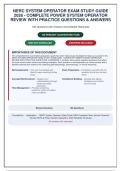
NERC SYSTEM OPERATOR EXAM STUDY GUIDE
2026 - COMPLETE POWER SYSTEM OPERATOR
REVIEW WITH PRACTICE QUESTIONS & ANSWERS
160 Questions with Answers and Detailed Rationales
100 PERCENT GUARANTEED PASS
INSTANT DOWNLOAD ANSWERS INCLUDED
IMPORTANCE OF THIS DOCUMENT
This comprehensive examination preparation guide has been meticulously developed to help you succeed in the
NERC SYSTEM OPERATOR EXAM STUDY GUIDE 2026 - COMPLETE POWER SYSTEM OPERATOR
REVIEW WITH PRACTICE QUESTIONS & ANSWERS. It contains 160 carefully selected questions that reflect
the most current exam content and testing strategies. Each question is accompanied by a correct answer and a
detailed rationale that explains the underlying pathophysiology, pharmacology, or clinical reasoning.
Self-Assessment – Test your knowledge and Exam Preparation – Familiarize yourself with the
identify areas requiring further question format and content
study areas
Concept Reinforcement – Deepen your Confidence Building – Develop test-taking
understanding through strategies and reduce
evidence-based exam anxiety
rationales
Time Management – Practice answering
questions under simulated
exam conditions
Review Summary 160 Questions
Foundations - Application - NERC System Operator Study Guide 2026 Complete Power System Operator
Review WITH & Power System Operations AND Reliability Graduate
All answers with rationales
,Table of Contents
Content Area Questions Key Topics
NERC System Operator 1-27 Frequency, Balancing, Authority, Transmission, According
Study Guide 2026 Complete
Power System Operator
Review WITH & Power
System Operations AND
Reliability Graduate
System 28-54 Frequency, Transmission, Power, Operator, Factor
Transmission 55-81 Frequency, System, Voltage, Balancing Authority, Operator
Balancing 82-108 Frequency, System, Transmission, Reserve, Response
Operator 109-135 Frequency, Transmission, System, Balancing, Reliability
Authority 136-160 Frequency, Balancing, Operator, System, Transmission
TOTAL 160 All questions include answers and detailed rationales
,Section A - NERC System Operator Study Guide 2026
Complete Power System Operator Review WITH & Power
System Operations AND Reliability Graduate
Q1.
During a sudden loss of a large generating unit, the Area Control Error (ACE) becomes
more negative. Which sequence of actions correctly restores frequency and ACE to target,
considering NERC BAL-001 and BAL-005?
A. Immediately deploy spinning reserve, B. Deploy regulating reserve first to arrest
then adjust interchange schedules to frequency decline, then use non-spinning
recover ACE, and finally restore frequency reserve to replace energy, and finally adjust
to 60 Hz. AGC setpoints to return ACE to zero.
C. Increase generation output across all D. Rely on tie-line bias control only, allowing
units regardless of ramp limits, then ACE to remain negative until the next
manually recalculate frequency bias. scheduling hour.
Correct: B - Deploy regulating reserve first to arrest frequency decline, then use
non-spinning reserve to replace energy, and finally adjust AGC setpoints to return ACE to
zero.
Rationale:The correct sequence is to use regulating reserves to arrest frequency decline,
then replace energy with non-spinning reserves, and finally adjust AGC to restore ACE.
Option A incorrectly prioritizes interchange adjustments before frequency recovery. Option C
ignores ramp limits and bias recalculation is not needed. Option D fails to correct ACE
promptly, violating BAL-001.
Q2.
A Balancing Authority (BA) is experiencing a sudden loss of a 500 MW generator. The
frequency bias is -100 MW/0.1 Hz and the frequency is initially 59.95 Hz. Which of the
following best describes the immediate effect on ACE and the required action under NERC
BAL-001?
A. ACE will become positive; the BA must B. ACE will become negative; the BA must
increase generation to restore frequency to deploy regulating reserve to restore
60 Hz. frequency and ACE to zero.
C. ACE will become negative; the BA must D. ACE remains unchanged because the
reduce interchange to offset the loss. frequency deviation is within the deadband.
Correct: B - ACE will become negative; the BA must deploy regulating reserve to restore
frequency and ACE to zero.
Page 3
, Section A - NERC System Operator Study Guide 2026 Complete Power System Operator Review WITH & Power System Operations AND
Reliability Graduate
Rationale: The loss of generation creates a generation deficit, making ACE negative. The BA
must deploy regulating reserve to increase generation and correct both frequency and ACE.
Option A is incorrect because ACE is negative, not positive. Option C is incorrect because
reducing interchange worsens the deficit. Option D is incorrect because the frequency
deviation triggers ACE correction regardless of deadband.
Q3.
Under NERC Standard VAR-002, a generator operator must maintain voltage and reactive
power within specified limits. If a system disturbance causes a sudden voltage drop,
which of the following is the most appropriate immediate action?
A. Increase reactive power output to support B. Switch the automatic voltage regulator to
voltage, then notify the Transmission manual and adjust excitation.
Operator.
C. Reduce real power output to allow more D. Disconnect the generator to protect it
reactive capability. from overexcitation.
Correct: A - Increase reactive power output to support voltage, then notify the
Transmission Operator.
Rationale:To support voltage during a disturbance, the generator should increase reactive
power output (e.g., raising excitation) to provide voltage support, and the Transmission
Operator must be notified per VAR-002. Option B is incorrect because switching to manual
may delay response. Option C reduces real power but is not the primary voltage support
action. Option D is a last resort, not immediate.
Q4.
A Transmission Operator is considering using a non-dispatchable intermittent resource to
meet a capacity obligation. Under NERC standards, what is the primary reliability
concern?
A. The resource's output cannot be forecast B. The resource may not be available during
accurately. peak load periods.
C. The resource's output is variable and D. The resource cannot provide frequency
may cause voltage fluctuations. response.
Correct: B - The resource may not be available during peak load periods.
Rationale:The primary reliability concern for non-dispatchable intermittent resources is their
limited capacity value during peak periods, which affects resource adequacy. While
forecasting and variability are concerns, they are secondary to capacity availability. Voltage
fluctuations and frequency response are not unique to intermittent resources.
Page 4
2026 - COMPLETE POWER SYSTEM OPERATOR
REVIEW WITH PRACTICE QUESTIONS & ANSWERS
160 Questions with Answers and Detailed Rationales
100 PERCENT GUARANTEED PASS
INSTANT DOWNLOAD ANSWERS INCLUDED
IMPORTANCE OF THIS DOCUMENT
This comprehensive examination preparation guide has been meticulously developed to help you succeed in the
NERC SYSTEM OPERATOR EXAM STUDY GUIDE 2026 - COMPLETE POWER SYSTEM OPERATOR
REVIEW WITH PRACTICE QUESTIONS & ANSWERS. It contains 160 carefully selected questions that reflect
the most current exam content and testing strategies. Each question is accompanied by a correct answer and a
detailed rationale that explains the underlying pathophysiology, pharmacology, or clinical reasoning.
Self-Assessment – Test your knowledge and Exam Preparation – Familiarize yourself with the
identify areas requiring further question format and content
study areas
Concept Reinforcement – Deepen your Confidence Building – Develop test-taking
understanding through strategies and reduce
evidence-based exam anxiety
rationales
Time Management – Practice answering
questions under simulated
exam conditions
Review Summary 160 Questions
Foundations - Application - NERC System Operator Study Guide 2026 Complete Power System Operator
Review WITH & Power System Operations AND Reliability Graduate
All answers with rationales
,Table of Contents
Content Area Questions Key Topics
NERC System Operator 1-27 Frequency, Balancing, Authority, Transmission, According
Study Guide 2026 Complete
Power System Operator
Review WITH & Power
System Operations AND
Reliability Graduate
System 28-54 Frequency, Transmission, Power, Operator, Factor
Transmission 55-81 Frequency, System, Voltage, Balancing Authority, Operator
Balancing 82-108 Frequency, System, Transmission, Reserve, Response
Operator 109-135 Frequency, Transmission, System, Balancing, Reliability
Authority 136-160 Frequency, Balancing, Operator, System, Transmission
TOTAL 160 All questions include answers and detailed rationales
,Section A - NERC System Operator Study Guide 2026
Complete Power System Operator Review WITH & Power
System Operations AND Reliability Graduate
Q1.
During a sudden loss of a large generating unit, the Area Control Error (ACE) becomes
more negative. Which sequence of actions correctly restores frequency and ACE to target,
considering NERC BAL-001 and BAL-005?
A. Immediately deploy spinning reserve, B. Deploy regulating reserve first to arrest
then adjust interchange schedules to frequency decline, then use non-spinning
recover ACE, and finally restore frequency reserve to replace energy, and finally adjust
to 60 Hz. AGC setpoints to return ACE to zero.
C. Increase generation output across all D. Rely on tie-line bias control only, allowing
units regardless of ramp limits, then ACE to remain negative until the next
manually recalculate frequency bias. scheduling hour.
Correct: B - Deploy regulating reserve first to arrest frequency decline, then use
non-spinning reserve to replace energy, and finally adjust AGC setpoints to return ACE to
zero.
Rationale:The correct sequence is to use regulating reserves to arrest frequency decline,
then replace energy with non-spinning reserves, and finally adjust AGC to restore ACE.
Option A incorrectly prioritizes interchange adjustments before frequency recovery. Option C
ignores ramp limits and bias recalculation is not needed. Option D fails to correct ACE
promptly, violating BAL-001.
Q2.
A Balancing Authority (BA) is experiencing a sudden loss of a 500 MW generator. The
frequency bias is -100 MW/0.1 Hz and the frequency is initially 59.95 Hz. Which of the
following best describes the immediate effect on ACE and the required action under NERC
BAL-001?
A. ACE will become positive; the BA must B. ACE will become negative; the BA must
increase generation to restore frequency to deploy regulating reserve to restore
60 Hz. frequency and ACE to zero.
C. ACE will become negative; the BA must D. ACE remains unchanged because the
reduce interchange to offset the loss. frequency deviation is within the deadband.
Correct: B - ACE will become negative; the BA must deploy regulating reserve to restore
frequency and ACE to zero.
Page 3
, Section A - NERC System Operator Study Guide 2026 Complete Power System Operator Review WITH & Power System Operations AND
Reliability Graduate
Rationale: The loss of generation creates a generation deficit, making ACE negative. The BA
must deploy regulating reserve to increase generation and correct both frequency and ACE.
Option A is incorrect because ACE is negative, not positive. Option C is incorrect because
reducing interchange worsens the deficit. Option D is incorrect because the frequency
deviation triggers ACE correction regardless of deadband.
Q3.
Under NERC Standard VAR-002, a generator operator must maintain voltage and reactive
power within specified limits. If a system disturbance causes a sudden voltage drop,
which of the following is the most appropriate immediate action?
A. Increase reactive power output to support B. Switch the automatic voltage regulator to
voltage, then notify the Transmission manual and adjust excitation.
Operator.
C. Reduce real power output to allow more D. Disconnect the generator to protect it
reactive capability. from overexcitation.
Correct: A - Increase reactive power output to support voltage, then notify the
Transmission Operator.
Rationale:To support voltage during a disturbance, the generator should increase reactive
power output (e.g., raising excitation) to provide voltage support, and the Transmission
Operator must be notified per VAR-002. Option B is incorrect because switching to manual
may delay response. Option C reduces real power but is not the primary voltage support
action. Option D is a last resort, not immediate.
Q4.
A Transmission Operator is considering using a non-dispatchable intermittent resource to
meet a capacity obligation. Under NERC standards, what is the primary reliability
concern?
A. The resource's output cannot be forecast B. The resource may not be available during
accurately. peak load periods.
C. The resource's output is variable and D. The resource cannot provide frequency
may cause voltage fluctuations. response.
Correct: B - The resource may not be available during peak load periods.
Rationale:The primary reliability concern for non-dispatchable intermittent resources is their
limited capacity value during peak periods, which affects resource adequacy. While
forecasting and variability are concerns, they are secondary to capacity availability. Voltage
fluctuations and frequency response are not unique to intermittent resources.
Page 4


