

Page 1 of 86
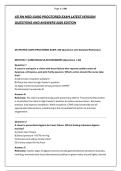
ATI RN MED-SURG PROCTORED EXAM LATEST VERSION
QUESTIONS AND ANSWERS 2026 EDITION
ATI RN MED-SURG PROCTORED EXAM: 250 Questions with Detailed Rationales
SECTION 1: CARDIOVASCULAR DISORDERS (Questions 1-40)
Question 1
A nurse is caring for a client with heart failure who reports sudden onset of
dyspnea, orthopnea, and pink frothy sputum. Which action should the nurse take
first?
A) Administer morphine sulfate IV
B) Place the client in high-Fowler's position
C) Apply continuous positive airway pressure (CPAP)
D) Administer furosemide IV
Answer: B
Rationale: The client is experiencing acute pulmonary edema. The priority intervention
is to position the client in high-Fowler's position to reduce venous return, decrease
preload, and improve ventilation. While morphine, CPAP, and furosemide are all
appropriate interventions, positioning is the immediate first action to promote
oxygenation .
Question 2
A client is prescribed digoxin for heart failure. Which finding indicates digoxin
toxicity?
A) Heart rate 72 bpm
B) Blood pressure 118/76 mm Hg
C) Nausea and yellow-tinted vision
D) Urinary output 50 mL/hour
Answer: C
Rationale: Classic signs of digoxin toxicity include gastrointestinal symptoms (nausea,
vomiting, anorexia) and visual disturbances (yellow or green halos around lights, blurred
, Page 2 of 86
vision). The nurse should check the apical pulse for one full minute before
administering digoxin and hold the dose if the heart rate is below 60 bpm .
Question 3
A client is prescribed sublingual nitroglycerin for acute angina. Which statement
indicates understanding?
A) "I can keep my medication for 1 year before replacing it."
B) "I should lie down when I take this medication."
C) "I will take one tablet every 5 minutes until the pain is gone, up to 3 tablets."
D) "I will swallow the tablet with a full glass of water."
Answer: C
Rationale: For acute angina, the client should take one sublingual nitroglycerin tablet
every 5 minutes for up to 3 doses. If pain is not relieved after 3 doses, the client should
seek emergency care. The tablet should be placed under the tongue and allowed to
dissolve—not swallowed. Nitroglycerin should be stored in its original container, away
from light and moisture, and replaced every 6 months .
Question 4
A nurse is assessing a client with pericarditis. Which finding is characteristic of this
condition?
A) Pain relieved by leaning forward
B) Pain exacerbated by leaning forward
C) Pain relieved by lying flat
D) Pain that radiates to the right arm
Answer: A
Rationale: Pericarditis causes sharp, pleuritic chest pain that is worsened by lying flat
and inspiration and is relieved by leaning forward (which reduces pressure on the
pericardium). Pain that radiates to the right arm is not characteristic; pericarditis pain
may radiate to the left shoulder or neck .
Question 5
A nurse is caring for a client following a cardiac catheterization via the femoral
artery. Which finding requires immediate intervention?
A) Blood pressure 110/70 mm Hg
B) Heart rate 88 bpm
C) Pallor and coolness of the right foot
D) Small amount of serous drainage
, Page 3 of 86
Answer: C
Rationale: Pallor and coolness of the extremity distal to the catheterization site may
indicate arterial occlusion or thrombosis, which requires immediate intervention. The
nurse should assess the affected extremity for pulses, color, temperature, and
sensation. A small amount of serous drainage is expected .
Question 6
A client with hypertension has a blood pressure of 180/110 mm Hg and reports a
severe headache. Which action should the nurse take first?
A) Administer oral antihypertensive medication
B) Notify the healthcare provider
C) Reassess blood pressure in 30 minutes
D) Assess for other signs of target organ damage
Answer: B
Rationale: A blood pressure of 180/110 mm Hg with a severe headache is concerning
for hypertensive crisis. The nurse should notify the provider immediately while
assessing for other signs of target organ damage. Immediate treatment is necessary to
prevent stroke or other complications .
Question 7
A client is prescribed spironolactone for heart failure. Lab results show potassium
5.8 mEq/L. What is the nurse's priority action?
A) Administer the medication as prescribed
B) Hold the medication and notify the provider
C) Encourage intake of high-potassium foods
D) Repeat potassium level in 24 hours
Answer: B
Rationale: Spironolactone is a potassium-sparing diuretic; hyperkalemia is a
dangerous side effect requiring immediate attention. A potassium level of 5.8 mEq/L is
above the normal range (3.5-5.0 mEq/L) and indicates hyperkalemia. The medication
should be held, and the provider notified for further orders .
Question 8
A nurse is assessing a client with suspected deep vein thrombosis (DVT). Which
finding is most concerning?
A) Unilateral calf swelling
B) Tenderness in the affected leg
, Page 4 of 86
C) Warmth and erythema
D) Sudden onset of chest pain and dyspnea
Answer: D
Rationale: Sudden chest pain and dyspnea are signs of pulmonary embolism (PE), a
life-threatening complication of DVT. The nurse should immediately assess for signs of
PE and notify the provider. Unilateral swelling, tenderness, and warmth are
characteristic of DVT but are not immediately life-threatening .
Question 9
A client is prescribed warfarin for atrial fibrillation. Which laboratory value should
the nurse monitor to evaluate therapeutic effect?
A) aPTT
B) Platelet count
C) INR
D) Bleeding time
Answer: C
Rationale: Warfarin is monitored using the International Normalized Ratio (INR). The
therapeutic INR range for atrial fibrillation is typically 2.0-3.0. aPTT is monitored for
heparin therapy. Platelet count is monitored for thrombocytopenia .
Question 10
A client receiving digoxin has nausea, vomiting, and a heart rate of 45 bpm. What
should the nurse do?
A) Administer digoxin as ordered
B) Hold medication and notify provider
C) Encourage fluids and monitor
D) Check potassium level and give potassium supplement
Answer: B
Rationale: Nausea, vomiting, and bradycardia are classic signs of digoxin toxicity. The
nurse should hold the next dose and notify the provider immediately. Potassium levels
should be checked, as hypokalemia increases the risk of digoxin toxicity, but potassium
supplementation should only be given with a provider's order .
Question 11
A nurse is providing dietary teaching to a client with hypertension. Which food
should the client avoid?
A) Baked chicken
ATI RN MED-SURG PROCTORED EXAM LATEST VERSION
QUESTIONS AND ANSWERS 2026 EDITION
ATI RN MED-SURG PROCTORED EXAM: 250 Questions with Detailed Rationales
SECTION 1: CARDIOVASCULAR DISORDERS (Questions 1-40)
Question 1
A nurse is caring for a client with heart failure who reports sudden onset of
dyspnea, orthopnea, and pink frothy sputum. Which action should the nurse take
first?
A) Administer morphine sulfate IV
B) Place the client in high-Fowler's position
C) Apply continuous positive airway pressure (CPAP)
D) Administer furosemide IV
Answer: B
Rationale: The client is experiencing acute pulmonary edema. The priority intervention
is to position the client in high-Fowler's position to reduce venous return, decrease
preload, and improve ventilation. While morphine, CPAP, and furosemide are all
appropriate interventions, positioning is the immediate first action to promote
oxygenation .
Question 2
A client is prescribed digoxin for heart failure. Which finding indicates digoxin
toxicity?
A) Heart rate 72 bpm
B) Blood pressure 118/76 mm Hg
C) Nausea and yellow-tinted vision
D) Urinary output 50 mL/hour
Answer: C
Rationale: Classic signs of digoxin toxicity include gastrointestinal symptoms (nausea,
vomiting, anorexia) and visual disturbances (yellow or green halos around lights, blurred
, Page 2 of 86
vision). The nurse should check the apical pulse for one full minute before
administering digoxin and hold the dose if the heart rate is below 60 bpm .
Question 3
A client is prescribed sublingual nitroglycerin for acute angina. Which statement
indicates understanding?
A) "I can keep my medication for 1 year before replacing it."
B) "I should lie down when I take this medication."
C) "I will take one tablet every 5 minutes until the pain is gone, up to 3 tablets."
D) "I will swallow the tablet with a full glass of water."
Answer: C
Rationale: For acute angina, the client should take one sublingual nitroglycerin tablet
every 5 minutes for up to 3 doses. If pain is not relieved after 3 doses, the client should
seek emergency care. The tablet should be placed under the tongue and allowed to
dissolve—not swallowed. Nitroglycerin should be stored in its original container, away
from light and moisture, and replaced every 6 months .
Question 4
A nurse is assessing a client with pericarditis. Which finding is characteristic of this
condition?
A) Pain relieved by leaning forward
B) Pain exacerbated by leaning forward
C) Pain relieved by lying flat
D) Pain that radiates to the right arm
Answer: A
Rationale: Pericarditis causes sharp, pleuritic chest pain that is worsened by lying flat
and inspiration and is relieved by leaning forward (which reduces pressure on the
pericardium). Pain that radiates to the right arm is not characteristic; pericarditis pain
may radiate to the left shoulder or neck .
Question 5
A nurse is caring for a client following a cardiac catheterization via the femoral
artery. Which finding requires immediate intervention?
A) Blood pressure 110/70 mm Hg
B) Heart rate 88 bpm
C) Pallor and coolness of the right foot
D) Small amount of serous drainage
, Page 3 of 86
Answer: C
Rationale: Pallor and coolness of the extremity distal to the catheterization site may
indicate arterial occlusion or thrombosis, which requires immediate intervention. The
nurse should assess the affected extremity for pulses, color, temperature, and
sensation. A small amount of serous drainage is expected .
Question 6
A client with hypertension has a blood pressure of 180/110 mm Hg and reports a
severe headache. Which action should the nurse take first?
A) Administer oral antihypertensive medication
B) Notify the healthcare provider
C) Reassess blood pressure in 30 minutes
D) Assess for other signs of target organ damage
Answer: B
Rationale: A blood pressure of 180/110 mm Hg with a severe headache is concerning
for hypertensive crisis. The nurse should notify the provider immediately while
assessing for other signs of target organ damage. Immediate treatment is necessary to
prevent stroke or other complications .
Question 7
A client is prescribed spironolactone for heart failure. Lab results show potassium
5.8 mEq/L. What is the nurse's priority action?
A) Administer the medication as prescribed
B) Hold the medication and notify the provider
C) Encourage intake of high-potassium foods
D) Repeat potassium level in 24 hours
Answer: B
Rationale: Spironolactone is a potassium-sparing diuretic; hyperkalemia is a
dangerous side effect requiring immediate attention. A potassium level of 5.8 mEq/L is
above the normal range (3.5-5.0 mEq/L) and indicates hyperkalemia. The medication
should be held, and the provider notified for further orders .
Question 8
A nurse is assessing a client with suspected deep vein thrombosis (DVT). Which
finding is most concerning?
A) Unilateral calf swelling
B) Tenderness in the affected leg
, Page 4 of 86
C) Warmth and erythema
D) Sudden onset of chest pain and dyspnea
Answer: D
Rationale: Sudden chest pain and dyspnea are signs of pulmonary embolism (PE), a
life-threatening complication of DVT. The nurse should immediately assess for signs of
PE and notify the provider. Unilateral swelling, tenderness, and warmth are
characteristic of DVT but are not immediately life-threatening .
Question 9
A client is prescribed warfarin for atrial fibrillation. Which laboratory value should
the nurse monitor to evaluate therapeutic effect?
A) aPTT
B) Platelet count
C) INR
D) Bleeding time
Answer: C
Rationale: Warfarin is monitored using the International Normalized Ratio (INR). The
therapeutic INR range for atrial fibrillation is typically 2.0-3.0. aPTT is monitored for
heparin therapy. Platelet count is monitored for thrombocytopenia .
Question 10
A client receiving digoxin has nausea, vomiting, and a heart rate of 45 bpm. What
should the nurse do?
A) Administer digoxin as ordered
B) Hold medication and notify provider
C) Encourage fluids and monitor
D) Check potassium level and give potassium supplement
Answer: B
Rationale: Nausea, vomiting, and bradycardia are classic signs of digoxin toxicity. The
nurse should hold the next dose and notify the provider immediately. Potassium levels
should be checked, as hypokalemia increases the risk of digoxin toxicity, but potassium
supplementation should only be given with a provider's order .
Question 11
A nurse is providing dietary teaching to a client with hypertension. Which food
should the client avoid?
A) Baked chicken


