Page 1 of 138
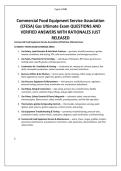
Commercial Food Equipment Service Association
(CFESA) Gas Ultimate Exam QUESTIONS AND
VERIFIED ANSWERS WITH RATIONALES JUST
RELEASED
Commercial Food Equipment Service Association (CFESA) Gas Ultimate Exam
10 MOSTLY TESTED EXAM COVERAGE AREAS
1. Gas Safety, Leak Detection & Safe Work Practices — gas leaks, shutoff procedures, ignition
hazards, ventilation, leak testing, PPE, safe service procedures, and emergency actions.
2. Gas Types, Properties & Terminology — natural gas, LP/propane, BTU input, gas pressure,
heating value, specific gravity, and basic gas terms.
3. Combustion Air, Ventilation & Venting — combustion air, makeup air, exhaust systems, flue
draft, incomplete combustion, carbon monoxide, soot, and vent restrictions.
4. Burners, Orifices & Air Shutters — burner ports, burner cleaning, orifice sizing, air adjustment,
flame appearance, burner alignment, ignition, and flame stability.
5. Gas Pressure, Regulators & Manometers — inlet pressure, manifold pressure, regulators,
pressure testing, pressure drop, manometer use, and pressure adjustment.
6. Gas Piping, Sizing & Connections — pipe sizing, pressure loss, shutoff valves, flexible
connectors, unions, sediment traps, fittings, and gas-tight connections.
7. Gas Valves, Safety Controls & Flame Safeguards — automatic valves, manual valves,
thermocouples, flame sensors, safety shutoffs, proving systems, and fail-safe operation.
8. Thermostats, Ignition & Operating Controls — thermostats, temperature sensing, spark
ignition, pilot systems, ignition sequence, control circuits, and cycling.
9. Gas Equipment Troubleshooting & Testing — systematic troubleshooting, pressure tests,
combustion checks, control checks, symptoms, diagnosis, repair verification, and final testing.
10. Commercial Food Equipment Service & Maintenance — ovens, fryers, ranges, griddles, broilers,
preventive maintenance, manufacturer instructions, code awareness, documentation, and final
safety checks.
1.
, Page 2 of 138
Before servicing a commercial gas appliance, which action should the technician take first to reduce fire
and explosion risks?
A. Increase the burner flame
B. Shut off the gas supply and control ignition sources
C. Remove the thermostat
D. Open every gas valve
Answer: B
Rationale: Shutting off gas and controlling ignition sources reduces immediate fire and explosion
hazards.
2.
Which instrument is commonly used by a commercial food equipment technician to measure low gas
pressure accurately?
A. Thermometer
B. Manometer
C. Megohmmeter
D. Scale
, Page 3 of 138
Answer: B
Rationale: A manometer is commonly used to measure low gas pressure.
3.
What is the main purpose of a burner orifice in a commercial gas-fired cooking appliance?
A. Measure temperature
B. Store gas
C. Meter gas entering the burner
D. Control water pressure
Answer: C
Rationale: The orifice controls the amount of gas entering the burner.
4.
Why does a gas-fired commercial appliance need enough combustion air during normal operation?
A. It supports proper and complete combustion
B. It increases food weight
, Page 4 of 138
C. It removes the regulator
D. It changes natural gas into propane
Answer: A
Rationale: Gas needs enough oxygen to burn properly and safely.
5.
A technician smells gas around a commercial oven that is not operating. What should happen
immediately?
A. Light the pilot
B. Continue working
C. Stop the gas supply and control ignition sources
D. Increase gas pressure
Answer: C
Rationale: A suspected gas leak must be handled as an immediate safety concern.
6.
What does BTU input normally describe on the nameplate of a commercial gas appliance?
Commercial Food Equipment Service Association
(CFESA) Gas Ultimate Exam QUESTIONS AND
VERIFIED ANSWERS WITH RATIONALES JUST
RELEASED
Commercial Food Equipment Service Association (CFESA) Gas Ultimate Exam
10 MOSTLY TESTED EXAM COVERAGE AREAS
1. Gas Safety, Leak Detection & Safe Work Practices — gas leaks, shutoff procedures, ignition
hazards, ventilation, leak testing, PPE, safe service procedures, and emergency actions.
2. Gas Types, Properties & Terminology — natural gas, LP/propane, BTU input, gas pressure,
heating value, specific gravity, and basic gas terms.
3. Combustion Air, Ventilation & Venting — combustion air, makeup air, exhaust systems, flue
draft, incomplete combustion, carbon monoxide, soot, and vent restrictions.
4. Burners, Orifices & Air Shutters — burner ports, burner cleaning, orifice sizing, air adjustment,
flame appearance, burner alignment, ignition, and flame stability.
5. Gas Pressure, Regulators & Manometers — inlet pressure, manifold pressure, regulators,
pressure testing, pressure drop, manometer use, and pressure adjustment.
6. Gas Piping, Sizing & Connections — pipe sizing, pressure loss, shutoff valves, flexible
connectors, unions, sediment traps, fittings, and gas-tight connections.
7. Gas Valves, Safety Controls & Flame Safeguards — automatic valves, manual valves,
thermocouples, flame sensors, safety shutoffs, proving systems, and fail-safe operation.
8. Thermostats, Ignition & Operating Controls — thermostats, temperature sensing, spark
ignition, pilot systems, ignition sequence, control circuits, and cycling.
9. Gas Equipment Troubleshooting & Testing — systematic troubleshooting, pressure tests,
combustion checks, control checks, symptoms, diagnosis, repair verification, and final testing.
10. Commercial Food Equipment Service & Maintenance — ovens, fryers, ranges, griddles, broilers,
preventive maintenance, manufacturer instructions, code awareness, documentation, and final
safety checks.
1.
, Page 2 of 138
Before servicing a commercial gas appliance, which action should the technician take first to reduce fire
and explosion risks?
A. Increase the burner flame
B. Shut off the gas supply and control ignition sources
C. Remove the thermostat
D. Open every gas valve
Answer: B
Rationale: Shutting off gas and controlling ignition sources reduces immediate fire and explosion
hazards.
2.
Which instrument is commonly used by a commercial food equipment technician to measure low gas
pressure accurately?
A. Thermometer
B. Manometer
C. Megohmmeter
D. Scale
, Page 3 of 138
Answer: B
Rationale: A manometer is commonly used to measure low gas pressure.
3.
What is the main purpose of a burner orifice in a commercial gas-fired cooking appliance?
A. Measure temperature
B. Store gas
C. Meter gas entering the burner
D. Control water pressure
Answer: C
Rationale: The orifice controls the amount of gas entering the burner.
4.
Why does a gas-fired commercial appliance need enough combustion air during normal operation?
A. It supports proper and complete combustion
B. It increases food weight
, Page 4 of 138
C. It removes the regulator
D. It changes natural gas into propane
Answer: A
Rationale: Gas needs enough oxygen to burn properly and safely.
5.
A technician smells gas around a commercial oven that is not operating. What should happen
immediately?
A. Light the pilot
B. Continue working
C. Stop the gas supply and control ignition sources
D. Increase gas pressure
Answer: C
Rationale: A suspected gas leak must be handled as an immediate safety concern.
6.
What does BTU input normally describe on the nameplate of a commercial gas appliance?