

Page 1 of 145
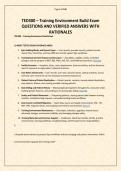
TED300 – Training Environment Build Exam
QUESTIONS AND VERIFIED ANSWERS WITH
RATIONALES
TED300 – Training Environment Build Exam
10 MOST TESTED EXAM COVERAGE AREAS
1. Epic Building Blocks and Record Types — User records, provider records, patient records,
master files, Chronicles, and how different records support Epic workflows.
2. Training Environment Purpose and Structure — Reusability, stability, safety, controlled
changes, and the purpose of MST, REF, PREP, ACE, PLY, and EXAM environments. (Docsity)
3. Facility Structure — Hospitals, clinics, units, departments, business entities, and the hierarchy
used to represent an organization's physical structure.
4. User Roles and Security — User records, user roles, security classes, startup activities, access,
and how users receive the correct training environment experience.
5. Patient Data and Patient Duplication — Patient records, contacts, manual patient duplication,
step patients, Mitosis, and creating reusable training patients.
6. Date Sliding and Patient History — Moving duplicated patients through time, encounter order,
building patient histories, and avoiding errors during date sliding. (Docsity)
7. Scotty and Patient Movement — Teleporting patients, moving patient data between training
contexts, troubleshooting requests, and understanding Scotty workflows.
8. Data Courier and Build Migration — Static data, source and target environments, POC, TST,
MST, PRD, migration limits, and keeping environments synchronized. (Stuvia)
9. Training Environment Maintenance — Data wipes, refreshes, upgrades, manual versus
automatic changes, environment stability, and managing changes safely.
10. Training Materials and End-User Support — Cookbooks, Quick Start Guides, EUPAs, practice
environments, training workflows, troubleshooting, and Principal Trainer responsibilities.
1.
A hospital wants learners to practice Epic workflows without changing real patient information. Which
environment best supports this training need?
, Page 2 of 145
A. Production environment
B. Training environment
C. Billing environment
D. Reporting environment
Answer: B. Training environment
Rationale: A training environment gives learners a safe place to practice workflows without affecting
production patient information.
2.
A user logs into Hyperspace and sees specific startup activities based on assigned access. What primarily
controls these startup activities?
A. User Role
B. Patient Record
C. Facility Structure
D. Master File
Answer: A. User Role
Rationale: The User Role controls the startup activities and workflow experience presented to the user.
, Page 3 of 145
3.
An Epic training team needs a tool that duplicates patients regularly so they remain useful for training.
Which tool should they use?
A. Scotty
B. Mitosis
C. Data Courier
D. Chronicles
Answer: B. Mitosis
Rationale: Mitosis duplicates patients on a regular schedule so training patients remain fresh and
reusable.
4.
A trainer needs to move a duplicated patient forward through time so older encounters appear before
newer encounters. What process should be used?
A. Date sliding
B. Data wiping
, Page 4 of 145
C. Data Courier
D. Environment refresh
Answer: A. Date sliding
Rationale: Date sliding changes the dates of duplicated patient information so encounters can appear
over time.
5.
A doctor works in the hospital and needs to appear as a person who can perform clinical activities.
Which records are normally needed?
A. Patient and facility records
B. User and provider records
C. Master and patient records
D. Facility and security records
Answer: B. User and provider records
Rationale: The user record supports system access, while the provider record represents the clinician.
6.
TED300 – Training Environment Build Exam
QUESTIONS AND VERIFIED ANSWERS WITH
RATIONALES
TED300 – Training Environment Build Exam
10 MOST TESTED EXAM COVERAGE AREAS
1. Epic Building Blocks and Record Types — User records, provider records, patient records,
master files, Chronicles, and how different records support Epic workflows.
2. Training Environment Purpose and Structure — Reusability, stability, safety, controlled
changes, and the purpose of MST, REF, PREP, ACE, PLY, and EXAM environments. (Docsity)
3. Facility Structure — Hospitals, clinics, units, departments, business entities, and the hierarchy
used to represent an organization's physical structure.
4. User Roles and Security — User records, user roles, security classes, startup activities, access,
and how users receive the correct training environment experience.
5. Patient Data and Patient Duplication — Patient records, contacts, manual patient duplication,
step patients, Mitosis, and creating reusable training patients.
6. Date Sliding and Patient History — Moving duplicated patients through time, encounter order,
building patient histories, and avoiding errors during date sliding. (Docsity)
7. Scotty and Patient Movement — Teleporting patients, moving patient data between training
contexts, troubleshooting requests, and understanding Scotty workflows.
8. Data Courier and Build Migration — Static data, source and target environments, POC, TST,
MST, PRD, migration limits, and keeping environments synchronized. (Stuvia)
9. Training Environment Maintenance — Data wipes, refreshes, upgrades, manual versus
automatic changes, environment stability, and managing changes safely.
10. Training Materials and End-User Support — Cookbooks, Quick Start Guides, EUPAs, practice
environments, training workflows, troubleshooting, and Principal Trainer responsibilities.
1.
A hospital wants learners to practice Epic workflows without changing real patient information. Which
environment best supports this training need?
, Page 2 of 145
A. Production environment
B. Training environment
C. Billing environment
D. Reporting environment
Answer: B. Training environment
Rationale: A training environment gives learners a safe place to practice workflows without affecting
production patient information.
2.
A user logs into Hyperspace and sees specific startup activities based on assigned access. What primarily
controls these startup activities?
A. User Role
B. Patient Record
C. Facility Structure
D. Master File
Answer: A. User Role
Rationale: The User Role controls the startup activities and workflow experience presented to the user.
, Page 3 of 145
3.
An Epic training team needs a tool that duplicates patients regularly so they remain useful for training.
Which tool should they use?
A. Scotty
B. Mitosis
C. Data Courier
D. Chronicles
Answer: B. Mitosis
Rationale: Mitosis duplicates patients on a regular schedule so training patients remain fresh and
reusable.
4.
A trainer needs to move a duplicated patient forward through time so older encounters appear before
newer encounters. What process should be used?
A. Date sliding
B. Data wiping
, Page 4 of 145
C. Data Courier
D. Environment refresh
Answer: A. Date sliding
Rationale: Date sliding changes the dates of duplicated patient information so encounters can appear
over time.
5.
A doctor works in the hospital and needs to appear as a person who can perform clinical activities.
Which records are normally needed?
A. Patient and facility records
B. User and provider records
C. Master and patient records
D. Facility and security records
Answer: B. User and provider records
Rationale: The user record supports system access, while the provider record represents the clinician.
6.


