Intermediate Accounting Exam • FASB Accounting Standards Codification • 2026/2027
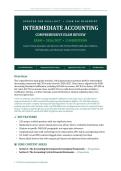
UPDATED FOR 2026/2027 • FASB ASC BLUEPRINT
INTERMEDIATE ACCOUNTING
COMPREHENSIVE EXAM REVIEW
EXAM • 2026/2027 • 210 QUESTIONS
Latest Version Questions and Answers with Verified FASB Codification Citations,
Full Rationales, and Distractor Analysis for Every Item
210 VERIFIED Q&As Randomized Choice Order Updated for 2026/2027 Full Rationales
Overview
This comprehensive study guide provides 210 unique practice questions built for Intermediate
Accounting coursework and CPA-track review for 2026/2027. Every item is aligned to the FASB
Accounting Standards Codification, including ASC 606 on revenue, ASC 842 on leases, ASC 820 on
fair value, ASC 740 on income taxes, and ASC 326 on credit losses. Each question includes a
Codification citation, a written rationale, and a full distractor analysis explaining why every
incorrect option fails.
A note on authority: the FASB Accounting Standards Codification is the single source of authoritative
nongovernmental U.S. GAAP, amended through Accounting Standards Updates. The SEC holds statutory
authority over public company reporting and adds Regulation S-X and S-K requirements, the PCAOB sets
auditing standards under Sarbanes-Oxley, and IFRS differences are flagged where they are commonly tested.
Section 7 reflects standards effective across the 2026 and 2027 reporting cycles, including ASU 2023-07, ASU
2023-09, ASU 2024-03, and the ASU 2025-01 effective date clarification.
✓ KEY FEATURES
• 210 unique, verified questions with zero duplicate stems
• Randomized correct-answer placement across all four letters, verified by distribution audit
• Citations to specific FASB ASC paragraphs, not vague topic references
• Computational items with worked figures for depreciation, EPS, bonds, and adjusting entries
• U.S. GAAP versus IFRS contrasts flagged where examiners commonly test them
• Master Quick Answer Key with compact grid layout and duplicate-check confirmation
▣ CORE CONTENT AREAS
• Section 1: The Accounting Environment & Conceptual Framework — 30 questions
• Section 2: The Accounting Cycle & Financial Statements — 30 questions
1 | FASB Accounting Standards Codification
, Intermediate Accounting Exam • FASB Accounting Standards Codification • 2026/2027
• Section 3: Revenue Recognition & Measurement — 30 questions
• Section 4: Asset Valuation & Depreciation — 35 questions
• Section 5: Liabilities & Equity — 30 questions
• Section 6: Investments & Financial Instruments — 25 questions
• Section 7: Special Topics & Emerging Issues — 30 questions
2 | FASB Accounting Standards Codification
, Intermediate Accounting Exam • FASB Accounting Standards Codification • 2026/2027
SECTION 1: THE ACCOUNTING ENVIRONMENT & CONCEPTUAL
FRAMEWORK (30 QUESTIONS)
GAAP, the FASB Codification, the objective of financial reporting, and qualitative characteristics
1. What is the single source of authoritative nongovernmental U.S. GAAP?
A. AICPA Statements on Auditing Standards
B. SEC Regulation S-X exclusively
C. IASB International Financial Reporting Standards
D. The FASB Accounting Standards Codification
Correct Answer: D. The FASB Accounting Standards Codification
FASB ASC 105-10-05-1
Rationale: The Codification is the single source of authoritative nongovernmental U.S. GAAP; all other
accounting literature is nonauthoritative.
Distractor Analysis:
A is incorrect: "AICPA Statements on Auditing Standards" — violates FASB ASC 105-10-05-1 and would
breach scope/safety vs correct practice.
B is incorrect: "SEC Regulation S-X exclusively" — violates FASB ASC 105-10-05-1 and would breach
scope/safety vs correct practice.
C is incorrect: "IASB International Financial Reporting Standards" — violates FASB ASC 105-10-05-1 and
would breach scope/safety vs correct practice.
2. How does the FASB amend the Accounting Standards Codification?
A. By issuing Statements of Financial Accounting Standards
B. By issuing Staff Accounting Bulletins
C. By issuing Accounting Standards Updates
D. By issuing Interpretations of Auditing Standards
Correct Answer: C. By issuing Accounting Standards Updates
FASB ASC 105-10-65
Rationale: Since the Codification became effective, the FASB amends it exclusively through Accounting
Standards Updates, which are not themselves authoritative apart from the Codification.
Distractor Analysis:
A is incorrect: "By issuing Statements of Financial Accounting Standards" — violates FASB ASC 105-10-65
and would breach scope/safety vs correct practice.
B is incorrect: "By issuing Staff Accounting Bulletins" — violates FASB ASC 105-10-65 and would breach
scope/safety vs correct practice.
D is incorrect: "By issuing Interpretations of Auditing Standards" — violates FASB ASC 105-10-65 and
would breach scope/safety vs correct practice.
3 | FASB Accounting Standards Codification
, Intermediate Accounting Exam • FASB Accounting Standards Codification • 2026/2027
3. What is the stated objective of general purpose financial reporting?
A. Determining the entity's taxable income for the period
B. Providing financial information useful to investors, lenders, and other creditors in making
resource allocation decisions
C. Establishing the liquidation value of the entity
D. Demonstrating management's compliance with internal budgets
Correct Answer: B. Providing financial information useful to investors, lenders, and other
creditors in making resource allocation decisions
FASB Concepts Statement No. 8, Chapter 1, OB2
Rationale: The objective is to provide financial information about the reporting entity that is useful to existing
and potential investors, lenders, and other creditors in making decisions about providing resources.
Distractor Analysis:
A is incorrect: "Determining the entity's taxable income for the period" — violates FASB Concepts
Statement No. 8, Chapter 1, OB2 and would breach scope/safety vs correct practice.
C is incorrect: "Establishing the liquidation value of the entity" — violates FASB Concepts Statement No. 8,
Chapter 1, OB2 and would breach scope/safety vs correct practice.
D is incorrect: "Demonstrating management's compliance with internal budgets" — violates FASB Concepts
Statement No. 8, Chapter 1, OB2 and would breach scope/safety vs correct practice.
4. Which two characteristics are the fundamental qualitative characteristics of useful
financial information?
A. Comparability and consistency
B. Timeliness and verifiability
C. Relevance and faithful representation
D. Materiality and conservatism
Correct Answer: C. Relevance and faithful representation
FASB Concepts Statement No. 8, Chapter 3, QC5
Rationale: Relevance and faithful representation are the fundamental qualitative characteristics; the others are
enhancing characteristics.
Distractor Analysis:
A is incorrect: "Comparability and consistency" — violates FASB Concepts Statement No. 8, Chapter 3, QC5
and would breach scope/safety vs correct practice.
B is incorrect: "Timeliness and verifiability" — violates FASB Concepts Statement No. 8, Chapter 3, QC5 and
would breach scope/safety vs correct practice.
D is incorrect: "Materiality and conservatism" — violates FASB Concepts Statement No. 8, Chapter 3, QC5
and would breach scope/safety vs correct practice.
4 | FASB Accounting Standards Codification
UPDATED FOR 2026/2027 • FASB ASC BLUEPRINT
INTERMEDIATE ACCOUNTING
COMPREHENSIVE EXAM REVIEW
EXAM • 2026/2027 • 210 QUESTIONS
Latest Version Questions and Answers with Verified FASB Codification Citations,
Full Rationales, and Distractor Analysis for Every Item
210 VERIFIED Q&As Randomized Choice Order Updated for 2026/2027 Full Rationales
Overview
This comprehensive study guide provides 210 unique practice questions built for Intermediate
Accounting coursework and CPA-track review for 2026/2027. Every item is aligned to the FASB
Accounting Standards Codification, including ASC 606 on revenue, ASC 842 on leases, ASC 820 on
fair value, ASC 740 on income taxes, and ASC 326 on credit losses. Each question includes a
Codification citation, a written rationale, and a full distractor analysis explaining why every
incorrect option fails.
A note on authority: the FASB Accounting Standards Codification is the single source of authoritative
nongovernmental U.S. GAAP, amended through Accounting Standards Updates. The SEC holds statutory
authority over public company reporting and adds Regulation S-X and S-K requirements, the PCAOB sets
auditing standards under Sarbanes-Oxley, and IFRS differences are flagged where they are commonly tested.
Section 7 reflects standards effective across the 2026 and 2027 reporting cycles, including ASU 2023-07, ASU
2023-09, ASU 2024-03, and the ASU 2025-01 effective date clarification.
✓ KEY FEATURES
• 210 unique, verified questions with zero duplicate stems
• Randomized correct-answer placement across all four letters, verified by distribution audit
• Citations to specific FASB ASC paragraphs, not vague topic references
• Computational items with worked figures for depreciation, EPS, bonds, and adjusting entries
• U.S. GAAP versus IFRS contrasts flagged where examiners commonly test them
• Master Quick Answer Key with compact grid layout and duplicate-check confirmation
▣ CORE CONTENT AREAS
• Section 1: The Accounting Environment & Conceptual Framework — 30 questions
• Section 2: The Accounting Cycle & Financial Statements — 30 questions
1 | FASB Accounting Standards Codification
, Intermediate Accounting Exam • FASB Accounting Standards Codification • 2026/2027
• Section 3: Revenue Recognition & Measurement — 30 questions
• Section 4: Asset Valuation & Depreciation — 35 questions
• Section 5: Liabilities & Equity — 30 questions
• Section 6: Investments & Financial Instruments — 25 questions
• Section 7: Special Topics & Emerging Issues — 30 questions
2 | FASB Accounting Standards Codification
, Intermediate Accounting Exam • FASB Accounting Standards Codification • 2026/2027
SECTION 1: THE ACCOUNTING ENVIRONMENT & CONCEPTUAL
FRAMEWORK (30 QUESTIONS)
GAAP, the FASB Codification, the objective of financial reporting, and qualitative characteristics
1. What is the single source of authoritative nongovernmental U.S. GAAP?
A. AICPA Statements on Auditing Standards
B. SEC Regulation S-X exclusively
C. IASB International Financial Reporting Standards
D. The FASB Accounting Standards Codification
Correct Answer: D. The FASB Accounting Standards Codification
FASB ASC 105-10-05-1
Rationale: The Codification is the single source of authoritative nongovernmental U.S. GAAP; all other
accounting literature is nonauthoritative.
Distractor Analysis:
A is incorrect: "AICPA Statements on Auditing Standards" — violates FASB ASC 105-10-05-1 and would
breach scope/safety vs correct practice.
B is incorrect: "SEC Regulation S-X exclusively" — violates FASB ASC 105-10-05-1 and would breach
scope/safety vs correct practice.
C is incorrect: "IASB International Financial Reporting Standards" — violates FASB ASC 105-10-05-1 and
would breach scope/safety vs correct practice.
2. How does the FASB amend the Accounting Standards Codification?
A. By issuing Statements of Financial Accounting Standards
B. By issuing Staff Accounting Bulletins
C. By issuing Accounting Standards Updates
D. By issuing Interpretations of Auditing Standards
Correct Answer: C. By issuing Accounting Standards Updates
FASB ASC 105-10-65
Rationale: Since the Codification became effective, the FASB amends it exclusively through Accounting
Standards Updates, which are not themselves authoritative apart from the Codification.
Distractor Analysis:
A is incorrect: "By issuing Statements of Financial Accounting Standards" — violates FASB ASC 105-10-65
and would breach scope/safety vs correct practice.
B is incorrect: "By issuing Staff Accounting Bulletins" — violates FASB ASC 105-10-65 and would breach
scope/safety vs correct practice.
D is incorrect: "By issuing Interpretations of Auditing Standards" — violates FASB ASC 105-10-65 and
would breach scope/safety vs correct practice.
3 | FASB Accounting Standards Codification
, Intermediate Accounting Exam • FASB Accounting Standards Codification • 2026/2027
3. What is the stated objective of general purpose financial reporting?
A. Determining the entity's taxable income for the period
B. Providing financial information useful to investors, lenders, and other creditors in making
resource allocation decisions
C. Establishing the liquidation value of the entity
D. Demonstrating management's compliance with internal budgets
Correct Answer: B. Providing financial information useful to investors, lenders, and other
creditors in making resource allocation decisions
FASB Concepts Statement No. 8, Chapter 1, OB2
Rationale: The objective is to provide financial information about the reporting entity that is useful to existing
and potential investors, lenders, and other creditors in making decisions about providing resources.
Distractor Analysis:
A is incorrect: "Determining the entity's taxable income for the period" — violates FASB Concepts
Statement No. 8, Chapter 1, OB2 and would breach scope/safety vs correct practice.
C is incorrect: "Establishing the liquidation value of the entity" — violates FASB Concepts Statement No. 8,
Chapter 1, OB2 and would breach scope/safety vs correct practice.
D is incorrect: "Demonstrating management's compliance with internal budgets" — violates FASB Concepts
Statement No. 8, Chapter 1, OB2 and would breach scope/safety vs correct practice.
4. Which two characteristics are the fundamental qualitative characteristics of useful
financial information?
A. Comparability and consistency
B. Timeliness and verifiability
C. Relevance and faithful representation
D. Materiality and conservatism
Correct Answer: C. Relevance and faithful representation
FASB Concepts Statement No. 8, Chapter 3, QC5
Rationale: Relevance and faithful representation are the fundamental qualitative characteristics; the others are
enhancing characteristics.
Distractor Analysis:
A is incorrect: "Comparability and consistency" — violates FASB Concepts Statement No. 8, Chapter 3, QC5
and would breach scope/safety vs correct practice.
B is incorrect: "Timeliness and verifiability" — violates FASB Concepts Statement No. 8, Chapter 3, QC5 and
would breach scope/safety vs correct practice.
D is incorrect: "Materiality and conservatism" — violates FASB Concepts Statement No. 8, Chapter 3, QC5
and would breach scope/safety vs correct practice.
4 | FASB Accounting Standards Codification