

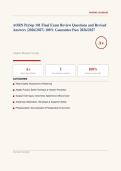
NURSING LICENSURE
AORN Periop 101 Final Exam Review Questions and Revised
Answers (2026/2027) 100% Guarantee Pass 2026/2027
A+
Complete Blueprint Coverage
A+ 5 100%
QUESTIONS VERIFIED CORE DOMAINS COVERED RATIONALES INCLUDED
CATEGORIES
Patient Safety, Assessment & Positioning
Aseptic Practice, Sterile Technique & Infection Prevention
Surgical Techniques, Instruments, Specimens & Wound Care
Anesthesia, Medications, Hemostasis & Equipment Safety
Professionalism, Documentation & Perioperative Environment
STUVIAACTUALEXAM
,
,AORN Periop 101 Final Exam Review Questions and Revised Answers (2026/2027) 100% Guarantee Pass 2026/2027
SECTION 1: PATIENT SAFETY, ASSESSMENT & POSITIONING
Q1.
A 68-year-old patient arrives for elective hip arthroplasty and reports taking garlic supplements daily for the past
three months. During the preoperative interview the circulating nurse notes the patient also consumes two
glasses of wine most evenings. The nurse recognizes that both substances can affect coagulation and
anesthesia response. Which action should the nurse take first to promote patient safety?
A. Document the findings and proceed with routine preoperative checklist completion.
B. Notify the anesthesia provider and surgeon of the herbal and alcohol use before the patient is transferred to the
operating room.
C. Instruct the patient to discontinue the garlic supplements immediately and reschedule the case for the following
week.
D. Order coagulation laboratory studies and hold the patient in preoperative holding until results return.
Correct Answer: B
Rationale:
Garlic and alcohol can potentiate bleeding risk and alter anesthetic requirements. Prompt communication with the
anesthesia provider and surgeon allows risk assessment and potential case modification before induction. Documentation
alone or unilateral cancellation without team discussion does not fulfill the collaborative safety responsibility of the
perioperative nurse.
Q2.
During a preoperative assessment for a laparoscopic cholecystectomy, the circulating nurse identifies that the
patient has a body mass index of 42 and limited neck extension. The anesthesia provider plans general
anesthesia with endotracheal intubation. What is the priority nursing intervention related to airway management?
A. Request a video laryngoscope and ensure difficult-airway equipment is immediately available in the room.
B. Position the patient in reverse Trendelenburg before induction to improve diaphragmatic excursion.
C. Administer an additional dose of preoperative anticholinergic to reduce secretions.
D. Delay the case until a fiber-optic intubation specialist can be consulted from another facility.
Correct Answer: A
Rationale:
Obesity and limited neck extension are recognized predictors of difficult airway. Ensuring advanced airway equipment is
ready before induction is an evidence-based safety step. Reverse Trendelenburg may help ventilation after intubation but
does not address the primary intubation risk.
, AORN Periop 101 Final Exam Review Questions and Revised Answers (2026/2027) 100% Guarantee Pass 2026/2027
SECTION 1: PATIENT SAFETY, ASSESSMENT & POSITIONING
Q3.
A patient scheduled for spinal anesthesia reports a history of severe anxiety and previous difficulty remaining still
during procedures. The circulating nurse is preparing the room. Which positioning consideration is most
important to discuss with the anesthesia provider before induction?
A. The need for additional padding under the hips to maintain lumbar curvature.
B. Availability of a calm environment and possible mild sedation to assist the patient in maintaining the required
flexed position during spinal placement.
C. Placement of sequential compression devices before the spinal is administered.
D. Use of a fracture table to stabilize the lower extremities throughout the case.
Correct Answer: B
Rationale:
Successful spinal anesthesia requires the patient to remain still in a flexed position. Addressing anxiety and offering
appropriate pharmacologic support reduces movement risk and improves first-attempt success. Padding and compression
devices are important but secondary to securing the conditions needed for safe needle placement.
Q4.
While reviewing the surgical consent for a patient undergoing right total knee arthroplasty, the circulating nurse
notices the laterality is marked correctly on the consent but the surgeon's initials are absent from the surgical
site. The patient is already in the operating room. What is the most appropriate immediate action?
A. Proceed with the time-out and document that the consent laterality matches the scheduled procedure.
B. Ask the surgeon to initial the marked site before the final time-out is completed.
C. Have the circulating nurse initial the site on the surgeon's behalf to avoid delay.
D. Cancel the case and return the patient to preoperative holding for a new consent.
Correct Answer: B
Rationale:
Site marking must be performed by a licensed independent practitioner who will be present during the procedure, typically
the surgeon. The nurse should not mark the site or proceed without verification. Requiring the surgeon to complete the mark
before time-out maintains Universal Protocol compliance without unnecessary cancellation.
AORN Periop 101 Final Exam Review Questions and Revised
Answers (2026/2027) 100% Guarantee Pass 2026/2027
A+
Complete Blueprint Coverage
A+ 5 100%
QUESTIONS VERIFIED CORE DOMAINS COVERED RATIONALES INCLUDED
CATEGORIES
Patient Safety, Assessment & Positioning
Aseptic Practice, Sterile Technique & Infection Prevention
Surgical Techniques, Instruments, Specimens & Wound Care
Anesthesia, Medications, Hemostasis & Equipment Safety
Professionalism, Documentation & Perioperative Environment
STUVIAACTUALEXAM
,
,AORN Periop 101 Final Exam Review Questions and Revised Answers (2026/2027) 100% Guarantee Pass 2026/2027
SECTION 1: PATIENT SAFETY, ASSESSMENT & POSITIONING
Q1.
A 68-year-old patient arrives for elective hip arthroplasty and reports taking garlic supplements daily for the past
three months. During the preoperative interview the circulating nurse notes the patient also consumes two
glasses of wine most evenings. The nurse recognizes that both substances can affect coagulation and
anesthesia response. Which action should the nurse take first to promote patient safety?
A. Document the findings and proceed with routine preoperative checklist completion.
B. Notify the anesthesia provider and surgeon of the herbal and alcohol use before the patient is transferred to the
operating room.
C. Instruct the patient to discontinue the garlic supplements immediately and reschedule the case for the following
week.
D. Order coagulation laboratory studies and hold the patient in preoperative holding until results return.
Correct Answer: B
Rationale:
Garlic and alcohol can potentiate bleeding risk and alter anesthetic requirements. Prompt communication with the
anesthesia provider and surgeon allows risk assessment and potential case modification before induction. Documentation
alone or unilateral cancellation without team discussion does not fulfill the collaborative safety responsibility of the
perioperative nurse.
Q2.
During a preoperative assessment for a laparoscopic cholecystectomy, the circulating nurse identifies that the
patient has a body mass index of 42 and limited neck extension. The anesthesia provider plans general
anesthesia with endotracheal intubation. What is the priority nursing intervention related to airway management?
A. Request a video laryngoscope and ensure difficult-airway equipment is immediately available in the room.
B. Position the patient in reverse Trendelenburg before induction to improve diaphragmatic excursion.
C. Administer an additional dose of preoperative anticholinergic to reduce secretions.
D. Delay the case until a fiber-optic intubation specialist can be consulted from another facility.
Correct Answer: A
Rationale:
Obesity and limited neck extension are recognized predictors of difficult airway. Ensuring advanced airway equipment is
ready before induction is an evidence-based safety step. Reverse Trendelenburg may help ventilation after intubation but
does not address the primary intubation risk.
, AORN Periop 101 Final Exam Review Questions and Revised Answers (2026/2027) 100% Guarantee Pass 2026/2027
SECTION 1: PATIENT SAFETY, ASSESSMENT & POSITIONING
Q3.
A patient scheduled for spinal anesthesia reports a history of severe anxiety and previous difficulty remaining still
during procedures. The circulating nurse is preparing the room. Which positioning consideration is most
important to discuss with the anesthesia provider before induction?
A. The need for additional padding under the hips to maintain lumbar curvature.
B. Availability of a calm environment and possible mild sedation to assist the patient in maintaining the required
flexed position during spinal placement.
C. Placement of sequential compression devices before the spinal is administered.
D. Use of a fracture table to stabilize the lower extremities throughout the case.
Correct Answer: B
Rationale:
Successful spinal anesthesia requires the patient to remain still in a flexed position. Addressing anxiety and offering
appropriate pharmacologic support reduces movement risk and improves first-attempt success. Padding and compression
devices are important but secondary to securing the conditions needed for safe needle placement.
Q4.
While reviewing the surgical consent for a patient undergoing right total knee arthroplasty, the circulating nurse
notices the laterality is marked correctly on the consent but the surgeon's initials are absent from the surgical
site. The patient is already in the operating room. What is the most appropriate immediate action?
A. Proceed with the time-out and document that the consent laterality matches the scheduled procedure.
B. Ask the surgeon to initial the marked site before the final time-out is completed.
C. Have the circulating nurse initial the site on the surgeon's behalf to avoid delay.
D. Cancel the case and return the patient to preoperative holding for a new consent.
Correct Answer: B
Rationale:
Site marking must be performed by a licensed independent practitioner who will be present during the procedure, typically
the surgeon. The nurse should not mark the site or proceed without verification. Requiring the surgeon to complete the mark
before time-out maintains Universal Protocol compliance without unnecessary cancellation.


