

HESI RN PHARM ACOLOGY • ORIGINAL PRACTICE QUESTIONS • 2026/2027
HESI RN PHARMACOLOGY • ORIGINAL PRACTICE QUESTIONS • 2026/2027
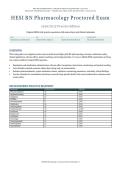
HESI RN Phar m acology Pr octor ed Exam
2026/2027 Pr actice Edition
Original HESI-style practice questions with answer keys and clinical rationales
200 20 4 2026/2027
ORIGINAL QUESTIONS CORE TOPIC AREAS QUESTION FORMATS PRACTICE EDITION
OVERVIEW
This study guide is an original practice resource built around high-yield RN pharmacology concepts, medication safety,
clinical application, adverse effects, patient teaching, and nursing priorities. It is not an official HESI examination and does
not contain recalled or leaked HESI questions.
Emphasizes safe medication administration, adverse-effect recognition, interactions, monitoring, and patient teaching.
Uses clinically oriented scenarios rather than relying only on memorization.
Includes pharmacokinetics, major medication classes, antidotes, monitoring parameters, and safety-critical findings.
Use the rationales for remediation and always reconcile drug-specific details with current authoritative references and
course policy.
RECOMMENDED PRACTICE BLUEPRINT
DOMAIN QUESTIONS SHARE
Pharmacokinetics 16 8.0%
Medication Safety 16 8.0%
Analgesics 16 8.0%
NSAIDs 8 4.0%
Acetaminophen 8 4.0%
Antibiotics 16 8.0%
Anticoagulants 16 8.0%
Cardiovascular 20 10.0%
Endocrine 16 8.0%
Respiratory 12 6.0%
Psychiatric 16 8.0%
Neurologic 12 6.0%
Gastrointestinal 12 6.0%
Antineoplastic 12 6.0%
Anti-infective 4 2.0%
HESI RN Pharmacology | 2026/2027 Practice Study Guide | 1
, HESI RN PHARM ACOLOGY • ORIGINAL PRACTICE QUESTIONS • 2026/2027
PLAN • PRACTICE • REMEDIATE
HOW TO USE THIS PRACTICE EXAM
Complete the questions under timed conditions when possible. Mark uncertain items without immediately checking the
rationale. After the attempt, review every missed item, identify the underlying pharmacology concept, and repeat the topic
until the reasoning is clear.
FORMAT LEGEND
Knowledge Check
Clinical Application
Patient Teaching
Priority / Safety
CONTENT MAP
Pharmacokinetics — 16 items
Medication Safety — 16 items
Analgesics — 16 items
NSAIDs — 8 items
Acetaminophen — 8 items
Antibiotics — 16 items
Anticoagulants — 16 items
Cardiovascular — 20 items
Endocrine — 16 items
Respiratory — 12 items
Psychiatric — 16 items
Neurologic — 12 items
Gastrointestinal — 12 items
Antineoplastic — 12 items
Anti-infective — 4 items
Elsevier publicly identifies Pharmacology as an HESI RN Specialty Exam and describes specialty exams as standardized
end-of-course assessments. Elsevier has also described NGN-oriented items in HESI RN Specialty Exams, including
Pharmacology. This guide therefore uses application and clinical-judgment-oriented practice writing, but it does not
reproduce or claim to reproduce the official exam.
HESI RN Pharmacology | 2026/2027 Practice Study Guide | 2
, HESI RN PHARM ACOLOGY • ORIGINAL PRACTICE QUESTIONS • 2026/2027
ONE MIX ED PRACTICE EX AM • 200 QUESTIONS
H ESI RN Phar m acology Pr octor ed Exam • 2026/2027 Pr actice Edition
EXAM DIRECTIONS
Select the single best response for each question. Review the rationale after completing the exam. For clinical use, current
prescribing information, institutional policy, and the patient's individualized plan of care take precedence.
QUESTION 1 | K NOW LEDGE CHECK | PHARMACOK INETICS
A n ur se explain s th at th e ter m bioavailability r efer s to w h ich pr oper ty of a m edication ?
A. The fraction of a dose that reaches systemic circulation
B. The time required for renal excretion
C. The degree of protein binding
D. The rate at which a drug is metabolized
CORRECT ANSW ER: A
CLINICAL RATIONALE: Bioavailability is the fraction of an administered dose that reaches systemic circulation in
an active form.
DISTRACTOR / RESPONSE ANALY SIS: The other responses are less appropriate because they do not match the
pharmacologic principle, safety priority, or clinical condition being tested.
QUESTION 2 | CLINICAL APPLICATION | PHARMACOK INETICS
A n ur se is car in g for a patien t. a nur se explain s th at th e ter m bioavailability r efer s to w h ich pr oper ty of a
m edication ?
A. The fraction of a dose that reaches systemic circulation
B. The time required for renal excretion
C. The degree of protein binding
D. The rate at which a drug is metabolized
CORRECT ANSW ER: A
CLINICAL RATIONALE: Bioavailability is the fraction of an administered dose that reaches systemic circulation in
an active form.
DISTRACTOR / RESPONSE ANALY SIS: The other responses are less appropriate because they do not match the
pharmacologic principle, safety priority, or clinical condition being tested.
QUESTION 3 | PATIENT TEACHING | PHARMACOK INETICS
Dur in g m edication teach in g, a n ur se explain s that th e ter m bioavailability r efer s to w hich pr o per ty of a
m edication ?
A. The fraction of a dose that reaches systemic circulation
B. The time required for renal excretion
C. The degree of protein binding
D. The rate at which a drug is metabolized
CORRECT ANSW ER: A
CLINICAL RATIONALE: Bioavailability is the fraction of an administered dose that reaches systemic circulation in
an active form.
DISTRACTOR / RESPONSE ANALY SIS: The other responses are less appropriate because they do not match the
pharmacologic principle, safety priority, or clinical condition being tested.
HESI RN Pharmacology | 2026/2027 Practice Study Guide | 3
, HESI RN PHARM ACOLOGY • ORIGINAL PRACTICE QUESTIONS • 2026/2027
QUESTION 4 | PRIORITY / SAFETY | PHARMACOK INETICS
Fr om a m edication -safety per spective, a n ur se explain s that th e ter m bioavailability r efer s to w hich
pr o per ty of a m edication ?
A. The fraction of a dose that reaches systemic circulation
B. The time required for renal excretion
C. The degree of protein binding
D. The rate at which a drug is metabolized
CORRECT ANSW ER: A
CLINICAL RATIONALE: Bioavailability is the fraction of an administered dose that reaches systemic circulation in
an active form.
DISTRACTOR / RESPONSE ANALY SIS: The other responses are less appropriate because they do not match the
pharmacologic principle, safety priority, or clinical condition being tested.
QUESTION 5 | K NOW LEDGE CHECK | PHARMACOK INETICS
W hich or gan is th e m ajor site of biotr an sfor m ation for m an y m edication s?
A. Liver
B. Spleen
C. Pancreas
D. Thyroid
CORRECT ANSW ER: A
CLINICAL RATIONALE: The liver contains major enzyme systems, including CYP enzymes, that metabolize many
medications.
DISTRACTOR / RESPONSE ANALY SIS: The other responses are less appropriate because they do not match the
pharmacologic principle, safety priority, or clinical condition being tested.
QUESTION 6 | CLINICAL APPLICATION | PHARMACOK INETICS
A n ur se is car in g for a patien t. w h ich or gan is th e m ajor site of biotr an sfor m ation for m an y m edications?
A. Liver
B. Spleen
C. Pancreas
D. Thyroid
CORRECT ANSW ER: A
CLINICAL RATIONALE: The liver contains major enzyme systems, including CYP enzymes, that metabolize many
medications.
DISTRACTOR / RESPONSE ANALY SIS: The other responses are less appropriate because they do not match the
pharmacologic principle, safety priority, or clinical condition being tested.
QUESTION 7 | PATIENT TEACHING | PHARMACOK INETICS
Dur in g m edication teach in g, w hich or gan is th e m ajor site of biotr an sfor m ation for m an y m edications?
A. Liver
B. Spleen
C. Pancreas
D. Thyroid
CORRECT ANSW ER: A
CLINICAL RATIONALE: The liver contains major enzyme systems, including CYP enzymes, that metabolize many
medications.
HESI RN Pharmacology | 2026/2027 Practice Study Guide | 4
HESI RN PHARMACOLOGY • ORIGINAL PRACTICE QUESTIONS • 2026/2027
HESI RN Phar m acology Pr octor ed Exam
2026/2027 Pr actice Edition
Original HESI-style practice questions with answer keys and clinical rationales
200 20 4 2026/2027
ORIGINAL QUESTIONS CORE TOPIC AREAS QUESTION FORMATS PRACTICE EDITION
OVERVIEW
This study guide is an original practice resource built around high-yield RN pharmacology concepts, medication safety,
clinical application, adverse effects, patient teaching, and nursing priorities. It is not an official HESI examination and does
not contain recalled or leaked HESI questions.
Emphasizes safe medication administration, adverse-effect recognition, interactions, monitoring, and patient teaching.
Uses clinically oriented scenarios rather than relying only on memorization.
Includes pharmacokinetics, major medication classes, antidotes, monitoring parameters, and safety-critical findings.
Use the rationales for remediation and always reconcile drug-specific details with current authoritative references and
course policy.
RECOMMENDED PRACTICE BLUEPRINT
DOMAIN QUESTIONS SHARE
Pharmacokinetics 16 8.0%
Medication Safety 16 8.0%
Analgesics 16 8.0%
NSAIDs 8 4.0%
Acetaminophen 8 4.0%
Antibiotics 16 8.0%
Anticoagulants 16 8.0%
Cardiovascular 20 10.0%
Endocrine 16 8.0%
Respiratory 12 6.0%
Psychiatric 16 8.0%
Neurologic 12 6.0%
Gastrointestinal 12 6.0%
Antineoplastic 12 6.0%
Anti-infective 4 2.0%
HESI RN Pharmacology | 2026/2027 Practice Study Guide | 1
, HESI RN PHARM ACOLOGY • ORIGINAL PRACTICE QUESTIONS • 2026/2027
PLAN • PRACTICE • REMEDIATE
HOW TO USE THIS PRACTICE EXAM
Complete the questions under timed conditions when possible. Mark uncertain items without immediately checking the
rationale. After the attempt, review every missed item, identify the underlying pharmacology concept, and repeat the topic
until the reasoning is clear.
FORMAT LEGEND
Knowledge Check
Clinical Application
Patient Teaching
Priority / Safety
CONTENT MAP
Pharmacokinetics — 16 items
Medication Safety — 16 items
Analgesics — 16 items
NSAIDs — 8 items
Acetaminophen — 8 items
Antibiotics — 16 items
Anticoagulants — 16 items
Cardiovascular — 20 items
Endocrine — 16 items
Respiratory — 12 items
Psychiatric — 16 items
Neurologic — 12 items
Gastrointestinal — 12 items
Antineoplastic — 12 items
Anti-infective — 4 items
Elsevier publicly identifies Pharmacology as an HESI RN Specialty Exam and describes specialty exams as standardized
end-of-course assessments. Elsevier has also described NGN-oriented items in HESI RN Specialty Exams, including
Pharmacology. This guide therefore uses application and clinical-judgment-oriented practice writing, but it does not
reproduce or claim to reproduce the official exam.
HESI RN Pharmacology | 2026/2027 Practice Study Guide | 2
, HESI RN PHARM ACOLOGY • ORIGINAL PRACTICE QUESTIONS • 2026/2027
ONE MIX ED PRACTICE EX AM • 200 QUESTIONS
H ESI RN Phar m acology Pr octor ed Exam • 2026/2027 Pr actice Edition
EXAM DIRECTIONS
Select the single best response for each question. Review the rationale after completing the exam. For clinical use, current
prescribing information, institutional policy, and the patient's individualized plan of care take precedence.
QUESTION 1 | K NOW LEDGE CHECK | PHARMACOK INETICS
A n ur se explain s th at th e ter m bioavailability r efer s to w h ich pr oper ty of a m edication ?
A. The fraction of a dose that reaches systemic circulation
B. The time required for renal excretion
C. The degree of protein binding
D. The rate at which a drug is metabolized
CORRECT ANSW ER: A
CLINICAL RATIONALE: Bioavailability is the fraction of an administered dose that reaches systemic circulation in
an active form.
DISTRACTOR / RESPONSE ANALY SIS: The other responses are less appropriate because they do not match the
pharmacologic principle, safety priority, or clinical condition being tested.
QUESTION 2 | CLINICAL APPLICATION | PHARMACOK INETICS
A n ur se is car in g for a patien t. a nur se explain s th at th e ter m bioavailability r efer s to w h ich pr oper ty of a
m edication ?
A. The fraction of a dose that reaches systemic circulation
B. The time required for renal excretion
C. The degree of protein binding
D. The rate at which a drug is metabolized
CORRECT ANSW ER: A
CLINICAL RATIONALE: Bioavailability is the fraction of an administered dose that reaches systemic circulation in
an active form.
DISTRACTOR / RESPONSE ANALY SIS: The other responses are less appropriate because they do not match the
pharmacologic principle, safety priority, or clinical condition being tested.
QUESTION 3 | PATIENT TEACHING | PHARMACOK INETICS
Dur in g m edication teach in g, a n ur se explain s that th e ter m bioavailability r efer s to w hich pr o per ty of a
m edication ?
A. The fraction of a dose that reaches systemic circulation
B. The time required for renal excretion
C. The degree of protein binding
D. The rate at which a drug is metabolized
CORRECT ANSW ER: A
CLINICAL RATIONALE: Bioavailability is the fraction of an administered dose that reaches systemic circulation in
an active form.
DISTRACTOR / RESPONSE ANALY SIS: The other responses are less appropriate because they do not match the
pharmacologic principle, safety priority, or clinical condition being tested.
HESI RN Pharmacology | 2026/2027 Practice Study Guide | 3
, HESI RN PHARM ACOLOGY • ORIGINAL PRACTICE QUESTIONS • 2026/2027
QUESTION 4 | PRIORITY / SAFETY | PHARMACOK INETICS
Fr om a m edication -safety per spective, a n ur se explain s that th e ter m bioavailability r efer s to w hich
pr o per ty of a m edication ?
A. The fraction of a dose that reaches systemic circulation
B. The time required for renal excretion
C. The degree of protein binding
D. The rate at which a drug is metabolized
CORRECT ANSW ER: A
CLINICAL RATIONALE: Bioavailability is the fraction of an administered dose that reaches systemic circulation in
an active form.
DISTRACTOR / RESPONSE ANALY SIS: The other responses are less appropriate because they do not match the
pharmacologic principle, safety priority, or clinical condition being tested.
QUESTION 5 | K NOW LEDGE CHECK | PHARMACOK INETICS
W hich or gan is th e m ajor site of biotr an sfor m ation for m an y m edication s?
A. Liver
B. Spleen
C. Pancreas
D. Thyroid
CORRECT ANSW ER: A
CLINICAL RATIONALE: The liver contains major enzyme systems, including CYP enzymes, that metabolize many
medications.
DISTRACTOR / RESPONSE ANALY SIS: The other responses are less appropriate because they do not match the
pharmacologic principle, safety priority, or clinical condition being tested.
QUESTION 6 | CLINICAL APPLICATION | PHARMACOK INETICS
A n ur se is car in g for a patien t. w h ich or gan is th e m ajor site of biotr an sfor m ation for m an y m edications?
A. Liver
B. Spleen
C. Pancreas
D. Thyroid
CORRECT ANSW ER: A
CLINICAL RATIONALE: The liver contains major enzyme systems, including CYP enzymes, that metabolize many
medications.
DISTRACTOR / RESPONSE ANALY SIS: The other responses are less appropriate because they do not match the
pharmacologic principle, safety priority, or clinical condition being tested.
QUESTION 7 | PATIENT TEACHING | PHARMACOK INETICS
Dur in g m edication teach in g, w hich or gan is th e m ajor site of biotr an sfor m ation for m an y m edications?
A. Liver
B. Spleen
C. Pancreas
D. Thyroid
CORRECT ANSW ER: A
CLINICAL RATIONALE: The liver contains major enzyme systems, including CYP enzymes, that metabolize many
medications.
HESI RN Pharmacology | 2026/2027 Practice Study Guide | 4


