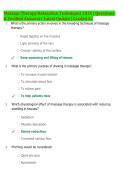
Massage Therapy Relaxation Techniques 2026 | Questions
& Verified Answers | Latest Update | Graded A+
1. What is the primary action involved in the kneading technique of massage
therapy?
Rapid tapping on the muscles
Light stroking of the skin
Circular rubbing of the surface
Deep squeezing and lifting of tissues
2. What is the primary purpose of shaking in massage therapy?
To increase muscle tension
To stimulate blood flow
To relieve pain
To help patients relax
3. Which physiological effect of massage therapy is associated with reducing
swelling in tissues?
Sedation
Muscle relaxation
Edema reduction
Increased venous flow
4. Pinching would be considered:
Quid pro quo
Nonverbal
, Verbal
Physical
5. In a scenario where a client requires relaxation but has a history of muscle
tension, which stroking technique would be more appropriate and why?
Deep stroking, because it relieves muscle tension effectively.
Superficial stroking, because it uses light contact to promote
relaxation without applying excessive pressure.
Both techniques can be used interchangeably regardless of the
client's condition.
Neither, as both techniques are contraindicated for relaxation.
6. What should a massage therapist avoid to ensure patient safety during
treatment?
Client feedback
Massage oils
Contraindications
Ambient lighting
7. This massage technique involves light slaps or karate chops.
Friction
Effleurage
Petrissage
Hacking
,8. What term is used to describe conditions that make massage therapy unsafe
for certain patients?
Contraindications
Physiological effects
Indications
Techniques
9. Describe how the McMillan technique's adherence to venous and lymph flow
impacts its application in massage therapy.
The McMillan technique is primarily used for deep tissue work.
The McMillan technique enhances circulation and lymphatic
drainage by following venous and lymph flow.
The McMillan technique focuses solely on muscle relaxation without
considering circulation.
The McMillan technique restricts blood flow to the muscles.
10. A stroking method of massage is known as?
Effleurage
Vibration
Tapotement
Petrissaage
11. If a massage therapist wants to incorporate the tapping technique into a
treatment for a client with muscle tension, what considerations should they
keep in mind?
Perform tapping only on areas with no muscle tension.
, Ensure the tapping is gentle and appropriate for the client's
sensitivity and comfort level.
Use vigorous tapping to maximize muscle stimulation.
Apply tapping technique exclusively on the client's back.
12. If a massage therapist is treating a patient with tight muscles, which
technique would be most appropriate to use and why?
Friction, because it applies deep pressure to mobilize superficial
tissues and relieve tension.
Kneading, because it stretches and compresses the muscles gently.
Tapotement, because it stimulates the muscles with rhythmic tapping.
Vibration, because it relaxes the muscles through rapid movements.
13. If a massage therapist is starting a session with a client who is tense and
anxious, which technique should they use first and why?
Stroking (effleurage) to help relax the client and ease them into the
session.
Tapotement to energize the client before the session.
Deep tissue massage to immediately relieve tension.
Friction to stimulate circulation right away.
14. Describe the difference between superficial stroking and deep stroking in
massage therapy.
Superficial stroking is a technique for athletes, while deep stroking is
for relaxation.
Superficial stroking is for relaxation, and deep stroking is for pain
relief.
& Verified Answers | Latest Update | Graded A+
1. What is the primary action involved in the kneading technique of massage
therapy?
Rapid tapping on the muscles
Light stroking of the skin
Circular rubbing of the surface
Deep squeezing and lifting of tissues
2. What is the primary purpose of shaking in massage therapy?
To increase muscle tension
To stimulate blood flow
To relieve pain
To help patients relax
3. Which physiological effect of massage therapy is associated with reducing
swelling in tissues?
Sedation
Muscle relaxation
Edema reduction
Increased venous flow
4. Pinching would be considered:
Quid pro quo
Nonverbal
, Verbal
Physical
5. In a scenario where a client requires relaxation but has a history of muscle
tension, which stroking technique would be more appropriate and why?
Deep stroking, because it relieves muscle tension effectively.
Superficial stroking, because it uses light contact to promote
relaxation without applying excessive pressure.
Both techniques can be used interchangeably regardless of the
client's condition.
Neither, as both techniques are contraindicated for relaxation.
6. What should a massage therapist avoid to ensure patient safety during
treatment?
Client feedback
Massage oils
Contraindications
Ambient lighting
7. This massage technique involves light slaps or karate chops.
Friction
Effleurage
Petrissage
Hacking
,8. What term is used to describe conditions that make massage therapy unsafe
for certain patients?
Contraindications
Physiological effects
Indications
Techniques
9. Describe how the McMillan technique's adherence to venous and lymph flow
impacts its application in massage therapy.
The McMillan technique is primarily used for deep tissue work.
The McMillan technique enhances circulation and lymphatic
drainage by following venous and lymph flow.
The McMillan technique focuses solely on muscle relaxation without
considering circulation.
The McMillan technique restricts blood flow to the muscles.
10. A stroking method of massage is known as?
Effleurage
Vibration
Tapotement
Petrissaage
11. If a massage therapist wants to incorporate the tapping technique into a
treatment for a client with muscle tension, what considerations should they
keep in mind?
Perform tapping only on areas with no muscle tension.
, Ensure the tapping is gentle and appropriate for the client's
sensitivity and comfort level.
Use vigorous tapping to maximize muscle stimulation.
Apply tapping technique exclusively on the client's back.
12. If a massage therapist is treating a patient with tight muscles, which
technique would be most appropriate to use and why?
Friction, because it applies deep pressure to mobilize superficial
tissues and relieve tension.
Kneading, because it stretches and compresses the muscles gently.
Tapotement, because it stimulates the muscles with rhythmic tapping.
Vibration, because it relaxes the muscles through rapid movements.
13. If a massage therapist is starting a session with a client who is tense and
anxious, which technique should they use first and why?
Stroking (effleurage) to help relax the client and ease them into the
session.
Tapotement to energize the client before the session.
Deep tissue massage to immediately relieve tension.
Friction to stimulate circulation right away.
14. Describe the difference between superficial stroking and deep stroking in
massage therapy.
Superficial stroking is a technique for athletes, while deep stroking is
for relaxation.
Superficial stroking is for relaxation, and deep stroking is for pain
relief.