

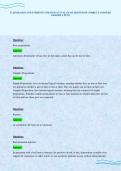
D 265 REASON AND EVIDENCE UPDATED ACTUAL EXAM QUESTIONS CORRECT ANSWERS
GRADED A PLUS
Question:
Non- propositions.
Answer:
statements about matter of fact; they do not make a claim that can be true or false.
Question:
Complex Propositions.
Answer:
Simple Propositions: have no internal logical structure, meaning whether they are true or false does
not depend on whether a part of them is true or false. They are simply true or false on their own.
Complex Proposition: have internal logical structure, meaning they are composed of simple
propositions. Whether complex propositions are true or false depends on whether their parts are true
or false and how those parts are connected.
Question:
Premise.
Answer:
an assumption; the basis for a conclusion
Question:
Bad inferential structure.
Answer:
In arguments with a bad form or structure, the premises do not, in fact, demonstrate or maybe even
support the conclusion. In other words, we can accept the premises as true without being logically
, compelled to accept the conclusion.
Question:
False Premise.
Answer:
In arguments with false premise(s), there is something wrong with their particular content.
Question:
Conclusion Indicators.
Answer:
Therefore, So It follows that Hence Thus Entails that We may conclude that Implies that Wherefore
As a result
Question:
Premise Indicators.
Answer:
Because For Given that In that As Since As indicated by
Question:
Inductive Inference.
Answer:
the support the premises intend to provide for the conclusion is less than certain-if the premises do
not guarantee the conclusion.
Question:
Deductive inference.
Answer:
GRADED A PLUS
Question:
Non- propositions.
Answer:
statements about matter of fact; they do not make a claim that can be true or false.
Question:
Complex Propositions.
Answer:
Simple Propositions: have no internal logical structure, meaning whether they are true or false does
not depend on whether a part of them is true or false. They are simply true or false on their own.
Complex Proposition: have internal logical structure, meaning they are composed of simple
propositions. Whether complex propositions are true or false depends on whether their parts are true
or false and how those parts are connected.
Question:
Premise.
Answer:
an assumption; the basis for a conclusion
Question:
Bad inferential structure.
Answer:
In arguments with a bad form or structure, the premises do not, in fact, demonstrate or maybe even
support the conclusion. In other words, we can accept the premises as true without being logically
, compelled to accept the conclusion.
Question:
False Premise.
Answer:
In arguments with false premise(s), there is something wrong with their particular content.
Question:
Conclusion Indicators.
Answer:
Therefore, So It follows that Hence Thus Entails that We may conclude that Implies that Wherefore
As a result
Question:
Premise Indicators.
Answer:
Because For Given that In that As Since As indicated by
Question:
Inductive Inference.
Answer:
the support the premises intend to provide for the conclusion is less than certain-if the premises do
not guarantee the conclusion.
Question:
Deductive inference.
Answer:


