

Page 1 of 73
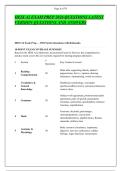
HESI A2 EXAM PREP 2026 QUESTIONS LATEST
VERSION QUESTIONS AND ANSWERS
HESI A2 Exam Prep — 250 Practice Questions with Rationales
10-POINT EXAM COVERAGE SUMMARY
Based on the HESI A2 (Admission Assessment) Exam by Elsevier, this comprehensive
practice exam covers the core sections required for nursing program admission :
#
# Section Key Content Covered
Questions
Main idea, supporting details, author's
Reading
1 50 purpose/tone, fact vs. opinion, drawing
Comprehension
inferences, summarizing, words in context
Vocabulary & Healthcare terminology, word parts
2 General 45 (prefixes/suffixes/roots), synonyms/antonyms,
Knowledge context clues
Subject-verb agreement, pronoun-antecedent
agreement, parts of speech, punctuation
3 Grammar 50
(commas, semicolons, apostrophes), sentence
structure, capitalization
Fractions, decimals, percentages,
ratios/proportions, conversions
4 Math 50
(household/metric), algebra basics, Roman
numerals, military time
Body systems (circulatory, respiratory,
Anatomy &
5 30 digestive, nervous, endocrine), cellular
Physiology
biology, organ functions, homeostasis
, Page 2 of 73
#
# Section Key Content Covered
Questions
Cell structure/organelles, mitosis/meiosis,
Biology & DNA/RNA, photosynthesis/respiration,
6 25
Chemistry chemical reactions, periodic table, atomic
structure
SECTION 1: READING COMPREHENSION (Questions 1-50)
Passage 1: Telemedicine
Telemedicine refers to the use of digital communication technologies, such as computers and
mobile devices, to provide healthcare services remotely. This practice allows patients to
consult with healthcare providers via video conferencing, secure messaging, or remote
monitoring without needing an in-person office visit. Telemedicine has expanded rapidly,
particularly during the COVID-19 pandemic, as it reduces exposure risk and increases access
to care for individuals in rural or underserved areas. Benefits include convenience, reduced
travel time and costs, and decreased waiting periods. However, challenges remain, including
disparities in internet access, concerns about data privacy and security, and limitations in
performing physical examinations remotely.
1. What is the main benefit of telemedicine discussed in the passage?
• A. It eliminates the need for all in-person doctor visits
• B. It improves access to healthcare, especially for rural patients
• C. It guarantees lower healthcare costs for everyone
• D. It replaces the need for hospitals
Answer: B
Rationale: The passage highlights that telemedicine "increases access to care for individuals
in rural or underserved areas." While other benefits are mentioned, improving access is a
central theme. It does not eliminate all in-person visits, guarantee lower costs, or replace
hospitals .
, Page 3 of 73
2. Based on information in the passage, what can be inferred about the future of
telemedicine?
• A. It will completely replace traditional in-person healthcare
• B. It will likely remain a viable option alongside traditional care
• C. It will disappear after the pandemic ends
• D. It will only be used for mental health services
Answer: B
Rationale: Given its benefits and rapid expansion during the pandemic, the passage implies
that telemedicine will remain a viable option for healthcare delivery, though likely alongside
traditional care .
3. What does "remote monitoring" most likely refer to in this passage?
• A. Watching patients through a camera without their knowledge
• B. Using technology to track patient health data from a distance
• C. Having patients come to the office for check-ups
• D. Monitoring the internet usage of patients
Answer: B
Rationale: In the context of telemedicine, remote monitoring involves using digital devices
to track patients' vital signs or health data (like blood pressure or glucose levels) and
transmitting that information to healthcare providers without requiring an in-person visit .
4. The author's tone in this passage can best be described as:
• A. Critical
• B. Informative
• C. Persuasive
• D. Skeptical
Answer: B
Rationale: The passage presents factual information about telemedicine, including both
benefits and challenges, in a neutral, objective manner. This indicates an informative tone .
5. Which of the following is NOT mentioned as a challenge of telemedicine?
• A. Disparities in internet access
• B. Concerns about data privacy and security
, Page 4 of 73
• C. Limitations in performing remote physical examinations
• D. Higher costs than in-person visits
Answer: D
Rationale: The passage mentions internet access disparities, data privacy/security concerns,
and limitations in remote physical examinations as challenges. Higher costs are not
mentioned .
Passage 2: Antibiotics
The discovery of antibiotics in the early 20th century revolutionized medicine. Penicillin,
discovered by Alexander Fleming in 1928, was the first true antibiotic. It was not until the
1940s, however, that penicillin was mass-produced and made widely available for clinical
use. Antibiotics work by targeting specific structures or processes in bacterial cells, such as
the cell wall, protein synthesis machinery, or DNA replication. Antibiotics are classified as
bactericidal (killing bacteria) or bacteriostatic (inhibiting bacterial growth). The overuse and
misuse of antibiotics have led to the emergence of antibiotic-resistant bacteria, a growing
global health threat. Nursing responsibilities related to antibiotics include monitoring for
allergic reactions, assessing for therapeutic effectiveness, and educating patients about
completing the full course of treatment even if symptoms improve.
6. Who discovered penicillin?
• A. Joseph Lister
• B. Louis Pasteur
• C. Alexander Fleming
• D. Edward Jenner
Answer: C
Rationale: The passage states that penicillin was discovered by Alexander Fleming in 1928 .
7. The word "bactericidal" means:
• A. Inhibiting bacterial growth
• B. Killing bacteria
• C. Preventing infection
• D. Strengthening the immune system
HESI A2 EXAM PREP 2026 QUESTIONS LATEST
VERSION QUESTIONS AND ANSWERS
HESI A2 Exam Prep — 250 Practice Questions with Rationales
10-POINT EXAM COVERAGE SUMMARY
Based on the HESI A2 (Admission Assessment) Exam by Elsevier, this comprehensive
practice exam covers the core sections required for nursing program admission :
#
# Section Key Content Covered
Questions
Main idea, supporting details, author's
Reading
1 50 purpose/tone, fact vs. opinion, drawing
Comprehension
inferences, summarizing, words in context
Vocabulary & Healthcare terminology, word parts
2 General 45 (prefixes/suffixes/roots), synonyms/antonyms,
Knowledge context clues
Subject-verb agreement, pronoun-antecedent
agreement, parts of speech, punctuation
3 Grammar 50
(commas, semicolons, apostrophes), sentence
structure, capitalization
Fractions, decimals, percentages,
ratios/proportions, conversions
4 Math 50
(household/metric), algebra basics, Roman
numerals, military time
Body systems (circulatory, respiratory,
Anatomy &
5 30 digestive, nervous, endocrine), cellular
Physiology
biology, organ functions, homeostasis
, Page 2 of 73
#
# Section Key Content Covered
Questions
Cell structure/organelles, mitosis/meiosis,
Biology & DNA/RNA, photosynthesis/respiration,
6 25
Chemistry chemical reactions, periodic table, atomic
structure
SECTION 1: READING COMPREHENSION (Questions 1-50)
Passage 1: Telemedicine
Telemedicine refers to the use of digital communication technologies, such as computers and
mobile devices, to provide healthcare services remotely. This practice allows patients to
consult with healthcare providers via video conferencing, secure messaging, or remote
monitoring without needing an in-person office visit. Telemedicine has expanded rapidly,
particularly during the COVID-19 pandemic, as it reduces exposure risk and increases access
to care for individuals in rural or underserved areas. Benefits include convenience, reduced
travel time and costs, and decreased waiting periods. However, challenges remain, including
disparities in internet access, concerns about data privacy and security, and limitations in
performing physical examinations remotely.
1. What is the main benefit of telemedicine discussed in the passage?
• A. It eliminates the need for all in-person doctor visits
• B. It improves access to healthcare, especially for rural patients
• C. It guarantees lower healthcare costs for everyone
• D. It replaces the need for hospitals
Answer: B
Rationale: The passage highlights that telemedicine "increases access to care for individuals
in rural or underserved areas." While other benefits are mentioned, improving access is a
central theme. It does not eliminate all in-person visits, guarantee lower costs, or replace
hospitals .
, Page 3 of 73
2. Based on information in the passage, what can be inferred about the future of
telemedicine?
• A. It will completely replace traditional in-person healthcare
• B. It will likely remain a viable option alongside traditional care
• C. It will disappear after the pandemic ends
• D. It will only be used for mental health services
Answer: B
Rationale: Given its benefits and rapid expansion during the pandemic, the passage implies
that telemedicine will remain a viable option for healthcare delivery, though likely alongside
traditional care .
3. What does "remote monitoring" most likely refer to in this passage?
• A. Watching patients through a camera without their knowledge
• B. Using technology to track patient health data from a distance
• C. Having patients come to the office for check-ups
• D. Monitoring the internet usage of patients
Answer: B
Rationale: In the context of telemedicine, remote monitoring involves using digital devices
to track patients' vital signs or health data (like blood pressure or glucose levels) and
transmitting that information to healthcare providers without requiring an in-person visit .
4. The author's tone in this passage can best be described as:
• A. Critical
• B. Informative
• C. Persuasive
• D. Skeptical
Answer: B
Rationale: The passage presents factual information about telemedicine, including both
benefits and challenges, in a neutral, objective manner. This indicates an informative tone .
5. Which of the following is NOT mentioned as a challenge of telemedicine?
• A. Disparities in internet access
• B. Concerns about data privacy and security
, Page 4 of 73
• C. Limitations in performing remote physical examinations
• D. Higher costs than in-person visits
Answer: D
Rationale: The passage mentions internet access disparities, data privacy/security concerns,
and limitations in remote physical examinations as challenges. Higher costs are not
mentioned .
Passage 2: Antibiotics
The discovery of antibiotics in the early 20th century revolutionized medicine. Penicillin,
discovered by Alexander Fleming in 1928, was the first true antibiotic. It was not until the
1940s, however, that penicillin was mass-produced and made widely available for clinical
use. Antibiotics work by targeting specific structures or processes in bacterial cells, such as
the cell wall, protein synthesis machinery, or DNA replication. Antibiotics are classified as
bactericidal (killing bacteria) or bacteriostatic (inhibiting bacterial growth). The overuse and
misuse of antibiotics have led to the emergence of antibiotic-resistant bacteria, a growing
global health threat. Nursing responsibilities related to antibiotics include monitoring for
allergic reactions, assessing for therapeutic effectiveness, and educating patients about
completing the full course of treatment even if symptoms improve.
6. Who discovered penicillin?
• A. Joseph Lister
• B. Louis Pasteur
• C. Alexander Fleming
• D. Edward Jenner
Answer: C
Rationale: The passage states that penicillin was discovered by Alexander Fleming in 1928 .
7. The word "bactericidal" means:
• A. Inhibiting bacterial growth
• B. Killing bacteria
• C. Preventing infection
• D. Strengthening the immune system


