

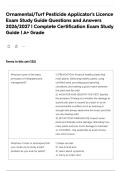
Ornamental/Turf Pesticide Applicator's Licence
Exam Study Guide Questions and Answers
2026/2027 | Complete Certification Exam Study
Guide | A+ Grade
Terms in this set (132)
What are some of the basic 1.) PREVENTION: Produce healthy plants that
principles of Integrated pest resist plants: (Selecting healthy plants, using
management? certified seed, providing good growing
conditions, and making a good match between
the plant and the site)
2.) MONITOR AND IDENTIFY THE PEST: Identify
the problem: (Finding out whether the damage to
a particular plant is caused by a pest or by an
environmental condition such as freezing or
drought and always determine the exact pest that
you are dealing with)
3.) SET ACTION THRESHOLDS: Expect some
pests and tolerate some damage: (Deciding how
many pests and how much damage to tolerate)
4.) CONTROL: Use pesticides as a last choice-
Not a first choice
What are 4 tools or techniques that 1.) Keep records
you could use to study a plant 2.) Use a hand lens
problem as you look for pests? 3.) Learn about symptoms
4.) Carry an index card
, What are 2 kinds of drift? 1.) Particle drift: (The movement of fine particles
(droplets or dust) through the air while the
pesticide is being applied)
2.) Vapor drift: (The movement of the pesticide in
the form of a gas or vapor during or after
application)
What is a Buffer? This is the non treated zone between the area to
be treated and sensitive areas such as ponds,
streams, wells, and drains
What is a Re-entry period? The length of time that must pass before anyone
can enter a treated area
Resistance to pesticides come Using the same pesticides over and over again
from...
What will happen to Pesticides in They are eventually broken down by bacteria and
the soil over time? fungi
When should you apply a When pests are abundant enough cause
pesticide? unacceptable damage
What hand lens magnification is 5 power to 10 power
recommended for insect
identification?
Exam Study Guide Questions and Answers
2026/2027 | Complete Certification Exam Study
Guide | A+ Grade
Terms in this set (132)
What are some of the basic 1.) PREVENTION: Produce healthy plants that
principles of Integrated pest resist plants: (Selecting healthy plants, using
management? certified seed, providing good growing
conditions, and making a good match between
the plant and the site)
2.) MONITOR AND IDENTIFY THE PEST: Identify
the problem: (Finding out whether the damage to
a particular plant is caused by a pest or by an
environmental condition such as freezing or
drought and always determine the exact pest that
you are dealing with)
3.) SET ACTION THRESHOLDS: Expect some
pests and tolerate some damage: (Deciding how
many pests and how much damage to tolerate)
4.) CONTROL: Use pesticides as a last choice-
Not a first choice
What are 4 tools or techniques that 1.) Keep records
you could use to study a plant 2.) Use a hand lens
problem as you look for pests? 3.) Learn about symptoms
4.) Carry an index card
, What are 2 kinds of drift? 1.) Particle drift: (The movement of fine particles
(droplets or dust) through the air while the
pesticide is being applied)
2.) Vapor drift: (The movement of the pesticide in
the form of a gas or vapor during or after
application)
What is a Buffer? This is the non treated zone between the area to
be treated and sensitive areas such as ponds,
streams, wells, and drains
What is a Re-entry period? The length of time that must pass before anyone
can enter a treated area
Resistance to pesticides come Using the same pesticides over and over again
from...
What will happen to Pesticides in They are eventually broken down by bacteria and
the soil over time? fungi
When should you apply a When pests are abundant enough cause
pesticide? unacceptable damage
What hand lens magnification is 5 power to 10 power
recommended for insect
identification?


