

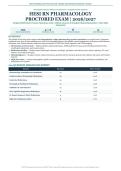
HESI RN PHARMACOLOGY PRACTICE EXAM • ORIGINAL NGN-INTEGRATED QUESTIONS • 2026/2027
RN PHARMACOLOGY SPECIALTY PRACTICE • CURRENT STUDY EDITION
HESI RN PHARMACOLOGY
PROCTORED EXAM | 2026/2027
Original HESI-Style Practice Questions with Verified Answers & Detailed Clinical Rationales | NGN-Style
Integrated
100 4×6 8 9
ORIGINAL QUESTIONS UNFOLDING CASES CONTENT DOMAINS ITEM FORMATS
OVERVIEW
This editable Word study guide contains 100 independently written pharmacology practice questions in one mixed exam. It integrates
traditional items, four six-item unfolding cases, nine Word-compatible formats, deterministic option randomization, bold-green verified answers,
calculation work, clinical rationales, distractor/response analysis, NCLEX Client Needs alignment, and CJMM mapping.
✓ Mechanisms and movement — Pharmacokinetics, pharmacodynamics, ADME, half-life, first pass, protein binding, therapeutic index,
renal/hepatic impairment, and receptor actions.
✓ Medication families — Cardiovascular, hematologic, endocrine, neurologic, psychiatric, anti-infective, pain, opioid, respiratory, GI, renal,
immune, and metabolic therapies.
✓ Clinical judgment — Recognize toxicity, analyze interactions, prioritize adverse outcomes, generate safe solutions, take action, and evaluate
response.
✓ High-alert safety — Insulin, anticoagulants, opioids, concentrated potassium, calculations, smart pumps, medication reconciliation, and
transparent error response.
100-QUESTION DOMAIN BLUEPRINT
Domain Questions Share of guide
Pharmacology Foundations & Calculations 12 12.0%
Cardiovascular & Hematologic Medications 20 20.0%
Endocrine Medications 13 13.0%
Neurologic & Psychiatric Medications 13 13.0%
Antibiotics & Anti-infectives 13 13.0%
Pain, Opioid & Respiratory Medications 12 12.0%
GI, Renal, Immune & Other Medications 9 9.0%
High-Alert Medication Safety 8 8.0%
HESI RN Pharmacology Practice Exam | 2026/2027 Edition | Original NGN-Integrated Questions | Verified Answers with Clinical Rationales | Page 1
, HESI RN PHARMACOLOGY PRACTICE EXAM • ORIGINAL NGN-INTEGRATED QUESTIONS • 2026/2027
PLAN • PRACTICE • REMEDIATE
HOW TO USE THIS MIXED EXAM
Transparent study mode for 2026/2027 RN pharmacology preparation.
CONTENT MAP
# Content domain Core emphasis Items
1 Pharmacology Foundations & Calculations ADME, kinetics, dynamics & dose calculations 12
2 Cardiovascular & Hematologic Medications Cardiac, diuretic & antithrombotic safety 20
3 Endocrine Medications Insulin, thyroid & diabetes pharmacotherapy 13
4 Neurologic & Psychiatric Medications Seizure, mood, psychosis & cognition therapies 13
5 Antibiotics & Anti-infectives Antimicrobial efficacy, reactions & stewardship 13
6 Pain, Opioid & Respiratory Medications Analgesia, reversal & respiratory pharmacology 12
7 GI, Renal, Immune & Other Medications GI, renal, immune & metabolic therapies 9
8 High-Alert Medication Safety High-alert systems, reconciliation & error response 8
FORMAT LEGEND
• Traditional multiple choice — choose the single safest or best response.
• Select all that apply — select every supported response.
• Extended multiple response — select all that apply; use the displayed plus/minus practice rule.
• Matrix/grid — choose one classification for each row.
• Bowtie — choose two actions, one condition, and two parameters.
• Cloze/drop-down — choose one option for each blank.
• Highlight — select lettered phrases that would be highlighted in an electronic record.
• Ordered response — number all steps in the safest sequence.
• Calculation/fill-in — enter the numeric response with unit and requested rounding; compare work with the displayed setup.
HESI RN Pharmacology Practice Exam | 2026/2027 Edition | Original NGN-Integrated Questions | Verified Answers with Clinical Rationales | Page 2
, HESI RN PHARMACOLOGY PRACTICE EXAM • ORIGINAL NGN-INTEGRATED QUESTIONS • 2026/2027
ONE MIXED EXAM • 100 QUESTIONS
HESI-STYLE RN PHARMACOLOGY
Medication topics are interleaved; unfolding cases remain sequential so each update is clinically coherent.
EXAM DIRECTIONS Answer each item before reading its green panel. Choices are shuffled with a fixed seed so correct answers are not tied to
one letter. For multiple-response and highlight items, select every supported option but avoid unsupported selections.
QUESTION 1 MULTIPLE CHOICE PHARMACOLOGY FOUNDATIONS & RECOGNIZE CUES
CALCULATIONS
1. A drug has a 6-hour half-life. Approximately what fraction remains 18 hours after a dose?
A. None
B. One fourth
C. One eighth
D. One half
CORRECT ANSWER C. One eighth
CLINICAL RATIONALE Eighteen hours equals three half-lives: 1 → 1/2 → 1/4 → 1/8.
DISTRACTOR / RESPONSE ANALYSIS Elimination is exponential; the drug is not necessarily completely gone after three half-lives.
ALIGNMENT Pharmacology Foundations & Calculations • NCLEX Client Needs: Pharmacological and Parenteral Therapies • CJMM: Recognize Cues
PRACTICE SCORING One point for the keyed response; zero otherwise. Maximum practice points: 1.
QUESTION 2 MULTIPLE CHOICE PHARMACOLOGY FOUNDATIONS & ANALYZE CUES
CALCULATIONS
2. Why may an oral dose be larger than an IV dose of the same drug?
A. Oral drugs always bind less protein.
B. Presystemic intestinal and hepatic metabolism can reduce oral bioavailability.
C. IV drugs have no pharmacodynamic effect.
D. IV drugs are destroyed in the stomach.
CORRECT ANSWER B. Presystemic intestinal and hepatic metabolism can reduce oral bioavailability.
CLINICAL RATIONALE First-pass metabolism removes part of an oral dose before it reaches systemic circulation.
DISTRACTOR / RESPONSE ANALYSIS IV therapy bypasses GI absorption and first pass; protein binding and pharmacodynamics do not automatically explain
the dose difference.
ALIGNMENT Pharmacology Foundations & Calculations • NCLEX Client Needs: Pharmacological and Parenteral Therapies • CJMM: Analyze Cues
PRACTICE SCORING One point for the keyed response; zero otherwise. Maximum practice points: 1.
QUESTION 3 CALCULATION / FILL-IN PAIN, OPIOID & RESPIRATORY TAKE ACTION
MEDICATIONS
STAND-ALONE NGN / CLINICAL-JUDGMENT FORMAT
3. Morphine 2 mg IV is prescribed. The vial contains 4 mg/mL. How many milliliters should the nurse prepare?
Numeric response with unit: ______________________________
CORRECT ANSWER 0.5 mL
STEP-BY-STEP CALCULATION 2 mg ÷ 4 mg/mL = 0.5 mL.
CLINICAL RATIONALE Use ordered dose divided by concentration and independently verify high-alert processes required by policy.
DISTRACTOR / RESPONSE ANALYSIS Multiplying dose by concentration gives an invalid unit and can cause overdose.
ALIGNMENT Pain, Opioid & Respiratory Medications • NCLEX Client Needs: Pharmacological and Parenteral Therapies • CJMM: Take Action
PRACTICE SCORING One point for the keyed numeric answer with unit and requested rounding. Maximum practice points: 1.
QUESTION 4 MULTIPLE CHOICE NEUROLOGIC & PSYCHIATRIC ANALYZE CUES
MEDICATIONS
4. Which cluster suggests serotonin syndrome after serotonergic medications?
A. Dry skin with hyporeflexia
B. Agitation, diaphoresis, hyperreflexia, clonus, and fever
C. Bradykinesia and lead-pipe rigidity only
D. Isolated gingival overgrowth
CORRECT ANSWER B. Agitation, diaphoresis, hyperreflexia, clonus, and fever
CLINICAL RATIONALE Neuromuscular hyperactivity plus autonomic and mental-status changes suggests serotonin toxicity.
DISTRACTOR / RESPONSE ANALYSIS Lead-pipe rigidity suggests NMS; dry/hyporeflexic or gingival findings indicate other conditions.
ALIGNMENT Neurologic & Psychiatric Medications • NCLEX Client Needs: Pharmacological and Parenteral Therapies • CJMM: Analyze Cues
PRACTICE SCORING One point for the keyed response; zero otherwise. Maximum practice points: 1.
QUESTION 5 MULTIPLE CHOICE ENDOCRINE MEDICATIONS GENERATE SOLUTIONS
5. Which teaching is most important for a client taking empagliflozin?
A. Seek care for nausea, abdominal pain, or rapid breathing even if glucose is not extremely high.
B. Genital hygiene and hydration are unrelated.
C. Continue it automatically through prolonged fasting and major surgery.
D. Euglycemic ketoacidosis is impossible.
HESI RN Pharmacology Practice Exam | 2026/2027 Edition | Original NGN-Integrated Questions | Verified Answers with Clinical Rationales | Page 3
, HESI RN PHARMACOLOGY PRACTICE EXAM • ORIGINAL NGN-INTEGRATED QUESTIONS • 2026/2027
CORRECT ANSWER A. Seek care for nausea, abdominal pain, or rapid breathing even if glucose is not extremely high.
CLINICAL RATIONALE SGLT2 inhibitors can cause euglycemic DKA and increase genital infection/volume-depletion risk; sick-day/perioperative
holding follows prescriber guidance.
DISTRACTOR / RESPONSE ANALYSIS Normal-ish glucose does not exclude DKA, and automatic continuation during fasting can increase risk.
ALIGNMENT Endocrine Medications • NCLEX Client Needs: Pharmacological and Parenteral Therapies • CJMM: Generate Solutions
PRACTICE SCORING One point for the keyed response; zero otherwise. Maximum practice points: 1.
QUESTION 6 ORDERED RESPONSE CARDIOVASCULAR & HEMATOLOGIC TAKE ACTION
MEDICATIONS
STAND-ALONE NGN / CLINICAL-JUDGMENT FORMAT
6. Order the client's actions for new chest pain when prescribed sublingual nitroglycerin.
☐ If pain is not improved after 5 minutes, activate emergency medical services Order: ____
☐ Place one prescribed tablet or spray under the tongue Order: ____
☐ Stop activity and sit or lie down safely Order: ____
☐ Continue prescribed repeat doses while awaiting help, up to the ordered maximum, unless hypotensive Order: ____
CORRECT ANSWER 1) Stop activity and sit or lie down safely → 2) Place one prescribed tablet or spray under the tongue → 3) If pain is
not improved after 5 minutes, activate emergency medical services → 4) Continue prescribed repeat doses while awaiting help, up to
the ordered maximum, unless hypotensive
CLINICAL RATIONALE Rest reduces demand, sublingual dosing provides rapid effect, and unresolved pain after one dose warrants emergency
evaluation.
DISTRACTOR / RESPONSE ANALYSIS Waiting for three doses before calling can delay reperfusion; standing increases fall risk from hypotension.
ALIGNMENT Cardiovascular & Hematologic Medications • NCLEX Client Needs: Pharmacological and Parenteral Therapies • CJMM: Take Action
PRACTICE SCORING Practice zero/one: one point only if every step is in order. Maximum practice points: 1.
QUESTION 7 MULTIPLE CHOICE ENDOCRINE MEDICATIONS RECOGNIZE CUES
7. Which instruction promotes consistent levothyroxine absorption?
A. Combine it with calcium to improve absorption.
B. Stop it when TSH first normalizes.
C. Take it on an empty stomach at the same time daily and separate it from iron/calcium as directed.
D. Take it only when symptoms occur.
CORRECT ANSWER C. Take it on an empty stomach at the same time daily and separate it from iron/calcium as directed.
CLINICAL RATIONALE Consistent empty-stomach dosing and separation from binding agents improve absorption and stable replacement.
DISTRACTOR / RESPONSE ANALYSIS Levothyroxine is scheduled long-term therapy; calcium/iron reduce absorption.
ALIGNMENT Endocrine Medications • NCLEX Client Needs: Pharmacological and Parenteral Therapies • CJMM: Recognize Cues
PRACTICE SCORING One point for the keyed response; zero otherwise. Maximum practice points: 1.
QUESTION 8 CALCULATION / FILL-IN GI, RENAL, IMMUNE & OTHER TAKE ACTION
MEDICATIONS
STAND-ALONE NGN / CLINICAL-JUDGMENT FORMAT
8. An IV immune globulin dose in 240 mL is to infuse over 4 hours after titration is complete. What average pump
rate is required?
Numeric response with unit: ______________________________
CORRECT ANSWER 60 mL/hr
STEP-BY-STEP CALCULATION 240 mL ÷ 4 hr = 60 mL/hr.
CLINICAL RATIONALE The calculated average applies only after following product-specific titration and monitoring instructions.
DISTRACTOR / RESPONSE ANALYSIS IV immune globulin rates are product/client specific; jumping directly to the average can trigger reactions.
ALIGNMENT GI, Renal, Immune & Other Medications • NCLEX Client Needs: Pharmacological and Parenteral Therapies • CJMM: Take Action
PRACTICE SCORING One point for the keyed numeric answer with unit and requested rounding. Maximum practice points: 1.
QUESTION 9 CALCULATION / FILL-IN GI, RENAL, IMMUNE & OTHER TAKE ACTION
MEDICATIONS
STAND-ALONE NGN / CLINICAL-JUDGMENT FORMAT
9. Lactulose 30 g is prescribed. Available solution contains 10 g per 15 mL. How many milliliters should be
administered?
Numeric response with unit: ______________________________
CORRECT ANSWER 45 mL
STEP-BY-STEP CALCULATION 30 g × (15 mL/10 g) = 45 mL.
CLINICAL RATIONALE Set up dimensional analysis so grams cancel and the answer remains in milliliters.
DISTRACTOR / RESPONSE ANALYSIS Dividing 30 by 15 without using the labeled ratio gives the wrong volume.
ALIGNMENT GI, Renal, Immune & Other Medications • NCLEX Client Needs: Pharmacological and Parenteral Therapies • CJMM: Take Action
PRACTICE SCORING One point for the keyed numeric answer with unit and requested rounding. Maximum practice points: 1.
QUESTION 10 MULTIPLE CHOICE GI, RENAL, IMMUNE & OTHER RECOGNIZE CUES
MEDICATIONS
10. Which finding is most concerning during tacrolimus therapy?
A. Normal potassium
B. Rising creatinine with tremor and elevated trough concentration
C. Stable graft function
D. Improved adherence
HESI RN Pharmacology Practice Exam | 2026/2027 Edition | Original NGN-Integrated Questions | Verified Answers with Clinical Rationales | Page 4
RN PHARMACOLOGY SPECIALTY PRACTICE • CURRENT STUDY EDITION
HESI RN PHARMACOLOGY
PROCTORED EXAM | 2026/2027
Original HESI-Style Practice Questions with Verified Answers & Detailed Clinical Rationales | NGN-Style
Integrated
100 4×6 8 9
ORIGINAL QUESTIONS UNFOLDING CASES CONTENT DOMAINS ITEM FORMATS
OVERVIEW
This editable Word study guide contains 100 independently written pharmacology practice questions in one mixed exam. It integrates
traditional items, four six-item unfolding cases, nine Word-compatible formats, deterministic option randomization, bold-green verified answers,
calculation work, clinical rationales, distractor/response analysis, NCLEX Client Needs alignment, and CJMM mapping.
✓ Mechanisms and movement — Pharmacokinetics, pharmacodynamics, ADME, half-life, first pass, protein binding, therapeutic index,
renal/hepatic impairment, and receptor actions.
✓ Medication families — Cardiovascular, hematologic, endocrine, neurologic, psychiatric, anti-infective, pain, opioid, respiratory, GI, renal,
immune, and metabolic therapies.
✓ Clinical judgment — Recognize toxicity, analyze interactions, prioritize adverse outcomes, generate safe solutions, take action, and evaluate
response.
✓ High-alert safety — Insulin, anticoagulants, opioids, concentrated potassium, calculations, smart pumps, medication reconciliation, and
transparent error response.
100-QUESTION DOMAIN BLUEPRINT
Domain Questions Share of guide
Pharmacology Foundations & Calculations 12 12.0%
Cardiovascular & Hematologic Medications 20 20.0%
Endocrine Medications 13 13.0%
Neurologic & Psychiatric Medications 13 13.0%
Antibiotics & Anti-infectives 13 13.0%
Pain, Opioid & Respiratory Medications 12 12.0%
GI, Renal, Immune & Other Medications 9 9.0%
High-Alert Medication Safety 8 8.0%
HESI RN Pharmacology Practice Exam | 2026/2027 Edition | Original NGN-Integrated Questions | Verified Answers with Clinical Rationales | Page 1
, HESI RN PHARMACOLOGY PRACTICE EXAM • ORIGINAL NGN-INTEGRATED QUESTIONS • 2026/2027
PLAN • PRACTICE • REMEDIATE
HOW TO USE THIS MIXED EXAM
Transparent study mode for 2026/2027 RN pharmacology preparation.
CONTENT MAP
# Content domain Core emphasis Items
1 Pharmacology Foundations & Calculations ADME, kinetics, dynamics & dose calculations 12
2 Cardiovascular & Hematologic Medications Cardiac, diuretic & antithrombotic safety 20
3 Endocrine Medications Insulin, thyroid & diabetes pharmacotherapy 13
4 Neurologic & Psychiatric Medications Seizure, mood, psychosis & cognition therapies 13
5 Antibiotics & Anti-infectives Antimicrobial efficacy, reactions & stewardship 13
6 Pain, Opioid & Respiratory Medications Analgesia, reversal & respiratory pharmacology 12
7 GI, Renal, Immune & Other Medications GI, renal, immune & metabolic therapies 9
8 High-Alert Medication Safety High-alert systems, reconciliation & error response 8
FORMAT LEGEND
• Traditional multiple choice — choose the single safest or best response.
• Select all that apply — select every supported response.
• Extended multiple response — select all that apply; use the displayed plus/minus practice rule.
• Matrix/grid — choose one classification for each row.
• Bowtie — choose two actions, one condition, and two parameters.
• Cloze/drop-down — choose one option for each blank.
• Highlight — select lettered phrases that would be highlighted in an electronic record.
• Ordered response — number all steps in the safest sequence.
• Calculation/fill-in — enter the numeric response with unit and requested rounding; compare work with the displayed setup.
HESI RN Pharmacology Practice Exam | 2026/2027 Edition | Original NGN-Integrated Questions | Verified Answers with Clinical Rationales | Page 2
, HESI RN PHARMACOLOGY PRACTICE EXAM • ORIGINAL NGN-INTEGRATED QUESTIONS • 2026/2027
ONE MIXED EXAM • 100 QUESTIONS
HESI-STYLE RN PHARMACOLOGY
Medication topics are interleaved; unfolding cases remain sequential so each update is clinically coherent.
EXAM DIRECTIONS Answer each item before reading its green panel. Choices are shuffled with a fixed seed so correct answers are not tied to
one letter. For multiple-response and highlight items, select every supported option but avoid unsupported selections.
QUESTION 1 MULTIPLE CHOICE PHARMACOLOGY FOUNDATIONS & RECOGNIZE CUES
CALCULATIONS
1. A drug has a 6-hour half-life. Approximately what fraction remains 18 hours after a dose?
A. None
B. One fourth
C. One eighth
D. One half
CORRECT ANSWER C. One eighth
CLINICAL RATIONALE Eighteen hours equals three half-lives: 1 → 1/2 → 1/4 → 1/8.
DISTRACTOR / RESPONSE ANALYSIS Elimination is exponential; the drug is not necessarily completely gone after three half-lives.
ALIGNMENT Pharmacology Foundations & Calculations • NCLEX Client Needs: Pharmacological and Parenteral Therapies • CJMM: Recognize Cues
PRACTICE SCORING One point for the keyed response; zero otherwise. Maximum practice points: 1.
QUESTION 2 MULTIPLE CHOICE PHARMACOLOGY FOUNDATIONS & ANALYZE CUES
CALCULATIONS
2. Why may an oral dose be larger than an IV dose of the same drug?
A. Oral drugs always bind less protein.
B. Presystemic intestinal and hepatic metabolism can reduce oral bioavailability.
C. IV drugs have no pharmacodynamic effect.
D. IV drugs are destroyed in the stomach.
CORRECT ANSWER B. Presystemic intestinal and hepatic metabolism can reduce oral bioavailability.
CLINICAL RATIONALE First-pass metabolism removes part of an oral dose before it reaches systemic circulation.
DISTRACTOR / RESPONSE ANALYSIS IV therapy bypasses GI absorption and first pass; protein binding and pharmacodynamics do not automatically explain
the dose difference.
ALIGNMENT Pharmacology Foundations & Calculations • NCLEX Client Needs: Pharmacological and Parenteral Therapies • CJMM: Analyze Cues
PRACTICE SCORING One point for the keyed response; zero otherwise. Maximum practice points: 1.
QUESTION 3 CALCULATION / FILL-IN PAIN, OPIOID & RESPIRATORY TAKE ACTION
MEDICATIONS
STAND-ALONE NGN / CLINICAL-JUDGMENT FORMAT
3. Morphine 2 mg IV is prescribed. The vial contains 4 mg/mL. How many milliliters should the nurse prepare?
Numeric response with unit: ______________________________
CORRECT ANSWER 0.5 mL
STEP-BY-STEP CALCULATION 2 mg ÷ 4 mg/mL = 0.5 mL.
CLINICAL RATIONALE Use ordered dose divided by concentration and independently verify high-alert processes required by policy.
DISTRACTOR / RESPONSE ANALYSIS Multiplying dose by concentration gives an invalid unit and can cause overdose.
ALIGNMENT Pain, Opioid & Respiratory Medications • NCLEX Client Needs: Pharmacological and Parenteral Therapies • CJMM: Take Action
PRACTICE SCORING One point for the keyed numeric answer with unit and requested rounding. Maximum practice points: 1.
QUESTION 4 MULTIPLE CHOICE NEUROLOGIC & PSYCHIATRIC ANALYZE CUES
MEDICATIONS
4. Which cluster suggests serotonin syndrome after serotonergic medications?
A. Dry skin with hyporeflexia
B. Agitation, diaphoresis, hyperreflexia, clonus, and fever
C. Bradykinesia and lead-pipe rigidity only
D. Isolated gingival overgrowth
CORRECT ANSWER B. Agitation, diaphoresis, hyperreflexia, clonus, and fever
CLINICAL RATIONALE Neuromuscular hyperactivity plus autonomic and mental-status changes suggests serotonin toxicity.
DISTRACTOR / RESPONSE ANALYSIS Lead-pipe rigidity suggests NMS; dry/hyporeflexic or gingival findings indicate other conditions.
ALIGNMENT Neurologic & Psychiatric Medications • NCLEX Client Needs: Pharmacological and Parenteral Therapies • CJMM: Analyze Cues
PRACTICE SCORING One point for the keyed response; zero otherwise. Maximum practice points: 1.
QUESTION 5 MULTIPLE CHOICE ENDOCRINE MEDICATIONS GENERATE SOLUTIONS
5. Which teaching is most important for a client taking empagliflozin?
A. Seek care for nausea, abdominal pain, or rapid breathing even if glucose is not extremely high.
B. Genital hygiene and hydration are unrelated.
C. Continue it automatically through prolonged fasting and major surgery.
D. Euglycemic ketoacidosis is impossible.
HESI RN Pharmacology Practice Exam | 2026/2027 Edition | Original NGN-Integrated Questions | Verified Answers with Clinical Rationales | Page 3
, HESI RN PHARMACOLOGY PRACTICE EXAM • ORIGINAL NGN-INTEGRATED QUESTIONS • 2026/2027
CORRECT ANSWER A. Seek care for nausea, abdominal pain, or rapid breathing even if glucose is not extremely high.
CLINICAL RATIONALE SGLT2 inhibitors can cause euglycemic DKA and increase genital infection/volume-depletion risk; sick-day/perioperative
holding follows prescriber guidance.
DISTRACTOR / RESPONSE ANALYSIS Normal-ish glucose does not exclude DKA, and automatic continuation during fasting can increase risk.
ALIGNMENT Endocrine Medications • NCLEX Client Needs: Pharmacological and Parenteral Therapies • CJMM: Generate Solutions
PRACTICE SCORING One point for the keyed response; zero otherwise. Maximum practice points: 1.
QUESTION 6 ORDERED RESPONSE CARDIOVASCULAR & HEMATOLOGIC TAKE ACTION
MEDICATIONS
STAND-ALONE NGN / CLINICAL-JUDGMENT FORMAT
6. Order the client's actions for new chest pain when prescribed sublingual nitroglycerin.
☐ If pain is not improved after 5 minutes, activate emergency medical services Order: ____
☐ Place one prescribed tablet or spray under the tongue Order: ____
☐ Stop activity and sit or lie down safely Order: ____
☐ Continue prescribed repeat doses while awaiting help, up to the ordered maximum, unless hypotensive Order: ____
CORRECT ANSWER 1) Stop activity and sit or lie down safely → 2) Place one prescribed tablet or spray under the tongue → 3) If pain is
not improved after 5 minutes, activate emergency medical services → 4) Continue prescribed repeat doses while awaiting help, up to
the ordered maximum, unless hypotensive
CLINICAL RATIONALE Rest reduces demand, sublingual dosing provides rapid effect, and unresolved pain after one dose warrants emergency
evaluation.
DISTRACTOR / RESPONSE ANALYSIS Waiting for three doses before calling can delay reperfusion; standing increases fall risk from hypotension.
ALIGNMENT Cardiovascular & Hematologic Medications • NCLEX Client Needs: Pharmacological and Parenteral Therapies • CJMM: Take Action
PRACTICE SCORING Practice zero/one: one point only if every step is in order. Maximum practice points: 1.
QUESTION 7 MULTIPLE CHOICE ENDOCRINE MEDICATIONS RECOGNIZE CUES
7. Which instruction promotes consistent levothyroxine absorption?
A. Combine it with calcium to improve absorption.
B. Stop it when TSH first normalizes.
C. Take it on an empty stomach at the same time daily and separate it from iron/calcium as directed.
D. Take it only when symptoms occur.
CORRECT ANSWER C. Take it on an empty stomach at the same time daily and separate it from iron/calcium as directed.
CLINICAL RATIONALE Consistent empty-stomach dosing and separation from binding agents improve absorption and stable replacement.
DISTRACTOR / RESPONSE ANALYSIS Levothyroxine is scheduled long-term therapy; calcium/iron reduce absorption.
ALIGNMENT Endocrine Medications • NCLEX Client Needs: Pharmacological and Parenteral Therapies • CJMM: Recognize Cues
PRACTICE SCORING One point for the keyed response; zero otherwise. Maximum practice points: 1.
QUESTION 8 CALCULATION / FILL-IN GI, RENAL, IMMUNE & OTHER TAKE ACTION
MEDICATIONS
STAND-ALONE NGN / CLINICAL-JUDGMENT FORMAT
8. An IV immune globulin dose in 240 mL is to infuse over 4 hours after titration is complete. What average pump
rate is required?
Numeric response with unit: ______________________________
CORRECT ANSWER 60 mL/hr
STEP-BY-STEP CALCULATION 240 mL ÷ 4 hr = 60 mL/hr.
CLINICAL RATIONALE The calculated average applies only after following product-specific titration and monitoring instructions.
DISTRACTOR / RESPONSE ANALYSIS IV immune globulin rates are product/client specific; jumping directly to the average can trigger reactions.
ALIGNMENT GI, Renal, Immune & Other Medications • NCLEX Client Needs: Pharmacological and Parenteral Therapies • CJMM: Take Action
PRACTICE SCORING One point for the keyed numeric answer with unit and requested rounding. Maximum practice points: 1.
QUESTION 9 CALCULATION / FILL-IN GI, RENAL, IMMUNE & OTHER TAKE ACTION
MEDICATIONS
STAND-ALONE NGN / CLINICAL-JUDGMENT FORMAT
9. Lactulose 30 g is prescribed. Available solution contains 10 g per 15 mL. How many milliliters should be
administered?
Numeric response with unit: ______________________________
CORRECT ANSWER 45 mL
STEP-BY-STEP CALCULATION 30 g × (15 mL/10 g) = 45 mL.
CLINICAL RATIONALE Set up dimensional analysis so grams cancel and the answer remains in milliliters.
DISTRACTOR / RESPONSE ANALYSIS Dividing 30 by 15 without using the labeled ratio gives the wrong volume.
ALIGNMENT GI, Renal, Immune & Other Medications • NCLEX Client Needs: Pharmacological and Parenteral Therapies • CJMM: Take Action
PRACTICE SCORING One point for the keyed numeric answer with unit and requested rounding. Maximum practice points: 1.
QUESTION 10 MULTIPLE CHOICE GI, RENAL, IMMUNE & OTHER RECOGNIZE CUES
MEDICATIONS
10. Which finding is most concerning during tacrolimus therapy?
A. Normal potassium
B. Rising creatinine with tremor and elevated trough concentration
C. Stable graft function
D. Improved adherence
HESI RN Pharmacology Practice Exam | 2026/2027 Edition | Original NGN-Integrated Questions | Verified Answers with Clinical Rationales | Page 4


