

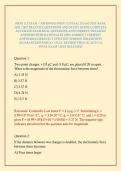
PHYS 112 EXAM / APPROVED PHYS 112 FINAL EXAM TEST BANK
2026 /2027 PRACTICE QUESTIONS AND STUDY GUIDE COMPLETE
ACCURATE EXAM REAL QUESTIONS AND CORRECT DETAILED
ANSWERS WITH RATIONALES (100% CORRECT VERIFIED
ANSWERS) CURRENTLY UPDATED VERSION 2026 EDITION
|GUARANTEED PASS A+ |FULL REVISED PHYS 112 ACTUAL
FINAL EXAM |JUST RELEASED
Question 1:
Two point charges, +3.0 μC and -5.0 μC, are placed 0.20 m apart.
What is the magnitude of the electrostatic force between them?
A) 1.35 N
B) 3.37 N
C) 3.37 N
D) 6.74 N
E) 13.5 N
Rationale: Coulomb's Law states F = k|q₁q₂|/r². Substituting k =
8.99×10⁹ N·m²/C², q₁ = 3.0×10⁻⁶ C, q₂ = 5.0×10⁻⁶ C, and r = 0.20 m
gives F = (8.99×10⁹)(15×10⁻¹²)/(0.04) = 3.37 N. The negative sign
indicates attraction but the question asks for magnitude.
Question 2:
If the distance between two charges is doubled, the electrostatic force
between them becomes:
A) Four times larger
,B) One-fourth as large
C) Twice as large
D) One-half as large
E) Unchanged
Rationale: Coulomb's Law is inversely proportional to the square of
the distance (F ∝ 1/r²). When r doubles, F decreases by a factor of 2²
= 4.
Question 3:
The fundamental charge e is equal to:
A) 1.6 × 10⁻¹⁹ C
B) 1.6 × 10⁻¹⁹ C
C) 1.6 × 10¹⁹ C
D) 9.11 × 10⁻³¹ C
E) 1.67 × 10⁻²⁷ C
Rationale: The fundamental charge is the magnitude of charge of an
electron or proton, e = 1.60 × 10⁻¹⁹ C.
Question 4:
Two identical charges experience a force of 2.0 N when separated by
0.50 m. What is the magnitude of each charge?
A) 1.2 × 10⁻⁶ C
,B) 2.4 × 10⁻⁶ C
C) 7.5 × 10⁻⁶ C
D) 1.5 × 10⁻⁵ C
E) 3.0 × 10⁻⁵ C
Rationale: Using F = kq²/r², q = r√(F/k) = 0.50√(2.0/8.99×10⁹) =
0.50√(2.225×10⁻¹⁰) = 0.50(1.49×10⁻⁵) = 7.45×10⁻⁶ C ≈ 7.5×10⁻⁶ C.
Question 5:
A hydrogen nucleus (+e) is located to the left of a carbon nucleus
(+6e). The force on the hydrogen nucleus is:
A) To the right with greater magnitude than the force on carbon
B) To the left with greater magnitude than the force on carbon
C) To the left with equal magnitude to the force on carbon
D) To the right with equal magnitude to the force on carbon
E) Zero
Rationale: By Newton's Third Law, the forces are equal in
magnitude and opposite in direction. Both charges are positive, so
they repel; the hydrogen nucleus experiences a force to the left.
Question 6:
Three charges are arranged in a line: +q at x=0, -2q at x=d, and +q
at x=2d. The net force on the charge at x=d is:
, A) Zero
B) To the right
C) To the left
D) Cannot be determined
E) kq²/d² to the right
Rationale: The -2q charge experiences attraction to the left from +q
at x=0 (F = 2kq²/d² left) and attraction to the right from +q at x=2d
(F = 2kq²/d² right). These forces are equal and opposite, so the net
force is zero. Wait, correction: Actually both forces are attractive, so
the net force is zero. The correct answer is A.
Question 7:
The electric field inside a charged parallel plate capacitor is:
A) Zero
B) Uniform
C) Non-uniform
D) Perpendicular to the plates
E) Dependent on plate separation
Rationale: The electric field between two parallel plates with uniform
charge distribution is uniform (constant magnitude and direction) in
the region between the plates, except near the edges.
Question 8:
2026 /2027 PRACTICE QUESTIONS AND STUDY GUIDE COMPLETE
ACCURATE EXAM REAL QUESTIONS AND CORRECT DETAILED
ANSWERS WITH RATIONALES (100% CORRECT VERIFIED
ANSWERS) CURRENTLY UPDATED VERSION 2026 EDITION
|GUARANTEED PASS A+ |FULL REVISED PHYS 112 ACTUAL
FINAL EXAM |JUST RELEASED
Question 1:
Two point charges, +3.0 μC and -5.0 μC, are placed 0.20 m apart.
What is the magnitude of the electrostatic force between them?
A) 1.35 N
B) 3.37 N
C) 3.37 N
D) 6.74 N
E) 13.5 N
Rationale: Coulomb's Law states F = k|q₁q₂|/r². Substituting k =
8.99×10⁹ N·m²/C², q₁ = 3.0×10⁻⁶ C, q₂ = 5.0×10⁻⁶ C, and r = 0.20 m
gives F = (8.99×10⁹)(15×10⁻¹²)/(0.04) = 3.37 N. The negative sign
indicates attraction but the question asks for magnitude.
Question 2:
If the distance between two charges is doubled, the electrostatic force
between them becomes:
A) Four times larger
,B) One-fourth as large
C) Twice as large
D) One-half as large
E) Unchanged
Rationale: Coulomb's Law is inversely proportional to the square of
the distance (F ∝ 1/r²). When r doubles, F decreases by a factor of 2²
= 4.
Question 3:
The fundamental charge e is equal to:
A) 1.6 × 10⁻¹⁹ C
B) 1.6 × 10⁻¹⁹ C
C) 1.6 × 10¹⁹ C
D) 9.11 × 10⁻³¹ C
E) 1.67 × 10⁻²⁷ C
Rationale: The fundamental charge is the magnitude of charge of an
electron or proton, e = 1.60 × 10⁻¹⁹ C.
Question 4:
Two identical charges experience a force of 2.0 N when separated by
0.50 m. What is the magnitude of each charge?
A) 1.2 × 10⁻⁶ C
,B) 2.4 × 10⁻⁶ C
C) 7.5 × 10⁻⁶ C
D) 1.5 × 10⁻⁵ C
E) 3.0 × 10⁻⁵ C
Rationale: Using F = kq²/r², q = r√(F/k) = 0.50√(2.0/8.99×10⁹) =
0.50√(2.225×10⁻¹⁰) = 0.50(1.49×10⁻⁵) = 7.45×10⁻⁶ C ≈ 7.5×10⁻⁶ C.
Question 5:
A hydrogen nucleus (+e) is located to the left of a carbon nucleus
(+6e). The force on the hydrogen nucleus is:
A) To the right with greater magnitude than the force on carbon
B) To the left with greater magnitude than the force on carbon
C) To the left with equal magnitude to the force on carbon
D) To the right with equal magnitude to the force on carbon
E) Zero
Rationale: By Newton's Third Law, the forces are equal in
magnitude and opposite in direction. Both charges are positive, so
they repel; the hydrogen nucleus experiences a force to the left.
Question 6:
Three charges are arranged in a line: +q at x=0, -2q at x=d, and +q
at x=2d. The net force on the charge at x=d is:
, A) Zero
B) To the right
C) To the left
D) Cannot be determined
E) kq²/d² to the right
Rationale: The -2q charge experiences attraction to the left from +q
at x=0 (F = 2kq²/d² left) and attraction to the right from +q at x=2d
(F = 2kq²/d² right). These forces are equal and opposite, so the net
force is zero. Wait, correction: Actually both forces are attractive, so
the net force is zero. The correct answer is A.
Question 7:
The electric field inside a charged parallel plate capacitor is:
A) Zero
B) Uniform
C) Non-uniform
D) Perpendicular to the plates
E) Dependent on plate separation
Rationale: The electric field between two parallel plates with uniform
charge distribution is uniform (constant magnitude and direction) in
the region between the plates, except near the edges.
Question 8:


