

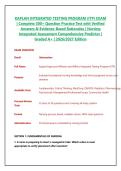
KAPLAN INTEGRATED TESTING PROGRAM (ITP) EXAM
| Complete 300+ Question Practice Test with Verified
Answers & Evidence-Based Rationales | Nursing
Integrated Assessment Comprehensive Predictor |
Graded A+ | 2026/2027 Edition
EXAM OVERVIEW
Detail Information
Full Name Kaplan/Lippincott Williams and Wilkins Integrated Testing Program (KTP)
Evaluate foundational nursing knowledge and clinical judgment across core
Purpose
domains
Fundamentals, Critical Thinking, Med/Surg, OB/GYN, Pediatrics, Pharmacology,
Available Tests
Psychosocial, Management/Professional Issues, Community Health
Focused Review
32 tests of 30 questions each covering all body systems
Tests
Format Nursing process-based, multiple-choice, NGN-style questions
Administration Proctored exams scheduled by nursing schools
SECTION 1: FUNDAMENTALS OF NURSING
1. A nurse is preparing to insert a nasogastric tube. Which action is most
appropriate to verify placement after insertion?
,A) Auscultate for air insufflation over the epigastric area
B) Measure the pH of aspirated gastric contents
C) Obtain a chest X-ray
D) Observe for bubbling when the tube is submerged in water
Answer: C
Rationale: Chest X-ray is the gold standard for confirming NG tube placement. pH testing
is useful for screening but is not definitive. Auscultation is unreliable for confirming
placement.
2. Which finding indicates a need for suctioning a tracheostomy tube?
A) Heart rate of 80 bpm
B) Respiratory rate of 18 breaths/min
C) Restlessness and decreased oxygen saturation
D) Pink, moist stoma
Answer: C
Rationale: Restlessness, increased work of breathing, and decreased SpO2 indicate airway
obstruction requiring suctioning. A normal heart rate and respiratory rate, and a pink,
moist stoma are expected findings.
3. A client with a new colostomy asks, "What foods should I avoid?" Which
response by the nurse is correct?
A) "You can eat anything you want."
B) "Avoid gas-forming foods like carbonated beverages."
C) "Avoid all fruits and vegetables."
D) "Only eat soft foods."
Answer: B
Rationale: Gas-forming foods like carbonated beverages, beans, and cabbage should be
avoided. Clients can eat most foods but should introduce new foods one at a time.
,4. A nurse is providing post-operative care to a client who had abdominal surgery.
Which action is most important to prevent deep vein thrombosis?
A) Administer prescribed anticoagulants
B) Encourage early ambulation
C) Apply sequential compression devices
D) All of the above
Answer: D
Rationale: All of these measures help prevent DVT in post-operative clients. Early
ambulation, SCDs, and anticoagulants are all appropriate interventions.
5. A client is in the immediate post-operative period. Which assessment finding
should the nurse report FIRST?
A) Pain score 6/10
B) Heart rate 110 bpm
C) Blood pressure 100/60 mmHg
D) Urine output 25 mL/hr
Answer: D
Rationale: Urine output <30 mL/hr indicates inadequate renal perfusion and should be
reported immediately. The other findings require monitoring but are not as urgent.
6. A nurse is performing a sterile dressing change. Which action contaminates the
sterile field?
A) Opening sterile packages away from the body
B) Setting the sterile field at waist level
C) Reaching across the sterile field to obtain a gauze
D) Pouring sterile solution into a sterile container
Answer: C
Rationale: Reaching across a sterile field contaminates it. The 1-inch border is also
considered contaminated. Maintaining sterility requires not reaching over the field.
, 7. A client with heart failure is prescribed furosemide. Which electrolyte imbalance
should the nurse monitor?
A) Hyperkalemia
B) Hypokalemia
C) Hyponatremia
D) Hypercalcemia
Answer: B
Rationale: Furosemide is a loop diuretic that causes potassium loss, leading to
hypokalemia. Monitoring electrolytes is critical to prevent cardiac complications.
8. A nurse is teaching a client about dietary modifications for hypertension. Which
statement indicates understanding?
A) "I will limit my sodium intake to 2 grams per day."
B) "I will increase my sodium intake."
C) "I will eat more processed foods."
D) "I will add salt to my meals."
Answer: A
Rationale: Limiting sodium to 2 grams per day helps manage hypertension. Processed
foods are typically high in sodium.
9. A client is prescribed digoxin for heart failure. Which finding indicates digoxin
toxicity?
A) Heart rate of 100 bpm
B) Nausea and vomiting
C) Constipation
D) Weight gain
Answer: B
Rationale: Nausea, vomiting, and visual disturbances (yellow-green halos) are classic signs
of digoxin toxicity. Bradycardia is also a sign.
| Complete 300+ Question Practice Test with Verified
Answers & Evidence-Based Rationales | Nursing
Integrated Assessment Comprehensive Predictor |
Graded A+ | 2026/2027 Edition
EXAM OVERVIEW
Detail Information
Full Name Kaplan/Lippincott Williams and Wilkins Integrated Testing Program (KTP)
Evaluate foundational nursing knowledge and clinical judgment across core
Purpose
domains
Fundamentals, Critical Thinking, Med/Surg, OB/GYN, Pediatrics, Pharmacology,
Available Tests
Psychosocial, Management/Professional Issues, Community Health
Focused Review
32 tests of 30 questions each covering all body systems
Tests
Format Nursing process-based, multiple-choice, NGN-style questions
Administration Proctored exams scheduled by nursing schools
SECTION 1: FUNDAMENTALS OF NURSING
1. A nurse is preparing to insert a nasogastric tube. Which action is most
appropriate to verify placement after insertion?
,A) Auscultate for air insufflation over the epigastric area
B) Measure the pH of aspirated gastric contents
C) Obtain a chest X-ray
D) Observe for bubbling when the tube is submerged in water
Answer: C
Rationale: Chest X-ray is the gold standard for confirming NG tube placement. pH testing
is useful for screening but is not definitive. Auscultation is unreliable for confirming
placement.
2. Which finding indicates a need for suctioning a tracheostomy tube?
A) Heart rate of 80 bpm
B) Respiratory rate of 18 breaths/min
C) Restlessness and decreased oxygen saturation
D) Pink, moist stoma
Answer: C
Rationale: Restlessness, increased work of breathing, and decreased SpO2 indicate airway
obstruction requiring suctioning. A normal heart rate and respiratory rate, and a pink,
moist stoma are expected findings.
3. A client with a new colostomy asks, "What foods should I avoid?" Which
response by the nurse is correct?
A) "You can eat anything you want."
B) "Avoid gas-forming foods like carbonated beverages."
C) "Avoid all fruits and vegetables."
D) "Only eat soft foods."
Answer: B
Rationale: Gas-forming foods like carbonated beverages, beans, and cabbage should be
avoided. Clients can eat most foods but should introduce new foods one at a time.
,4. A nurse is providing post-operative care to a client who had abdominal surgery.
Which action is most important to prevent deep vein thrombosis?
A) Administer prescribed anticoagulants
B) Encourage early ambulation
C) Apply sequential compression devices
D) All of the above
Answer: D
Rationale: All of these measures help prevent DVT in post-operative clients. Early
ambulation, SCDs, and anticoagulants are all appropriate interventions.
5. A client is in the immediate post-operative period. Which assessment finding
should the nurse report FIRST?
A) Pain score 6/10
B) Heart rate 110 bpm
C) Blood pressure 100/60 mmHg
D) Urine output 25 mL/hr
Answer: D
Rationale: Urine output <30 mL/hr indicates inadequate renal perfusion and should be
reported immediately. The other findings require monitoring but are not as urgent.
6. A nurse is performing a sterile dressing change. Which action contaminates the
sterile field?
A) Opening sterile packages away from the body
B) Setting the sterile field at waist level
C) Reaching across the sterile field to obtain a gauze
D) Pouring sterile solution into a sterile container
Answer: C
Rationale: Reaching across a sterile field contaminates it. The 1-inch border is also
considered contaminated. Maintaining sterility requires not reaching over the field.
, 7. A client with heart failure is prescribed furosemide. Which electrolyte imbalance
should the nurse monitor?
A) Hyperkalemia
B) Hypokalemia
C) Hyponatremia
D) Hypercalcemia
Answer: B
Rationale: Furosemide is a loop diuretic that causes potassium loss, leading to
hypokalemia. Monitoring electrolytes is critical to prevent cardiac complications.
8. A nurse is teaching a client about dietary modifications for hypertension. Which
statement indicates understanding?
A) "I will limit my sodium intake to 2 grams per day."
B) "I will increase my sodium intake."
C) "I will eat more processed foods."
D) "I will add salt to my meals."
Answer: A
Rationale: Limiting sodium to 2 grams per day helps manage hypertension. Processed
foods are typically high in sodium.
9. A client is prescribed digoxin for heart failure. Which finding indicates digoxin
toxicity?
A) Heart rate of 100 bpm
B) Nausea and vomiting
C) Constipation
D) Weight gain
Answer: B
Rationale: Nausea, vomiting, and visual disturbances (yellow-green halos) are classic signs
of digoxin toxicity. Bradycardia is also a sign.


