

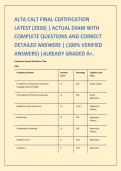
ALTA CALT FINAL CERTIFICATION
LATEST (2026) | ACTUAL EXAM WITH
COMPLETE QUESTIONS AND CORRECT
DETAILED ANSWERS | (100% VERIFIED
ANSWERS) |ALREADY GRADED A+.
Competency Domain Distribution Table
Table
Competency Domain Question Percentage Cognitive Level
Count Focus
Foundations of Multisensory Structured 12 10% Recall, Analysis
Language Education (MSLE)
Phonological and Phonemic Awareness 12 10% Recall,
Application
Alphabet Principle and Phonics 14 11.5% Application,
Analysis
Morphology 12 10% Application,
Analysis
Orthography and Spelling 12 10% Application,
Analysis
Reading Fluency 8 6.5% Application
Vocabulary 8 6.5% Application
, Competency Domain Question Percentage Cognitive Level
Count Focus
Comprehension 10 8.5% Application,
Analysis
Handwriting and Written Expression 6 5% Application
Assessment and Diagnostic Teaching 14 11.5% Analysis
Therapy Planning and Delivery 10 8.5% Application,
Analysis
Professional and Ethical Practice 8 6.5% Recall,
Application
TOTAL 120 100%
CASE STUDY A: Comprehensive Student Profile
Student: Marcus, age 9 years 3 months, fourth grade
Referral Concern: Significant difficulty with reading decoding, spelling, and written expression despite average
intelligence and strong oral vocabulary.
Assessment Data:
• WJ-IV ACH Letter-Word Identification: Standard Score 82 (12th percentile)
• WJ-IV ACH Word Attack: Standard Score 78 (7th percentile)
• WJ-IV ACH Spelling: Standard Score 80 (9th percentile)
• WJ-IV ACH Passage Comprehension: Standard Score 88 (21st percentile)
• CTOPP-2 Elision: Standard Score 85 (16th percentile)
• CTOPP-2 Blending Words: Standard Score 83 (13th percentile)
• TOWRE-2 Sight Word Efficiency: Standard Score 79 (8th percentile)
• TOWRE-2 Phonemic Decoding Efficiency: Standard Score 76 (5th percentile)
• DSA (Developmental Spelling Analysis): Stage — Phonetic (mid-to-late)
,Writing Sample: "The litle boy whent to the store. He byed sum candy. It was gud. He eated it fast."
Teacher Report: Marcus avoids reading aloud, guesses at unfamiliar words using first-letter cues, and writes
minimal responses. He has memorized approximately 75 high-frequency words. He demonstrates strong listening
comprehension and verbal reasoning.
Q1: Based on Marcus's assessment profile, which underlying processing deficit most significantly contributes to his
reading and spelling difficulties?
A. Orthographic processing weakness with intact phonological skills
B. Phonological processing deficit with emerging orthographic knowledge
C. Semantic processing impairment affecting vocabulary access
D. Syntactic processing disorder impacting sentence comprehension
Correct Answer: B
Rationale: Marcus's consistently low scores on phonological measures (CTOPP-2 Elision and Blending Words in the
13th–16th percentiles) combined with poor nonword decoding (Word Attack SS 78) and phonetic spelling stage
indicate a core phonological processing deficit. His average oral vocabulary and listening comprehension (implied
by Passage Comprehension SS 88 relative to decoding scores) suggest intact semantic and syntactic processing.
This pattern aligns with ALTA standards for dyslexia identification, which emphasize phonological deficits as the
primary characteristic.
Q2: Marcus's spelling of whent for went, byed for bought, and eated for ate best illustrates which developmental
spelling characteristic?
A. Precommunicative random letter strings without sound-symbol correspondence
B. Semiphonetic use of salient sounds only with omissions of medial phonemes
C. Phonetic stage application of regular sound-symbol correspondences to irregular words
D. Transitional stage overgeneralization of morphological patterns
Correct Answer: C
Rationale: Marcus's spellings demonstrate consistent application of phoneme-grapheme correspondences to
words that violate standard English orthography (whent applies the regular past tense /t/ pattern; byed uses
phonetic approximation). This is characteristic of the phonetic stage, where students spell by sound without full
appreciation of orthographic conventions, morphological history, or irregular word patterns. ALTA MSLE principles
emphasize that students in this stage require explicit instruction in irregular word patterns and morphological
structure.
Q3: Which instructional priority should be addressed FIRST in Marcus's multisensory structured language therapy
plan?
A. Morphological analysis of Latin roots and affixes to build academic vocabulary
B. Systematic, explicit phonics instruction targeting advanced syllable types and syllable division
C. Direct comprehension strategy instruction using expository text structures
D. Cursive handwriting instruction to improve letter formation automaticity
, Correct Answer: B
Rationale: According to the diagnostic-prescriptive teaching cycle central to ALTA MSLE practice, intervention must
target the lowest unmastered skill level in the scope and sequence. Marcus's phonetic spelling stage, poor
nonword decoding, and weak phonemic awareness indicate he has not mastered basic and intermediate phonics
concepts, including vowel teams, r-controlled syllables, and syllable division patterns. Instruction must be
systematic and sequential, building from mastered skills (consonant sounds, short vowels, closed syllables)
forward. Advanced morphology and comprehension strategy instruction would be premature without
foundational decoding automaticity.
Q4: When designing Marcus's progress monitoring plan, which data collection method best aligns with ALTA
standards for diagnostic-prescriptive teaching?
A. Weekly standardized test administration to track standard score changes
B. Daily curriculum-based measurement (CBM) of oral reading fluency and weekly spelling dictation probes
C. Monthly teacher interviews regarding classroom participation and behavior
D. Quarterly portfolio review of completed workbook pages and worksheets
Correct Answer: B
Rationale: ALTA emphasizes frequent, specific, and measurable data collection to inform instructional decision-
making. Curriculum-based measurement (CBM) provides sensitive, repeatable indicators of progress in
foundational skills. Weekly ORF CBM tracks decoding automaticity and rate growth, while spelling dictation probes
assess mastery of taught patterns. Standardized tests are inappropriate for frequent monitoring due to practice
effects. Teacher interviews and portfolio reviews lack the specificity and reliability required for diagnostic-
prescriptive adjustments.
MINI-CASE B: Multisensory Teaching Scenario
Scenario: A CALT is introducing the vowel team /ee/ (spelled ee and ea) to a group of three second-grade students.
All students have mastered closed syllables, open syllables, and VCe syllables. Two students have weak visual
memory but strong auditory processing; one student has strong visual memory but weak auditory processing.
Q5: Which multisensory instructional sequence best applies the principle of simultaneous multisensory instruction
for introducing the /ee/ vowel team?
A. Students trace the letter pattern in sand while saying the sound, then write the pattern on paper while saying a
keyword, then read the pattern in isolation and in words
B. Students listen to a recorded explanation of the rule, then complete a worksheet circling words with ee and ea,
then take a spelling test
C. Students watch a video demonstration of the sound, then discuss with a partner, then independently read a
decodable passage
D. Students memorize a list of ee and ea words through flashcard repetition, then write each word five times, then
sort words by pattern
LATEST (2026) | ACTUAL EXAM WITH
COMPLETE QUESTIONS AND CORRECT
DETAILED ANSWERS | (100% VERIFIED
ANSWERS) |ALREADY GRADED A+.
Competency Domain Distribution Table
Table
Competency Domain Question Percentage Cognitive Level
Count Focus
Foundations of Multisensory Structured 12 10% Recall, Analysis
Language Education (MSLE)
Phonological and Phonemic Awareness 12 10% Recall,
Application
Alphabet Principle and Phonics 14 11.5% Application,
Analysis
Morphology 12 10% Application,
Analysis
Orthography and Spelling 12 10% Application,
Analysis
Reading Fluency 8 6.5% Application
Vocabulary 8 6.5% Application
, Competency Domain Question Percentage Cognitive Level
Count Focus
Comprehension 10 8.5% Application,
Analysis
Handwriting and Written Expression 6 5% Application
Assessment and Diagnostic Teaching 14 11.5% Analysis
Therapy Planning and Delivery 10 8.5% Application,
Analysis
Professional and Ethical Practice 8 6.5% Recall,
Application
TOTAL 120 100%
CASE STUDY A: Comprehensive Student Profile
Student: Marcus, age 9 years 3 months, fourth grade
Referral Concern: Significant difficulty with reading decoding, spelling, and written expression despite average
intelligence and strong oral vocabulary.
Assessment Data:
• WJ-IV ACH Letter-Word Identification: Standard Score 82 (12th percentile)
• WJ-IV ACH Word Attack: Standard Score 78 (7th percentile)
• WJ-IV ACH Spelling: Standard Score 80 (9th percentile)
• WJ-IV ACH Passage Comprehension: Standard Score 88 (21st percentile)
• CTOPP-2 Elision: Standard Score 85 (16th percentile)
• CTOPP-2 Blending Words: Standard Score 83 (13th percentile)
• TOWRE-2 Sight Word Efficiency: Standard Score 79 (8th percentile)
• TOWRE-2 Phonemic Decoding Efficiency: Standard Score 76 (5th percentile)
• DSA (Developmental Spelling Analysis): Stage — Phonetic (mid-to-late)
,Writing Sample: "The litle boy whent to the store. He byed sum candy. It was gud. He eated it fast."
Teacher Report: Marcus avoids reading aloud, guesses at unfamiliar words using first-letter cues, and writes
minimal responses. He has memorized approximately 75 high-frequency words. He demonstrates strong listening
comprehension and verbal reasoning.
Q1: Based on Marcus's assessment profile, which underlying processing deficit most significantly contributes to his
reading and spelling difficulties?
A. Orthographic processing weakness with intact phonological skills
B. Phonological processing deficit with emerging orthographic knowledge
C. Semantic processing impairment affecting vocabulary access
D. Syntactic processing disorder impacting sentence comprehension
Correct Answer: B
Rationale: Marcus's consistently low scores on phonological measures (CTOPP-2 Elision and Blending Words in the
13th–16th percentiles) combined with poor nonword decoding (Word Attack SS 78) and phonetic spelling stage
indicate a core phonological processing deficit. His average oral vocabulary and listening comprehension (implied
by Passage Comprehension SS 88 relative to decoding scores) suggest intact semantic and syntactic processing.
This pattern aligns with ALTA standards for dyslexia identification, which emphasize phonological deficits as the
primary characteristic.
Q2: Marcus's spelling of whent for went, byed for bought, and eated for ate best illustrates which developmental
spelling characteristic?
A. Precommunicative random letter strings without sound-symbol correspondence
B. Semiphonetic use of salient sounds only with omissions of medial phonemes
C. Phonetic stage application of regular sound-symbol correspondences to irregular words
D. Transitional stage overgeneralization of morphological patterns
Correct Answer: C
Rationale: Marcus's spellings demonstrate consistent application of phoneme-grapheme correspondences to
words that violate standard English orthography (whent applies the regular past tense /t/ pattern; byed uses
phonetic approximation). This is characteristic of the phonetic stage, where students spell by sound without full
appreciation of orthographic conventions, morphological history, or irregular word patterns. ALTA MSLE principles
emphasize that students in this stage require explicit instruction in irregular word patterns and morphological
structure.
Q3: Which instructional priority should be addressed FIRST in Marcus's multisensory structured language therapy
plan?
A. Morphological analysis of Latin roots and affixes to build academic vocabulary
B. Systematic, explicit phonics instruction targeting advanced syllable types and syllable division
C. Direct comprehension strategy instruction using expository text structures
D. Cursive handwriting instruction to improve letter formation automaticity
, Correct Answer: B
Rationale: According to the diagnostic-prescriptive teaching cycle central to ALTA MSLE practice, intervention must
target the lowest unmastered skill level in the scope and sequence. Marcus's phonetic spelling stage, poor
nonword decoding, and weak phonemic awareness indicate he has not mastered basic and intermediate phonics
concepts, including vowel teams, r-controlled syllables, and syllable division patterns. Instruction must be
systematic and sequential, building from mastered skills (consonant sounds, short vowels, closed syllables)
forward. Advanced morphology and comprehension strategy instruction would be premature without
foundational decoding automaticity.
Q4: When designing Marcus's progress monitoring plan, which data collection method best aligns with ALTA
standards for diagnostic-prescriptive teaching?
A. Weekly standardized test administration to track standard score changes
B. Daily curriculum-based measurement (CBM) of oral reading fluency and weekly spelling dictation probes
C. Monthly teacher interviews regarding classroom participation and behavior
D. Quarterly portfolio review of completed workbook pages and worksheets
Correct Answer: B
Rationale: ALTA emphasizes frequent, specific, and measurable data collection to inform instructional decision-
making. Curriculum-based measurement (CBM) provides sensitive, repeatable indicators of progress in
foundational skills. Weekly ORF CBM tracks decoding automaticity and rate growth, while spelling dictation probes
assess mastery of taught patterns. Standardized tests are inappropriate for frequent monitoring due to practice
effects. Teacher interviews and portfolio reviews lack the specificity and reliability required for diagnostic-
prescriptive adjustments.
MINI-CASE B: Multisensory Teaching Scenario
Scenario: A CALT is introducing the vowel team /ee/ (spelled ee and ea) to a group of three second-grade students.
All students have mastered closed syllables, open syllables, and VCe syllables. Two students have weak visual
memory but strong auditory processing; one student has strong visual memory but weak auditory processing.
Q5: Which multisensory instructional sequence best applies the principle of simultaneous multisensory instruction
for introducing the /ee/ vowel team?
A. Students trace the letter pattern in sand while saying the sound, then write the pattern on paper while saying a
keyword, then read the pattern in isolation and in words
B. Students listen to a recorded explanation of the rule, then complete a worksheet circling words with ee and ea,
then take a spelling test
C. Students watch a video demonstration of the sound, then discuss with a partner, then independently read a
decodable passage
D. Students memorize a list of ee and ea words through flashcard repetition, then write each word five times, then
sort words by pattern


