

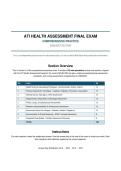
ATI HEALTH ASSESSMENT FINAL EXAM
COMPREHENSIVE PRACTICE
2026/2027 EDITION
This is an independent practice exam for educational study; it is not an official Wall Street Prep certification examination.
Section Overview
This is Version 2 of the comprehensive practice exam. It contains 100 new questions across nine sections, aligned
with the ATI Health Assessment blueprint, the current NCLEX-RN test plan, evidence-based physical assessment
standards, and nursing assessment competencies for 2026/2027.
Sec Topic Qs
1 Health History & Interviewing Techniques - Communication, History, Culture 15
2 Physical Assessment Techniques - Inspection, Palpation, Percussion, Auscultation 15
3 General Survey, Vital Signs, & Pain Assessment 10
4 Integumentary, Head, Neck, & Neurologic Assessment 12
5 Thorax, Lungs, & Cardiovascular Assessment 12
6 Abdomen, Musculoskeletal, & Genitourinary Assessment 12
7 Assessment Across the Lifespan - Pediatric, Geriatric, Pregnancy 10
8 Documentation & Clinical Reasoning - SOAP, Focused Assessment 8
9 Integrated Case Studies - Complex Assessment Scenarios 6
TOTAL 100
Instructions
For each question, select the single best answer. Use the answer key at the end of the exam to check your work. Each
item includes a brief rationale explaining the correct response.
Answer Key Distribution: 25 A · 25 B · 25 C · 25 D
, Section 1: Health History & Interviewing Techniques - Communication, History
Components, and Cultural Considerations
Q1: The 'history of present illness' (HPI) is best documented using:
A. Only the chief complaint
B. Only the family history
C. A chronological description of the current problem [CORRECT]
D. Only vital signs
Correct Answer: C
Rationale: The HPI is a chronological description of the current problem. The other options are different history components.
Q2: Which is an example of a closed-ended question?
A. 'Tell me about your pain.'
B. 'Describe what happened.'
C. 'Is the pain sharp or dull?' [CORRECT]
D. 'What brings you in today?'
Correct Answer: C
Rationale: A closed-ended question has a limited (often yes/no or choice) answer. The others are open-ended.
Q3: When the patient speaks a different language, the nurse should:
A. Use a qualified interpreter [CORRECT]
B. Speak loudly
C. Guess
D. Ignore the patient
Correct Answer: A
Rationale: Using a qualified interpreter ensures accurate communication. The other options are inappropriate.
Q4: A 'leaping' or 'excessive' interview question that suggests the answer should be avoided because it:
A. Is open-ended
B. Is neutral
C. Biases the patient's response [CORRECT]
D. Encourages detail
Correct Answer: C
Rationale: Leading questions bias the response. The other options describe appropriate questions.
Q5: Which is a component of the 'past medical history'?
A. Only the chief complaint
B. Only the family
C. Only social habits
D. Childhood illnesses and immunizations [CORRECT]
Correct Answer: D
Rationale: Past medical history includes childhood illnesses and immunizations. The other options are incorrect.
Q6: The 'family history' should include:
A. Only the patient's age
B. Only the patient's job
C. Health of parents and siblings [CORRECT]
D. Only the patient's diet
Correct Answer: C
Rationale: Family history includes the health of relatives. The other options are not family history.
Q7: Which is an appropriate way to ask about alcohol use?
A. 'How much alcohol do you drink in a typical week?' [CORRECT]
ATI Health Assessment Final Exam - v2 - 2026/2027 Page 2
, B. 'You don't drink, do you?'
C. 'Do you drink a lot?'
D. 'Everyone drinks, right?'
Correct Answer: A
Rationale: A neutral, non-judgmental question gathers accurate information. The others are leading or judgmental.
Q8: The 'review of systems' (ROS) is conducted:
A. Only for one system
B. Only for the skin
C. Only for the heart
D. Systematically, by body system [CORRECT]
Correct Answer: D
Rationale: The ROS is a systematic review by body system. The other options are incomplete.
Q9: Therapeutic communication in a health history includes:
A. Interrupting
B. Judging
C. Using empathy and open-ended questions [CORRECT]
D. Rushing
Correct Answer: C
Rationale: Empathy and open-ended questions are therapeutic. The other actions are not.
Q10: When assessing a child's history, the nurse should:
A. Only ask the child
B. Include the parent/caregiver as a source [CORRECT]
C. Ignore the parent
D. Only observe
Correct Answer: B
Rationale: Parents/caregivers are important sources for a child's history. The other options are incomplete.
Q11: A 'sensitive topic' (e.g., substance use) is best explored:
A. In a public area
B. Privately and non-judgmentally [CORRECT]
C. With judgment
D. By avoiding it
Correct Answer: B
Rationale: Sensitive topics are explored privately and non-judgmentally. The other options are inappropriate.
Q12: Which is an appropriate opening for an interview?
A. Starting with a question
B. Silence
C. Rushing
D. Introducing yourself and explaining the purpose [CORRECT]
Correct Answer: D
Rationale: Introducing yourself and explaining the purpose is an appropriate opening. The other options are not.
Q13: The 'social history' may include:
A. Only the chief complaint
B. Only the family
C. Only vital signs
D. Occupation, living situation, and substance use [CORRECT]
Correct Answer: D
Rationale: Social history includes occupation, living situation, and substance use. The other options are incorrect.
ATI Health Assessment Final Exam - v2 - 2026/2027 Page 3
COMPREHENSIVE PRACTICE
2026/2027 EDITION
This is an independent practice exam for educational study; it is not an official Wall Street Prep certification examination.
Section Overview
This is Version 2 of the comprehensive practice exam. It contains 100 new questions across nine sections, aligned
with the ATI Health Assessment blueprint, the current NCLEX-RN test plan, evidence-based physical assessment
standards, and nursing assessment competencies for 2026/2027.
Sec Topic Qs
1 Health History & Interviewing Techniques - Communication, History, Culture 15
2 Physical Assessment Techniques - Inspection, Palpation, Percussion, Auscultation 15
3 General Survey, Vital Signs, & Pain Assessment 10
4 Integumentary, Head, Neck, & Neurologic Assessment 12
5 Thorax, Lungs, & Cardiovascular Assessment 12
6 Abdomen, Musculoskeletal, & Genitourinary Assessment 12
7 Assessment Across the Lifespan - Pediatric, Geriatric, Pregnancy 10
8 Documentation & Clinical Reasoning - SOAP, Focused Assessment 8
9 Integrated Case Studies - Complex Assessment Scenarios 6
TOTAL 100
Instructions
For each question, select the single best answer. Use the answer key at the end of the exam to check your work. Each
item includes a brief rationale explaining the correct response.
Answer Key Distribution: 25 A · 25 B · 25 C · 25 D
, Section 1: Health History & Interviewing Techniques - Communication, History
Components, and Cultural Considerations
Q1: The 'history of present illness' (HPI) is best documented using:
A. Only the chief complaint
B. Only the family history
C. A chronological description of the current problem [CORRECT]
D. Only vital signs
Correct Answer: C
Rationale: The HPI is a chronological description of the current problem. The other options are different history components.
Q2: Which is an example of a closed-ended question?
A. 'Tell me about your pain.'
B. 'Describe what happened.'
C. 'Is the pain sharp or dull?' [CORRECT]
D. 'What brings you in today?'
Correct Answer: C
Rationale: A closed-ended question has a limited (often yes/no or choice) answer. The others are open-ended.
Q3: When the patient speaks a different language, the nurse should:
A. Use a qualified interpreter [CORRECT]
B. Speak loudly
C. Guess
D. Ignore the patient
Correct Answer: A
Rationale: Using a qualified interpreter ensures accurate communication. The other options are inappropriate.
Q4: A 'leaping' or 'excessive' interview question that suggests the answer should be avoided because it:
A. Is open-ended
B. Is neutral
C. Biases the patient's response [CORRECT]
D. Encourages detail
Correct Answer: C
Rationale: Leading questions bias the response. The other options describe appropriate questions.
Q5: Which is a component of the 'past medical history'?
A. Only the chief complaint
B. Only the family
C. Only social habits
D. Childhood illnesses and immunizations [CORRECT]
Correct Answer: D
Rationale: Past medical history includes childhood illnesses and immunizations. The other options are incorrect.
Q6: The 'family history' should include:
A. Only the patient's age
B. Only the patient's job
C. Health of parents and siblings [CORRECT]
D. Only the patient's diet
Correct Answer: C
Rationale: Family history includes the health of relatives. The other options are not family history.
Q7: Which is an appropriate way to ask about alcohol use?
A. 'How much alcohol do you drink in a typical week?' [CORRECT]
ATI Health Assessment Final Exam - v2 - 2026/2027 Page 2
, B. 'You don't drink, do you?'
C. 'Do you drink a lot?'
D. 'Everyone drinks, right?'
Correct Answer: A
Rationale: A neutral, non-judgmental question gathers accurate information. The others are leading or judgmental.
Q8: The 'review of systems' (ROS) is conducted:
A. Only for one system
B. Only for the skin
C. Only for the heart
D. Systematically, by body system [CORRECT]
Correct Answer: D
Rationale: The ROS is a systematic review by body system. The other options are incomplete.
Q9: Therapeutic communication in a health history includes:
A. Interrupting
B. Judging
C. Using empathy and open-ended questions [CORRECT]
D. Rushing
Correct Answer: C
Rationale: Empathy and open-ended questions are therapeutic. The other actions are not.
Q10: When assessing a child's history, the nurse should:
A. Only ask the child
B. Include the parent/caregiver as a source [CORRECT]
C. Ignore the parent
D. Only observe
Correct Answer: B
Rationale: Parents/caregivers are important sources for a child's history. The other options are incomplete.
Q11: A 'sensitive topic' (e.g., substance use) is best explored:
A. In a public area
B. Privately and non-judgmentally [CORRECT]
C. With judgment
D. By avoiding it
Correct Answer: B
Rationale: Sensitive topics are explored privately and non-judgmentally. The other options are inappropriate.
Q12: Which is an appropriate opening for an interview?
A. Starting with a question
B. Silence
C. Rushing
D. Introducing yourself and explaining the purpose [CORRECT]
Correct Answer: D
Rationale: Introducing yourself and explaining the purpose is an appropriate opening. The other options are not.
Q13: The 'social history' may include:
A. Only the chief complaint
B. Only the family
C. Only vital signs
D. Occupation, living situation, and substance use [CORRECT]
Correct Answer: D
Rationale: Social history includes occupation, living situation, and substance use. The other options are incorrect.
ATI Health Assessment Final Exam - v2 - 2026/2027 Page 3


