

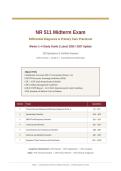
NR 511 Midterm Exam
Differential Diagnosis & Primary Care Practicum
Weeks 1–4 Study Guide | Latest Update
100 Questions & Verified Answers
100% Correct | Grade A | Comprehensive Rationales
Aligned With:
Chamberlain University NR 511 Curriculum (Weeks 1–4)
USPSTF Preventive Screening Guidelines (2026)
CDC / ACIP Adult Immunization Schedule
GINA Asthma Management Guidelines
GOLD COPD Report | ACC/AHA Hypertension & Lipid Guidelines
ADA Standards of Medical Care in Diabetes
Section Topic Questions
1 Clinical Decision-Making and Differential Diagnosis (Week 1) Q1 – Q15
2 Dermatologic Disorders Q16 – Q30
3 HEENT and Respiratory Disorders Q31 – Q50
4 Cardiovascular Disorders Q51 – Q65
5 Gastrointestinal and Genitourinary Disorders Q66 – Q80
6 Endocrine and Metabolic Disorders Q81 – Q90
7 Integrated Clinical Scenarios and Prioritization Q91 – Q100
Cognitive Distribution: 25% Recall • 55% Application • 20% Analysis
Style: 70% Scenario-based • 20% Direct Recall • 10% Clinical Judgment
Page 1 | Chamberlain University College of Nursing | Verified Grade A Content
,NR 511 — Differential Diagnosis & Primary Care Practicum Midterm Exam | Weeks 1–4 | 2026/2027
Examination Instructions & Scope
This midterm examination assesses advanced practice nursing students in Chamberlain University’s NR 511
Differential Diagnosis & Primary Care Practicum course, covering Weeks 1 through 4 of the 2026/2027 curriculum.
The examination comprises 100 multiple-choice questions distributed across seven clinical sections, each calibrated
to the NR 511 midterm blueprint. Questions emphasize clinical decision-making, evidence-based screening and
prevention, pharmacologic management, and the formulation of prioritized differential diagnoses consistent with the
advanced practice nursing role.
Questions reflect a cognitive mix of approximately 25% recall, 55% application, and 20% analysis, with 70%
scenario-based items, 20% direct recall, and 10% clinical judgment. Each item provides four options (A–D), one
correct answer marked [CORRECT], the verified answer key, and a detailed rationale citing the relevant guideline
(USPSTF, GINA, GOLD, ACC/AHA, ADA, CDC/ACIP) and Chamberlain NR 511 course concepts. Rationales also
explain why each distractor is incorrect, addressing common examination errors including USPSTF grade confusion,
sensitivity versus specificity versus predictive value misinterpretation, likelihood ratio thresholds (LR+ >10, LR−
<0.1), asthma versus COPD step therapy, hypertensive target confusion, and the differentiation of similar
dermatologic, HEENT, and gastrointestinal presentations.
Students should approach each scenario using the ABCDE priority framework when applicable, apply
evidence-based guidelines to pharmacologic selection, and integrate patient education and interprofessional
collaboration into management plans. Review both the correct response and the distractor analysis to build robust
clinical reasoning for the midterm and subsequent clinical practicum experiences.
Section 1: Clinical Decision-Making and Differential Diagnosis (Week 1)
Test characteristics, USPSTF screening, immunizations, evidence-based practice.
Q1. A 52-year-old woman presents with fatigue and vague abdominal complaints. The NP is formulating a
differential diagnosis list. Which statement best describes the purpose of a differential diagnosis in primary
care?
A. To confirm a single diagnosis as quickly as possible to reduce cost.
B. To generate a ranked list of possible diagnoses based on likelihood, allowing systematic evaluation and ruling
out of serious or life-threatening conditions first. [CORRECT]
C. To list every possible disease the patient could have regardless of likelihood.
D. To document the NP’s clinical impression for billing purposes only.
Correct Answer: B
Rationale:
A differential diagnosis is a ranked list of possible diagnoses based on clinical probability, allowing the NP to systematically
evaluate each possibility, prioritize serious or life-threatening conditions, and select appropriate diagnostic tests. It is not a
single rapid diagnosis, an exhaustive list, or a billing artifact; it is a structured clinical decision-making tool central to NR
511’s differential diagnosis framework.
Q2. A new rapid strep test has a sensitivity of 90% and specificity of 95%. Which interpretation is correct?
A. Sensitivity of 90% means the test correctly identifies 90% of patients without disease.
Page 2 | Chamberlain University College of Nursing | Verified Grade A Content
,NR 511 — Differential Diagnosis & Primary Care Practicum Midterm Exam | Weeks 1–4 | 2026/2027
B. Sensitivity of 90% means the test correctly identifies 90% of patients with disease (true positives), and
specificity of 95% means it correctly identifies 95% of patients without disease (true negatives). [CORRECT]
C. Specificity of 95% means 95% of positive tests are true positives.
D. Sensitivity of 90% means 10% of patients without disease will test positive.
Correct Answer: B
Rationale:
Sensitivity is the probability that a test is positive when disease is present (true positives); 90% sensitivity means 90% of
diseased patients test positive. Specificity is the probability that a test is negative when disease is absent (true negatives);
95% specificity means 95% of disease-free patients test negative. PPV and NPV (not sensitivity/specificity) describe the
probability of disease given a test result.
Q3. A screening test for disease X has a Positive Predictive Value (PPV) of 85%. Which interpretation is
correct?
A. 85% of patients without disease will test negative.
B. 85% of patients with a positive test actually have the disease. [CORRECT]
C. 85% of patients with the disease will test positive.
D. 85% of patients with a negative test do not have the disease.
Correct Answer: B
Rationale:
PPV is the probability that a positive test result indicates the disease is actually present. A PPV of 85% means that 85% of
patients with a positive test result truly have the disease. NPV (not PPV) describes the probability that a negative test
indicates disease absence. Sensitivity and specificity describe test performance given disease status, not vice versa.
Q4. A research study reports that a new diagnostic test for pulmonary embolism has a Negative Likelihood
Ratio (LR−) of 0.05. How should the NP interpret this value?
A. A negative test provides strong evidence against pulmonary embolism (LR− <0.1 indicates a large decrease
from pre-test probability). [CORRECT]
B. A negative test provides strong evidence for pulmonary embolism.
C. The test has low specificity.
D. The test result does not change the post-test probability of disease.
Correct Answer: A
Rationale:
The negative likelihood ratio (LR−) indicates how much a negative test result changes the odds of having the disease. An
LR− <0.1 represents a large, clinically meaningful decrease in the likelihood of disease, providing strong evidence against
pulmonary embolism. An LR+ >10 would provide strong evidence for disease. LR− does not directly measure specificity.
Q5. A new D-dimer assay for deep vein thrombosis reports a Positive Likelihood Ratio (LR+) of 12. What
does this indicate?
A. A positive result provides strong evidence for DVT (LR+ >10 indicates a large increase in post-test probability
of disease). [CORRECT]
B. A positive result provides strong evidence against DVT.
C. The test has high false-negative rate.
D. The test result has minimal impact on clinical decision-making.
Correct Answer: A
Page 3 | Chamberlain University College of Nursing | Verified Grade A Content
, NR 511 — Differential Diagnosis & Primary Care Practicum Midterm Exam | Weeks 1–4 | 2026/2027
Rationale:
LR+ indicates how much a positive test result increases the odds of having the disease. An LR+ >10 represents a large,
conclusive change from pre-test probability, providing strong evidence for the disease. In this case, a positive D-dimer with
LR+ 12 substantially increases the probability of DVT. LR− <0.1 would provide strong evidence against disease.
Q6. A 47-year-old woman asks about mammography screening. According to the 2026 USPSTF
recommendations, what is the appropriate screening recommendation?
A. Annual mammography starting at age 40.
B. Biennial mammography for women aged 50–74 (Grade B); for women 40–49, screening should be an
individualized shared decision-making process. [CORRECT]
C. Mammography every 5 years starting at age 50.
D. No mammography screening is recommended for average-risk women.
Correct Answer: B
Rationale:
USPSTF recommends biennial mammography for women aged 50–74 (Grade B). For women aged 40–49, the decision to
start screening should be individualized through shared decision-making, weighing benefits and harms. Annual screening
starting at 40 is not the USPSTF recommendation; screening every 5 years is too infrequent; and screening is recommended
for average-risk women in the 50–74 range.
Q7. A 60-year-old average-risk patient asks about colorectal cancer screening. Per USPSTF, which
recommendation is correct?
A. Screening is not necessary if there are no symptoms.
B. Screening from age 50 to 75 with colonoscopy every 10 years, annual FIT/gFOBT, sigmoidoscopy every 5 years,
or CT colonography every 5 years (Grade A). [CORRECT]
C. Screening only with colonoscopy at age 65.
D. Screening annually with fecal occult blood testing beginning at age 40.
Correct Answer: B
Rationale:
USPSTF recommends colorectal cancer screening for adults aged 50–75 (Grade A) using colonoscopy every 10 years,
annual FIT or gFOBT, sigmoidoscopy every 5 years (or every 10 years plus annual FIT), or CT colonography every 5 years.
Screening is not limited to symptomatic patients or a single modality, and the recommended starting age for average-risk
adults is 50 (not 40 or 65).
Q8. A 32-year-old woman with no history of abnormal Pap smears asks about cervical cancer screening.
Which recommendation aligns with current USPSTF guidelines?
A. Annual Pap smear starting at age 21.
B. Cervical cytology (Pap) alone every 3 years for ages 21–29; for ages 30–65, Pap plus HPV co-testing every 5
years, Pap alone every 3 years, or primary HPV testing every 5 years (Grade A). [CORRECT]
C. HPV testing alone every 5 years starting at age 21.
D. No screening needed if she has received the HPV vaccine.
Correct Answer: B
Rationale:
USPSTF recommends cervical cytology (Pap) alone every 3 years for women aged 21–29 (Grade A). For women 30–65,
acceptable strategies include Pap plus HPV co-testing every 5 years, Pap alone every 3 years, or primary HPV testing every
5 years (Grade A). Annual Pap smears are not recommended; primary HPV testing is not recommended for ages 21–29; and
Page 4 | Chamberlain University College of Nursing | Verified Grade A Content
Differential Diagnosis & Primary Care Practicum
Weeks 1–4 Study Guide | Latest Update
100 Questions & Verified Answers
100% Correct | Grade A | Comprehensive Rationales
Aligned With:
Chamberlain University NR 511 Curriculum (Weeks 1–4)
USPSTF Preventive Screening Guidelines (2026)
CDC / ACIP Adult Immunization Schedule
GINA Asthma Management Guidelines
GOLD COPD Report | ACC/AHA Hypertension & Lipid Guidelines
ADA Standards of Medical Care in Diabetes
Section Topic Questions
1 Clinical Decision-Making and Differential Diagnosis (Week 1) Q1 – Q15
2 Dermatologic Disorders Q16 – Q30
3 HEENT and Respiratory Disorders Q31 – Q50
4 Cardiovascular Disorders Q51 – Q65
5 Gastrointestinal and Genitourinary Disorders Q66 – Q80
6 Endocrine and Metabolic Disorders Q81 – Q90
7 Integrated Clinical Scenarios and Prioritization Q91 – Q100
Cognitive Distribution: 25% Recall • 55% Application • 20% Analysis
Style: 70% Scenario-based • 20% Direct Recall • 10% Clinical Judgment
Page 1 | Chamberlain University College of Nursing | Verified Grade A Content
,NR 511 — Differential Diagnosis & Primary Care Practicum Midterm Exam | Weeks 1–4 | 2026/2027
Examination Instructions & Scope
This midterm examination assesses advanced practice nursing students in Chamberlain University’s NR 511
Differential Diagnosis & Primary Care Practicum course, covering Weeks 1 through 4 of the 2026/2027 curriculum.
The examination comprises 100 multiple-choice questions distributed across seven clinical sections, each calibrated
to the NR 511 midterm blueprint. Questions emphasize clinical decision-making, evidence-based screening and
prevention, pharmacologic management, and the formulation of prioritized differential diagnoses consistent with the
advanced practice nursing role.
Questions reflect a cognitive mix of approximately 25% recall, 55% application, and 20% analysis, with 70%
scenario-based items, 20% direct recall, and 10% clinical judgment. Each item provides four options (A–D), one
correct answer marked [CORRECT], the verified answer key, and a detailed rationale citing the relevant guideline
(USPSTF, GINA, GOLD, ACC/AHA, ADA, CDC/ACIP) and Chamberlain NR 511 course concepts. Rationales also
explain why each distractor is incorrect, addressing common examination errors including USPSTF grade confusion,
sensitivity versus specificity versus predictive value misinterpretation, likelihood ratio thresholds (LR+ >10, LR−
<0.1), asthma versus COPD step therapy, hypertensive target confusion, and the differentiation of similar
dermatologic, HEENT, and gastrointestinal presentations.
Students should approach each scenario using the ABCDE priority framework when applicable, apply
evidence-based guidelines to pharmacologic selection, and integrate patient education and interprofessional
collaboration into management plans. Review both the correct response and the distractor analysis to build robust
clinical reasoning for the midterm and subsequent clinical practicum experiences.
Section 1: Clinical Decision-Making and Differential Diagnosis (Week 1)
Test characteristics, USPSTF screening, immunizations, evidence-based practice.
Q1. A 52-year-old woman presents with fatigue and vague abdominal complaints. The NP is formulating a
differential diagnosis list. Which statement best describes the purpose of a differential diagnosis in primary
care?
A. To confirm a single diagnosis as quickly as possible to reduce cost.
B. To generate a ranked list of possible diagnoses based on likelihood, allowing systematic evaluation and ruling
out of serious or life-threatening conditions first. [CORRECT]
C. To list every possible disease the patient could have regardless of likelihood.
D. To document the NP’s clinical impression for billing purposes only.
Correct Answer: B
Rationale:
A differential diagnosis is a ranked list of possible diagnoses based on clinical probability, allowing the NP to systematically
evaluate each possibility, prioritize serious or life-threatening conditions, and select appropriate diagnostic tests. It is not a
single rapid diagnosis, an exhaustive list, or a billing artifact; it is a structured clinical decision-making tool central to NR
511’s differential diagnosis framework.
Q2. A new rapid strep test has a sensitivity of 90% and specificity of 95%. Which interpretation is correct?
A. Sensitivity of 90% means the test correctly identifies 90% of patients without disease.
Page 2 | Chamberlain University College of Nursing | Verified Grade A Content
,NR 511 — Differential Diagnosis & Primary Care Practicum Midterm Exam | Weeks 1–4 | 2026/2027
B. Sensitivity of 90% means the test correctly identifies 90% of patients with disease (true positives), and
specificity of 95% means it correctly identifies 95% of patients without disease (true negatives). [CORRECT]
C. Specificity of 95% means 95% of positive tests are true positives.
D. Sensitivity of 90% means 10% of patients without disease will test positive.
Correct Answer: B
Rationale:
Sensitivity is the probability that a test is positive when disease is present (true positives); 90% sensitivity means 90% of
diseased patients test positive. Specificity is the probability that a test is negative when disease is absent (true negatives);
95% specificity means 95% of disease-free patients test negative. PPV and NPV (not sensitivity/specificity) describe the
probability of disease given a test result.
Q3. A screening test for disease X has a Positive Predictive Value (PPV) of 85%. Which interpretation is
correct?
A. 85% of patients without disease will test negative.
B. 85% of patients with a positive test actually have the disease. [CORRECT]
C. 85% of patients with the disease will test positive.
D. 85% of patients with a negative test do not have the disease.
Correct Answer: B
Rationale:
PPV is the probability that a positive test result indicates the disease is actually present. A PPV of 85% means that 85% of
patients with a positive test result truly have the disease. NPV (not PPV) describes the probability that a negative test
indicates disease absence. Sensitivity and specificity describe test performance given disease status, not vice versa.
Q4. A research study reports that a new diagnostic test for pulmonary embolism has a Negative Likelihood
Ratio (LR−) of 0.05. How should the NP interpret this value?
A. A negative test provides strong evidence against pulmonary embolism (LR− <0.1 indicates a large decrease
from pre-test probability). [CORRECT]
B. A negative test provides strong evidence for pulmonary embolism.
C. The test has low specificity.
D. The test result does not change the post-test probability of disease.
Correct Answer: A
Rationale:
The negative likelihood ratio (LR−) indicates how much a negative test result changes the odds of having the disease. An
LR− <0.1 represents a large, clinically meaningful decrease in the likelihood of disease, providing strong evidence against
pulmonary embolism. An LR+ >10 would provide strong evidence for disease. LR− does not directly measure specificity.
Q5. A new D-dimer assay for deep vein thrombosis reports a Positive Likelihood Ratio (LR+) of 12. What
does this indicate?
A. A positive result provides strong evidence for DVT (LR+ >10 indicates a large increase in post-test probability
of disease). [CORRECT]
B. A positive result provides strong evidence against DVT.
C. The test has high false-negative rate.
D. The test result has minimal impact on clinical decision-making.
Correct Answer: A
Page 3 | Chamberlain University College of Nursing | Verified Grade A Content
, NR 511 — Differential Diagnosis & Primary Care Practicum Midterm Exam | Weeks 1–4 | 2026/2027
Rationale:
LR+ indicates how much a positive test result increases the odds of having the disease. An LR+ >10 represents a large,
conclusive change from pre-test probability, providing strong evidence for the disease. In this case, a positive D-dimer with
LR+ 12 substantially increases the probability of DVT. LR− <0.1 would provide strong evidence against disease.
Q6. A 47-year-old woman asks about mammography screening. According to the 2026 USPSTF
recommendations, what is the appropriate screening recommendation?
A. Annual mammography starting at age 40.
B. Biennial mammography for women aged 50–74 (Grade B); for women 40–49, screening should be an
individualized shared decision-making process. [CORRECT]
C. Mammography every 5 years starting at age 50.
D. No mammography screening is recommended for average-risk women.
Correct Answer: B
Rationale:
USPSTF recommends biennial mammography for women aged 50–74 (Grade B). For women aged 40–49, the decision to
start screening should be individualized through shared decision-making, weighing benefits and harms. Annual screening
starting at 40 is not the USPSTF recommendation; screening every 5 years is too infrequent; and screening is recommended
for average-risk women in the 50–74 range.
Q7. A 60-year-old average-risk patient asks about colorectal cancer screening. Per USPSTF, which
recommendation is correct?
A. Screening is not necessary if there are no symptoms.
B. Screening from age 50 to 75 with colonoscopy every 10 years, annual FIT/gFOBT, sigmoidoscopy every 5 years,
or CT colonography every 5 years (Grade A). [CORRECT]
C. Screening only with colonoscopy at age 65.
D. Screening annually with fecal occult blood testing beginning at age 40.
Correct Answer: B
Rationale:
USPSTF recommends colorectal cancer screening for adults aged 50–75 (Grade A) using colonoscopy every 10 years,
annual FIT or gFOBT, sigmoidoscopy every 5 years (or every 10 years plus annual FIT), or CT colonography every 5 years.
Screening is not limited to symptomatic patients or a single modality, and the recommended starting age for average-risk
adults is 50 (not 40 or 65).
Q8. A 32-year-old woman with no history of abnormal Pap smears asks about cervical cancer screening.
Which recommendation aligns with current USPSTF guidelines?
A. Annual Pap smear starting at age 21.
B. Cervical cytology (Pap) alone every 3 years for ages 21–29; for ages 30–65, Pap plus HPV co-testing every 5
years, Pap alone every 3 years, or primary HPV testing every 5 years (Grade A). [CORRECT]
C. HPV testing alone every 5 years starting at age 21.
D. No screening needed if she has received the HPV vaccine.
Correct Answer: B
Rationale:
USPSTF recommends cervical cytology (Pap) alone every 3 years for women aged 21–29 (Grade A). For women 30–65,
acceptable strategies include Pap plus HPV co-testing every 5 years, Pap alone every 3 years, or primary HPV testing every
5 years (Grade A). Annual Pap smears are not recommended; primary HPV testing is not recommended for ages 21–29; and
Page 4 | Chamberlain University College of Nursing | Verified Grade A Content


