

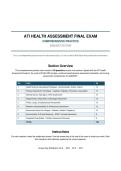
ATI HEALTH ASSESSMENT FINAL EXAM
COMPREHENSIVE PRACTICE
2026/2027 EDITION
This is an independent practice exam for educational study; it is not an official Wall Street Prep certification examination.
Section Overview
This comprehensive practice exam contains 100 questions across nine sections, aligned with the ATI Health
Assessment blueprint, the current NCLEX-RN test plan, evidence-based physical assessment standards, and nursing
assessment competencies for 2026/2027.
Sec Topic Qs
1 Health History & Interviewing Techniques - Communication, History, Culture 15
2 Physical Assessment Techniques - Inspection, Palpation, Percussion, Auscultation 15
3 General Survey, Vital Signs, & Pain Assessment 10
4 Integumentary, Head, Neck, & Neurologic Assessment 12
5 Thorax, Lungs, & Cardiovascular Assessment 12
6 Abdomen, Musculoskeletal, & Genitourinary Assessment 12
7 Assessment Across the Lifespan - Pediatric, Geriatric, Pregnancy 10
8 Documentation & Clinical Reasoning - SOAP, Focused Assessment 8
9 Integrated Case Studies - Complex Assessment Scenarios 6
TOTAL 100
Instructions
For each question, select the single best answer. Use the answer key at the end of the exam to check your work. Each
item includes a brief rationale explaining the correct response.
Answer Key Distribution: 25 A · 25 B · 25 C · 25 D
, Section 1: Health History & Interviewing Techniques - Communication, History
Components, and Cultural Considerations
Q1: The 'chief complaint' is best defined as:
A. The patient's blood pressure
B. The primary reason the patient is seeking care, in the patient's own words [CORRECT]
C. The referring provider's name
D. The billing code
Correct Answer: B
Rationale: The chief complaint is the primary reason for care in the patient's words. The other options are not the chief
complaint.
Q2: The 'history of present illness' (HPI) describes:
A. The details of the current problem, including onset, duration, and associated symptoms [CORRECT]
B. Past hospitalizations
C. Family history
D. Social history
Correct Answer: A
Rationale: The HPI describes the current problem's details. The other options are different history components.
Q3: A 'past medical history' includes:
A. Only the chief complaint
B. Only family history
C. Only social history
D. Previous illnesses, surgeries, and chronic conditions [CORRECT]
Correct Answer: D
Rationale: Past medical history includes prior illnesses, surgeries, and chronic conditions. The other options are incorrect.
Q4: 'Review of systems' (ROS) is:
A. Only a physical exam
B. Only the chief complaint
C. A systematic review of symptoms across body systems [CORRECT]
D. Only the family history
Correct Answer: C
Rationale: ROS is a systematic review of symptoms across body systems. The other options are incorrect.
Q5: Which is an example of an open-ended question?
A. 'Can you describe the pain you're feeling?' [CORRECT]
B. 'Is your pain sharp?'
C. 'Is the pain on a scale of 1-10?'
D. 'Does it hurt right now?'
Correct Answer: A
Rationale: An open-ended question invites a detailed description. The others are closed (yes/no) questions.
Q6: Active listening includes:
A. Interrupting
B. Focusing, acknowledging, and confirming understanding [CORRECT]
C. Checking a phone
D. Rushing the patient
Correct Answer: B
Rationale: Active listening involves focusing and confirming understanding. The other actions are not active listening.
Q7: When conducting a health history with a patient of a different culture, the nurse should:
ATI Health Assessment Final Exam - 2026/2027 Page 2
, A. Ignore culture
B. Impose beliefs
C. Assume beliefs
D. Respect cultural beliefs and use appropriate communication [CORRECT]
Correct Answer: D
Rationale: Cultural competence respects the patient's beliefs and communication preferences. The other options are
inappropriate.
Q8: Which is an appropriate question when exploring a sensitive topic?
A. Using a respectful, non-judgmental approach [CORRECT]
B. Being judgmental
C. Rushing the patient
D. Avoiding the topic
Correct Answer: A
Rationale: A respectful, non-judgmental approach is appropriate for sensitive topics. The other options are not.
Q9: The 'family history' is used to identify:
A. Genetic or familial patterns of disease [CORRECT]
B. Only the patient's current symptoms
C. Only the patient's age
D. Only the billing
Correct Answer: A
Rationale: Family history identifies familial disease patterns. The other options are incorrect.
Q10: The 'social history' includes:
A. Only the chief complaint
B. Only vital signs
C. Lifestyle factors such as smoking, alcohol, and occupation [CORRECT]
D. Only the family
Correct Answer: C
Rationale: Social history includes lifestyle factors. The other options are incorrect.
Q11: A 'functional assessment' evaluates:
A. Only the heart
B. Only the lungs
C. Only the skin
D. The patient's ability to perform daily activities (ADLs) [CORRECT]
Correct Answer: D
Rationale: A functional assessment evaluates ADL ability. The other options are physical systems.
Q12: Which is an appropriate interviewing technique?
A. Asking many questions at once
B. Interrupting frequently
C. Rushing the patient
D. Asking one question at a time and listening [CORRECT]
Correct Answer: D
Rationale: Asking one question at a time and listening is appropriate. The other options are not.
Q13: When the patient uses a term the nurse does not understand, the nurse should:
A. Ask the patient to clarify [CORRECT]
B. Ignore it
C. Guess
D. Change the subject
Correct Answer: A
ATI Health Assessment Final Exam - 2026/2027 Page 3
COMPREHENSIVE PRACTICE
2026/2027 EDITION
This is an independent practice exam for educational study; it is not an official Wall Street Prep certification examination.
Section Overview
This comprehensive practice exam contains 100 questions across nine sections, aligned with the ATI Health
Assessment blueprint, the current NCLEX-RN test plan, evidence-based physical assessment standards, and nursing
assessment competencies for 2026/2027.
Sec Topic Qs
1 Health History & Interviewing Techniques - Communication, History, Culture 15
2 Physical Assessment Techniques - Inspection, Palpation, Percussion, Auscultation 15
3 General Survey, Vital Signs, & Pain Assessment 10
4 Integumentary, Head, Neck, & Neurologic Assessment 12
5 Thorax, Lungs, & Cardiovascular Assessment 12
6 Abdomen, Musculoskeletal, & Genitourinary Assessment 12
7 Assessment Across the Lifespan - Pediatric, Geriatric, Pregnancy 10
8 Documentation & Clinical Reasoning - SOAP, Focused Assessment 8
9 Integrated Case Studies - Complex Assessment Scenarios 6
TOTAL 100
Instructions
For each question, select the single best answer. Use the answer key at the end of the exam to check your work. Each
item includes a brief rationale explaining the correct response.
Answer Key Distribution: 25 A · 25 B · 25 C · 25 D
, Section 1: Health History & Interviewing Techniques - Communication, History
Components, and Cultural Considerations
Q1: The 'chief complaint' is best defined as:
A. The patient's blood pressure
B. The primary reason the patient is seeking care, in the patient's own words [CORRECT]
C. The referring provider's name
D. The billing code
Correct Answer: B
Rationale: The chief complaint is the primary reason for care in the patient's words. The other options are not the chief
complaint.
Q2: The 'history of present illness' (HPI) describes:
A. The details of the current problem, including onset, duration, and associated symptoms [CORRECT]
B. Past hospitalizations
C. Family history
D. Social history
Correct Answer: A
Rationale: The HPI describes the current problem's details. The other options are different history components.
Q3: A 'past medical history' includes:
A. Only the chief complaint
B. Only family history
C. Only social history
D. Previous illnesses, surgeries, and chronic conditions [CORRECT]
Correct Answer: D
Rationale: Past medical history includes prior illnesses, surgeries, and chronic conditions. The other options are incorrect.
Q4: 'Review of systems' (ROS) is:
A. Only a physical exam
B. Only the chief complaint
C. A systematic review of symptoms across body systems [CORRECT]
D. Only the family history
Correct Answer: C
Rationale: ROS is a systematic review of symptoms across body systems. The other options are incorrect.
Q5: Which is an example of an open-ended question?
A. 'Can you describe the pain you're feeling?' [CORRECT]
B. 'Is your pain sharp?'
C. 'Is the pain on a scale of 1-10?'
D. 'Does it hurt right now?'
Correct Answer: A
Rationale: An open-ended question invites a detailed description. The others are closed (yes/no) questions.
Q6: Active listening includes:
A. Interrupting
B. Focusing, acknowledging, and confirming understanding [CORRECT]
C. Checking a phone
D. Rushing the patient
Correct Answer: B
Rationale: Active listening involves focusing and confirming understanding. The other actions are not active listening.
Q7: When conducting a health history with a patient of a different culture, the nurse should:
ATI Health Assessment Final Exam - 2026/2027 Page 2
, A. Ignore culture
B. Impose beliefs
C. Assume beliefs
D. Respect cultural beliefs and use appropriate communication [CORRECT]
Correct Answer: D
Rationale: Cultural competence respects the patient's beliefs and communication preferences. The other options are
inappropriate.
Q8: Which is an appropriate question when exploring a sensitive topic?
A. Using a respectful, non-judgmental approach [CORRECT]
B. Being judgmental
C. Rushing the patient
D. Avoiding the topic
Correct Answer: A
Rationale: A respectful, non-judgmental approach is appropriate for sensitive topics. The other options are not.
Q9: The 'family history' is used to identify:
A. Genetic or familial patterns of disease [CORRECT]
B. Only the patient's current symptoms
C. Only the patient's age
D. Only the billing
Correct Answer: A
Rationale: Family history identifies familial disease patterns. The other options are incorrect.
Q10: The 'social history' includes:
A. Only the chief complaint
B. Only vital signs
C. Lifestyle factors such as smoking, alcohol, and occupation [CORRECT]
D. Only the family
Correct Answer: C
Rationale: Social history includes lifestyle factors. The other options are incorrect.
Q11: A 'functional assessment' evaluates:
A. Only the heart
B. Only the lungs
C. Only the skin
D. The patient's ability to perform daily activities (ADLs) [CORRECT]
Correct Answer: D
Rationale: A functional assessment evaluates ADL ability. The other options are physical systems.
Q12: Which is an appropriate interviewing technique?
A. Asking many questions at once
B. Interrupting frequently
C. Rushing the patient
D. Asking one question at a time and listening [CORRECT]
Correct Answer: D
Rationale: Asking one question at a time and listening is appropriate. The other options are not.
Q13: When the patient uses a term the nurse does not understand, the nurse should:
A. Ask the patient to clarify [CORRECT]
B. Ignore it
C. Guess
D. Change the subject
Correct Answer: A
ATI Health Assessment Final Exam - 2026/2027 Page 3


