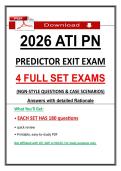
2026 ATI PN
PREDICTOR EXIT EXAM
4 FULL SET EXAMS
(NGN-STYLE QUESTIONS & CASE SCENARIOS)
Answers with detailed Rationale
What You’ll Get:
• EACH SET HAS 180 questions
• quick review
• Printable, easy-to-study PDF
Not affiliated with ATI, VATI or NCLEX. For study purposes only.
, Preview Questions Below
Get the Complete PDF After Purchase
"If you require further clarification or in need of any
study resources, feel free to Message me."
,Table of Contents
ATI PN EXIT SET 1 .............................................................................. 2
ATI PN EXIT SET 2 ............................................................................ 79
ATI PN EXIT SET 3 .......................................................................... 166
ATI PN EXIT SET 4 .......................................................................... 235
ATI PN EXIT SET 1
1. A nurse is assisting with the plan of care for a client following a transurethral
resection of the prostate. Which of the following interventions should the nurse
include in the plan of care?
A. Irrigate the bladder using strict sterile technique and maintain closed catheter
drainage system to minimize the risk of infection
B. Remove the catheter every 8 hours to prevent urinary tract infection
C. Encourage the client to void spontaneously without the catheter
D. Maintain the irrigation solution above the level of the bladder at all times
Correct Answer: A
Rationale: Following a transurethral resection of the prostate (TURP), continuous
bladder irrigation (CBI) with sterile technique is essential to prevent clot formation and
maintain catheter patency. A closed drainage system minimizes the risk of infection.
Option B is incorrect because the catheter should not be removed frequently. Option C
is incorrect because the client cannot void spontaneously with the catheter in place.
Option D is incorrect because the irrigation solution should be maintained below the
level of the bladder to prevent reflux of urine.
2. A nurse is reviewing a client's electronic medical record and finds that an
assistive personnel recorded the client's temperature as 35.3° C (95.5° F) 2 hours
earlier. Which of the following actions should the nurse take first?
, A. Document the finding and continue with routine care
B. Check the client's temperature using another method
C. Notify the provider immediately
D. Place the client in a warm blanket
Correct Answer: B
Rationale: The nurse should first verify the accuracy of the finding by rechecking the
temperature using another method. A temperature of 35.3° C indicates hypothermia, but
the nurse must validate the data before taking further action. After verification, the nurse
can implement appropriate interventions and notify the provider if confirmed.
3. A nurse is receiving change-of-shift report for four clients. Which of the
following clients should the nurse see first?
A. A client whose urinary output was 100 mL for the past 12 hours
B. A client who is requesting pain medication for a headache
C. A client who needs assistance to the bathroom
D. A client who is scheduled for discharge in 2 hours
Correct Answer: A
Rationale: A urinary output of 100 mL in 12 hours indicates oliguria (less than 30
mL/hour), which is a sign of potential renal failure, dehydration, or decreased cardiac
output. This requires immediate assessment as it can lead to life-threatening
complications. The other clients have needs that are important but not immediately life-
threatening.
4. A nurse is reinforcing teaching about weight loss with a female older adult
client who is overweight. Which of the following statements should the nurse
include in teaching?
A. Keep fat intake to no more than 30% of daily caloric intake
B. Eliminate all carbohydrates from the diet
C. Fast for 24 hours twice a week to promote weight loss
D. Consume less than 800 calories per day for rapid weight loss
Correct Answer: A
Rationale: A balanced diet for weight loss should include no more than 30% of calories
from fat, with emphasis on healthy fats. Option B is incorrect because carbohydrates
are necessary for energy. Option C is incorrect because fasting is not recommended for
PREDICTOR EXIT EXAM
4 FULL SET EXAMS
(NGN-STYLE QUESTIONS & CASE SCENARIOS)
Answers with detailed Rationale
What You’ll Get:
• EACH SET HAS 180 questions
• quick review
• Printable, easy-to-study PDF
Not affiliated with ATI, VATI or NCLEX. For study purposes only.
, Preview Questions Below
Get the Complete PDF After Purchase
"If you require further clarification or in need of any
study resources, feel free to Message me."
,Table of Contents
ATI PN EXIT SET 1 .............................................................................. 2
ATI PN EXIT SET 2 ............................................................................ 79
ATI PN EXIT SET 3 .......................................................................... 166
ATI PN EXIT SET 4 .......................................................................... 235
ATI PN EXIT SET 1
1. A nurse is assisting with the plan of care for a client following a transurethral
resection of the prostate. Which of the following interventions should the nurse
include in the plan of care?
A. Irrigate the bladder using strict sterile technique and maintain closed catheter
drainage system to minimize the risk of infection
B. Remove the catheter every 8 hours to prevent urinary tract infection
C. Encourage the client to void spontaneously without the catheter
D. Maintain the irrigation solution above the level of the bladder at all times
Correct Answer: A
Rationale: Following a transurethral resection of the prostate (TURP), continuous
bladder irrigation (CBI) with sterile technique is essential to prevent clot formation and
maintain catheter patency. A closed drainage system minimizes the risk of infection.
Option B is incorrect because the catheter should not be removed frequently. Option C
is incorrect because the client cannot void spontaneously with the catheter in place.
Option D is incorrect because the irrigation solution should be maintained below the
level of the bladder to prevent reflux of urine.
2. A nurse is reviewing a client's electronic medical record and finds that an
assistive personnel recorded the client's temperature as 35.3° C (95.5° F) 2 hours
earlier. Which of the following actions should the nurse take first?
, A. Document the finding and continue with routine care
B. Check the client's temperature using another method
C. Notify the provider immediately
D. Place the client in a warm blanket
Correct Answer: B
Rationale: The nurse should first verify the accuracy of the finding by rechecking the
temperature using another method. A temperature of 35.3° C indicates hypothermia, but
the nurse must validate the data before taking further action. After verification, the nurse
can implement appropriate interventions and notify the provider if confirmed.
3. A nurse is receiving change-of-shift report for four clients. Which of the
following clients should the nurse see first?
A. A client whose urinary output was 100 mL for the past 12 hours
B. A client who is requesting pain medication for a headache
C. A client who needs assistance to the bathroom
D. A client who is scheduled for discharge in 2 hours
Correct Answer: A
Rationale: A urinary output of 100 mL in 12 hours indicates oliguria (less than 30
mL/hour), which is a sign of potential renal failure, dehydration, or decreased cardiac
output. This requires immediate assessment as it can lead to life-threatening
complications. The other clients have needs that are important but not immediately life-
threatening.
4. A nurse is reinforcing teaching about weight loss with a female older adult
client who is overweight. Which of the following statements should the nurse
include in teaching?
A. Keep fat intake to no more than 30% of daily caloric intake
B. Eliminate all carbohydrates from the diet
C. Fast for 24 hours twice a week to promote weight loss
D. Consume less than 800 calories per day for rapid weight loss
Correct Answer: A
Rationale: A balanced diet for weight loss should include no more than 30% of calories
from fat, with emphasis on healthy fats. Option B is incorrect because carbohydrates
are necessary for energy. Option C is incorrect because fasting is not recommended for