

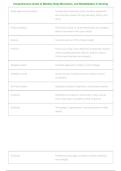
Comprehensive Guide to Mobility, Body Mechanics, and Rehabilitation in Nursing
Body alignment (posture) Coordination between joints, tendons, ligaments,
and muscles; present during standing, sitting, and
lying.
Proprioception The body's sense of where extremities are located;
allows movement with eyes closed.
Gravity Typically acts on 57% of body height.
Friction Force occurring in the direction of opposite motion;
when boosting patients, lift then slide to reduce
friction and maintain skin integrity.
Skeletal system Includes ligaments, tendons, and cartilage.
Skeletal muscle Some muscles maintain posture; others control
movement.
Nervous system Regulates balance, alignment, and proprioception.
Lordosis Significant curvature in lower back; often causes
lower back pain and alters center of gravity.
Kyphosis "Humpback" appearance; commonly seen in older
adults.
Scoliosis Presence at any age; curvature of spine making it
non-straight.
, Comprehensive Guide to Mobility, Body Mechanics, and Rehabilitation in Nursing
Osteogenesis imperfecta Congenital defect affecting alignment and balance.
Dystonia Muscle contractions resulting in abnormal posture;
continuous contractions on one side cause strain on
opposite side.
Basal ganglia posture Associated with Parkinson's disease; characterized
by stooped posture and shuffled gait.
Bradykinesia Slower muscle reaction seen in Parkinson's.
Akinesia Insufficient dopamine to stimulate muscles;
inadequate response time to movement commands.
Deconditioning syndrome Condition of physical, psychological, social, and
functional decline resulting from prolonged bed
rest, extremely sedentary lifestyle, and associated
loss of muscle strength.
Muscle loss on bed rest Individual of average height and weight without
chronic illness loses strength at approximately 3%
per day on bed rest.
Metabolic rate effects of immobility Decreases, causing GI disturbances, increased
constipation risk, negative nitrogen balance, and
decreased muscle mass.
Pneumonia risk Atelectasis occurs when secretions block airway and
distal lung collapses.
Body alignment (posture) Coordination between joints, tendons, ligaments,
and muscles; present during standing, sitting, and
lying.
Proprioception The body's sense of where extremities are located;
allows movement with eyes closed.
Gravity Typically acts on 57% of body height.
Friction Force occurring in the direction of opposite motion;
when boosting patients, lift then slide to reduce
friction and maintain skin integrity.
Skeletal system Includes ligaments, tendons, and cartilage.
Skeletal muscle Some muscles maintain posture; others control
movement.
Nervous system Regulates balance, alignment, and proprioception.
Lordosis Significant curvature in lower back; often causes
lower back pain and alters center of gravity.
Kyphosis "Humpback" appearance; commonly seen in older
adults.
Scoliosis Presence at any age; curvature of spine making it
non-straight.
, Comprehensive Guide to Mobility, Body Mechanics, and Rehabilitation in Nursing
Osteogenesis imperfecta Congenital defect affecting alignment and balance.
Dystonia Muscle contractions resulting in abnormal posture;
continuous contractions on one side cause strain on
opposite side.
Basal ganglia posture Associated with Parkinson's disease; characterized
by stooped posture and shuffled gait.
Bradykinesia Slower muscle reaction seen in Parkinson's.
Akinesia Insufficient dopamine to stimulate muscles;
inadequate response time to movement commands.
Deconditioning syndrome Condition of physical, psychological, social, and
functional decline resulting from prolonged bed
rest, extremely sedentary lifestyle, and associated
loss of muscle strength.
Muscle loss on bed rest Individual of average height and weight without
chronic illness loses strength at approximately 3%
per day on bed rest.
Metabolic rate effects of immobility Decreases, causing GI disturbances, increased
constipation risk, negative nitrogen balance, and
decreased muscle mass.
Pneumonia risk Atelectasis occurs when secretions block airway and
distal lung collapses.


