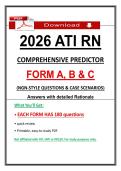
2026 ATI RN
COMPREHENSIVE PREDICTOR
FORM A, B & C
(NGN-STYLE QUESTIONS & CASE SCENARIOS)
Answers with detailed Rationale
What You’ll Get:
• EACH FORM HAS 180 questions
• quick review
• Printable, easy-to-study PDF
Not affiliated with ATI, VATI or NCLEX. For study purposes only.
,PREVIEW QUESTIONS BELOW
Get the Complete PDF After Purchase
"If you require further clarification or in need of
any study resources, feel free to Message me."
,Table of Contents
ATI RN COMP PREDICTOR FORM A .........................2
ATI RN COMP PREDICTOR FORM B .......................77
ATI RN COMP PREDICTOR FORM C ..................... 151
ATI RN COMP PREDICTOR FORM A
Question 1
A home health nurse is caring for a child who has Lyme disease. Which of the
following is an appropriate action for the nurse to take?
A. Ensure the state health department has been notified
B. Administer antitoxin
C. Educate the family to avoid sharing personal belongings
D. Assess for skin necrosis
Correct Answer: A
Rationale: Lyme disease is a reportable communicable disease in most states. The
nurse must ensure proper notification to public health authorities. Antitoxin is not used
for Lyme disease (antibiotics are). Skin necrosis is not a characteristic finding of Lyme
disease; erythema migrans is the classic rash.
Question 2
A nurse is caring for a client who has been admitted to the hospital. (NGN - Select
5 actions the nurse should take)
Select all that apply:
• [ ] Provide frequent rest periods
• [ ] Restrict client sodium intake
• [ ] Advise client to avoid using soap and alcohol-based lotions
• [ ] Instruct the client to avoid blowing their nose forcefully
, • [ ] Assess the client's level of orientation
Correct Answers: All 5 options should be selected
Rationale: These interventions are appropriate for a client with potential increased
intracranial pressure or post-operative cranial surgery. Rest periods reduce metabolic
demands; sodium restriction prevents fluid retention; avoiding soap/alcohol prevents
skin irritation; avoiding nose blowing prevents increased ICP; assessing orientation
monitors neurological status.
Question 3
A nurse is caring for a client who has a vented NG tube set to low intermittent
suction and has vomited. Which of the following actions should the nurse
perform first?
A. Administer an antiemetic medication
B. Evaluate functioning of the suction device
C. Provide oral hygiene care
D. Replace the NG tube
Correct Answer: B
Rationale: According to the nursing process and priority-setting framework, the nurse
must first assess the equipment. If the suction device is not functioning properly, gastric
contents cannot drain, leading to vomiting. The nurse must check for kinks, proper
suction settings, and tube placement before implementing other interventions.
Question 4
While performing a routine assessment, a nurse notices fraying on the electrical
cord of a client's continuous passive motion (CPM) device. Which of the following
actions should the nurse take first?
A. Initiate a requisition for a replacement CPM device
B. Report the defect to the equipment maintenance staff
C. Remove the device from the room
D. Ensure the device inspection sticker is current
Correct Answer: C
,Rationale: Client safety is the priority. A frayed electrical cord poses an immediate fire
and electrocution hazard. The nurse must remove the device from the room immediately
to prevent harm, then follow up with reporting and replacement.
Question 5
A nurse is setting up a sterile field to perform wound irrigation for a client. Which
of the following actions should the nurse take when pouring the sterile solution?
A. Remove the cap and place it sterile-side up on a clean surface
B. Place sterile gauze over areas of spilled
C. Hold the bottle in the center of the sterile field when pouring the solution
D. Hold the irrigation solution bottle with the label facing away from the palm of the hand
Correct Answer: A
Rationale: When pouring sterile solutions, the cap should be removed and placed
sterile-side up to maintain sterility. The bottle should be held outside the sterile field to
prevent contamination. The label should face the palm to prevent solution from running
over the label.
Question 6
A nurse is creating a plan of care for a female client who has recurrent urinary
tract infections. Which of the following interventions should the nurse include in
the plan?
A. Wear loose-fitting underwear
B. Take a bubble bath after intercourse
C. Drink four 240-mL (8-oz) glasses of water each day
D. Void every 5-6 hr during the day
Correct Answer: A
Rationale: Loose-fitting cotton underwear promotes air circulation and reduces
moisture, creating a less favorable environment for bacterial growth. Bubble baths can
irritate the urethra; adequate fluid intake requires more than 4 glasses (approximately
2,000-3,000 mL recommended); voiding should occur every 2-3 hours and after
intercourse.
Question 7
,A nurse is caring for a newborn. Fill in the blank. (NGN)
The client is at risk for developing __________ and __________.
A. Bronchopulmonary dysplasia
B. Transient tachypnea of the newborn
C. Tachycardia
D. Hypoglycemia
Correct Answers: Transient tachypnea of the newborn AND Hypoglycemia
Rationale: Newborns, especially those born via cesarean section or to mothers with
diabetes, are at risk for transient tachypnea of the newborn (TTN) due to delayed fluid
clearance and hypoglycemia due to immature glycogen stores and glucose regulation.
Question 8
A nurse is caring for an infant who has gastroenteritis. Which of the following
assessment findings should the nurse report to the provider?
A. Pale and a 24-hr fluid deficit of 30 mL
B. Sunken fontanels and dry mucous membranes
C. Decreased appetite and irritability
D. Temperature 38°C and pulse rate of 124/min
Correct Answer: B
Rationale: Sunken fontanels and dry mucous membranes are signs of moderate to
severe dehydration requiring immediate intervention. A 30 mL deficit is minimal;
decreased appetite and mild irritability are expected; temperature of 38°C and pulse of
124/min are elevated but not as critical as dehydration signs.
Question 9
A nurse is conducting health promotion education regarding contraindications to
combination oral contraceptive use to a group of women. Which of the following
conditions should the nurse include in the teaching?
A. Hypertension
B. Fibromyalgia
C. Renal calculi
D. Fibrocystic breast disease
Correct Answer: A
,Rationale: Hypertension is a major contraindication to combination oral contraceptives
due to increased risk of cardiovascular events, including stroke and myocardial
infarction. Estrogen can elevate blood pressure and increase thromboembolic risk.
Question 10
A nurse is providing teaching to a client who has a depressive disorder and a new
prescription for amitriptyline. Which of the following statements by the client
indicates an understanding of the teaching?
A. "I can continue to take St. John's wort while taking this medication"
B. "I know it will be a couple of weeks before the medication helps me feel better"
C. "I expect this medication to raise my blood pressure"
D. "I should take this medication on an empty stomach"
Correct Answer: B
Rationale: Tricyclic antidepressants like amitriptyline require 2-4 weeks to achieve
therapeutic effects. St. John's wort interacts dangerously with antidepressants
(serotonin syndrome). Amitriptyline may cause orthostatic hypotension, not
hypertension. It can be taken with food to reduce GI upset.
Question 11
A nurse is caring for a client who is immobile. Which of the following
interventions is appropriate to prevent contracture?
A. Position a pillow under the client's knee
B. Place a towel roll under the client's neck
C. Align a trochanter wedge between the client's legs
D. Apply an orthotic to the client's foot
Correct Answer: C
Rationale: A trochanter wedge maintains proper hip alignment and prevents external
rotation contractures. Pillows under knees promote flexion contractures; towel rolls
under the neck do not prevent contractures; foot orthotics prevent foot drop but not hip
contractures.
,Question 12
A nurse is assessing a client who is post-op following abdominal surgery and has
an indwelling urinary catheter that is draining dark yellow urine at 25 mL/hr.
Which of the following should the nurse anticipate?
A. Initiate continuous bladder irrigation
B. Administer fluid bolus
C. Clamp the catheter tubing for 30 min
D. Obtain a urine specimen for culture and sensitivity
Correct Answer: D
Rationale: Dark yellow, concentrated urine at a low output (25 mL/hr is below normal
30 mL/hr minimum) suggests possible infection or dehydration. A culture and sensitivity
will identify pathogens. The priority is determining if infection is present before
implementing other interventions.
Question 13
A nurse is reporting a client's laboratory tests to the provider to obtain a
prescription for the client's daily warfarin. Which of the following should the
nurse report to obtain the prescription for warfarin?
A. Fibrinogen level
B. aPTT
C. INR
D. Platelet count
Correct Answer: C
Rationale: Warfarin dosing is determined by the International Normalized Ratio (INR),
with a therapeutic range typically of 2.0-3.0 for most conditions. aPTT monitors heparin
therapy; fibrinogen and platelet counts assess clotting factors but do not guide warfarin
dosing.
Question 14
A nurse is assessing a client who is taking haloperidol and is experiencing
pseudo-parkinsonism. Which of the following is a sign of pseudo-parkinsonism?
A. Serpentine limb movement
B. Shuffling gait
,C. Nonreactive pupils
D. Smacking lips
Correct Answer: B
Rationale: Pseudo-parkinsonism, an extrapyramidal side effect of antipsychotics,
presents with symptoms similar to Parkinson's disease: shuffling gait, rigidity, tremor,
and bradykinesia. Serpentine movements indicate athetosis; smacking lips is tardive
dyskinesia; nonreactive pupils are not associated.
Question 15
A nurse cares for a client with expressive aphasia and right hemiparesis after a
stroke. What is the best way to promote communication among staff caring for
the client?
A. Posting swallow precautions at the head of client's bed
B. Noting changes in the treatment plan in the client's medical record
C. Recording the client's progress in the nurse's note
D. Have interdisciplinary team meetings for the client on a regular basis
Correct Answer: D
Rationale: Regular interdisciplinary team meetings ensure consistent, coordinated
communication about the client's communication needs, abilities, and strategies among
all caregivers. While documentation is important, direct team communication is most
effective for complex communication needs.
Question 16
A nurse is caring for a 2-year-old toddler. Which food choice should the nurse
recommend to promote independence in eating?
A. Banana slices
B. Grapes
C. Hot dog
D. Popcorn
Correct Answer: A
Rationale: Banana slices are soft, easy to pick up, and not a choking hazard. Grapes,
hot dogs, and popcorn are all high-risk choking foods for toddlers and should be
avoided or modified (cut into small pieces, never served whole).
, Question 17
A nurse on a med-surge unit is notified that a mass casualty event has occurred.
Which action should the nurse take?
A. Act as a liaison between the facility and media
B. Recommend to the provider specific acute care clients for discharge
C. Determine the medical needs of incoming clients through the emergency department
D. Call in additional med-surge unit nursing care staff
Correct Answer: C
Rationale: During a mass casualty event, nurses should participate in triage and
assessment of incoming clients to determine priority needs. Discharge
recommendations come after assessment; media liaison is not a nursing priority;
additional staff may be needed but determining needs comes first.
Question 18
A nurse has received report for 4 clients. Who should the nurse see first?
A. A client who is scheduled for a procedure in 1 hr
B. A client who received a pain medication 30 min ago for post-op pain
C. A client who has just been given a glass of orange juice for a low blood glucose level
D. A client who has 100 mL of fluid remaining in his IV bag
Correct Answer: C
Rationale: The client with hypoglycemia requires immediate reassessment to determine
if the intervention was effective and to prevent complications from low blood glucose.
This is a safety priority over scheduled procedures, pain reassessment (which can wait),
or IV bag changes.
Question 19
A nurse is performing postmortem care prior to the client's family visit. Which
action should the nurse take?
A. Cross patient's arms across their chest
B. Hold client's eyes shut for a few seconds
C. Place client in a high Fowler's position
D. Remove the client's dentures from their mouth
COMPREHENSIVE PREDICTOR
FORM A, B & C
(NGN-STYLE QUESTIONS & CASE SCENARIOS)
Answers with detailed Rationale
What You’ll Get:
• EACH FORM HAS 180 questions
• quick review
• Printable, easy-to-study PDF
Not affiliated with ATI, VATI or NCLEX. For study purposes only.
,PREVIEW QUESTIONS BELOW
Get the Complete PDF After Purchase
"If you require further clarification or in need of
any study resources, feel free to Message me."
,Table of Contents
ATI RN COMP PREDICTOR FORM A .........................2
ATI RN COMP PREDICTOR FORM B .......................77
ATI RN COMP PREDICTOR FORM C ..................... 151
ATI RN COMP PREDICTOR FORM A
Question 1
A home health nurse is caring for a child who has Lyme disease. Which of the
following is an appropriate action for the nurse to take?
A. Ensure the state health department has been notified
B. Administer antitoxin
C. Educate the family to avoid sharing personal belongings
D. Assess for skin necrosis
Correct Answer: A
Rationale: Lyme disease is a reportable communicable disease in most states. The
nurse must ensure proper notification to public health authorities. Antitoxin is not used
for Lyme disease (antibiotics are). Skin necrosis is not a characteristic finding of Lyme
disease; erythema migrans is the classic rash.
Question 2
A nurse is caring for a client who has been admitted to the hospital. (NGN - Select
5 actions the nurse should take)
Select all that apply:
• [ ] Provide frequent rest periods
• [ ] Restrict client sodium intake
• [ ] Advise client to avoid using soap and alcohol-based lotions
• [ ] Instruct the client to avoid blowing their nose forcefully
, • [ ] Assess the client's level of orientation
Correct Answers: All 5 options should be selected
Rationale: These interventions are appropriate for a client with potential increased
intracranial pressure or post-operative cranial surgery. Rest periods reduce metabolic
demands; sodium restriction prevents fluid retention; avoiding soap/alcohol prevents
skin irritation; avoiding nose blowing prevents increased ICP; assessing orientation
monitors neurological status.
Question 3
A nurse is caring for a client who has a vented NG tube set to low intermittent
suction and has vomited. Which of the following actions should the nurse
perform first?
A. Administer an antiemetic medication
B. Evaluate functioning of the suction device
C. Provide oral hygiene care
D. Replace the NG tube
Correct Answer: B
Rationale: According to the nursing process and priority-setting framework, the nurse
must first assess the equipment. If the suction device is not functioning properly, gastric
contents cannot drain, leading to vomiting. The nurse must check for kinks, proper
suction settings, and tube placement before implementing other interventions.
Question 4
While performing a routine assessment, a nurse notices fraying on the electrical
cord of a client's continuous passive motion (CPM) device. Which of the following
actions should the nurse take first?
A. Initiate a requisition for a replacement CPM device
B. Report the defect to the equipment maintenance staff
C. Remove the device from the room
D. Ensure the device inspection sticker is current
Correct Answer: C
,Rationale: Client safety is the priority. A frayed electrical cord poses an immediate fire
and electrocution hazard. The nurse must remove the device from the room immediately
to prevent harm, then follow up with reporting and replacement.
Question 5
A nurse is setting up a sterile field to perform wound irrigation for a client. Which
of the following actions should the nurse take when pouring the sterile solution?
A. Remove the cap and place it sterile-side up on a clean surface
B. Place sterile gauze over areas of spilled
C. Hold the bottle in the center of the sterile field when pouring the solution
D. Hold the irrigation solution bottle with the label facing away from the palm of the hand
Correct Answer: A
Rationale: When pouring sterile solutions, the cap should be removed and placed
sterile-side up to maintain sterility. The bottle should be held outside the sterile field to
prevent contamination. The label should face the palm to prevent solution from running
over the label.
Question 6
A nurse is creating a plan of care for a female client who has recurrent urinary
tract infections. Which of the following interventions should the nurse include in
the plan?
A. Wear loose-fitting underwear
B. Take a bubble bath after intercourse
C. Drink four 240-mL (8-oz) glasses of water each day
D. Void every 5-6 hr during the day
Correct Answer: A
Rationale: Loose-fitting cotton underwear promotes air circulation and reduces
moisture, creating a less favorable environment for bacterial growth. Bubble baths can
irritate the urethra; adequate fluid intake requires more than 4 glasses (approximately
2,000-3,000 mL recommended); voiding should occur every 2-3 hours and after
intercourse.
Question 7
,A nurse is caring for a newborn. Fill in the blank. (NGN)
The client is at risk for developing __________ and __________.
A. Bronchopulmonary dysplasia
B. Transient tachypnea of the newborn
C. Tachycardia
D. Hypoglycemia
Correct Answers: Transient tachypnea of the newborn AND Hypoglycemia
Rationale: Newborns, especially those born via cesarean section or to mothers with
diabetes, are at risk for transient tachypnea of the newborn (TTN) due to delayed fluid
clearance and hypoglycemia due to immature glycogen stores and glucose regulation.
Question 8
A nurse is caring for an infant who has gastroenteritis. Which of the following
assessment findings should the nurse report to the provider?
A. Pale and a 24-hr fluid deficit of 30 mL
B. Sunken fontanels and dry mucous membranes
C. Decreased appetite and irritability
D. Temperature 38°C and pulse rate of 124/min
Correct Answer: B
Rationale: Sunken fontanels and dry mucous membranes are signs of moderate to
severe dehydration requiring immediate intervention. A 30 mL deficit is minimal;
decreased appetite and mild irritability are expected; temperature of 38°C and pulse of
124/min are elevated but not as critical as dehydration signs.
Question 9
A nurse is conducting health promotion education regarding contraindications to
combination oral contraceptive use to a group of women. Which of the following
conditions should the nurse include in the teaching?
A. Hypertension
B. Fibromyalgia
C. Renal calculi
D. Fibrocystic breast disease
Correct Answer: A
,Rationale: Hypertension is a major contraindication to combination oral contraceptives
due to increased risk of cardiovascular events, including stroke and myocardial
infarction. Estrogen can elevate blood pressure and increase thromboembolic risk.
Question 10
A nurse is providing teaching to a client who has a depressive disorder and a new
prescription for amitriptyline. Which of the following statements by the client
indicates an understanding of the teaching?
A. "I can continue to take St. John's wort while taking this medication"
B. "I know it will be a couple of weeks before the medication helps me feel better"
C. "I expect this medication to raise my blood pressure"
D. "I should take this medication on an empty stomach"
Correct Answer: B
Rationale: Tricyclic antidepressants like amitriptyline require 2-4 weeks to achieve
therapeutic effects. St. John's wort interacts dangerously with antidepressants
(serotonin syndrome). Amitriptyline may cause orthostatic hypotension, not
hypertension. It can be taken with food to reduce GI upset.
Question 11
A nurse is caring for a client who is immobile. Which of the following
interventions is appropriate to prevent contracture?
A. Position a pillow under the client's knee
B. Place a towel roll under the client's neck
C. Align a trochanter wedge between the client's legs
D. Apply an orthotic to the client's foot
Correct Answer: C
Rationale: A trochanter wedge maintains proper hip alignment and prevents external
rotation contractures. Pillows under knees promote flexion contractures; towel rolls
under the neck do not prevent contractures; foot orthotics prevent foot drop but not hip
contractures.
,Question 12
A nurse is assessing a client who is post-op following abdominal surgery and has
an indwelling urinary catheter that is draining dark yellow urine at 25 mL/hr.
Which of the following should the nurse anticipate?
A. Initiate continuous bladder irrigation
B. Administer fluid bolus
C. Clamp the catheter tubing for 30 min
D. Obtain a urine specimen for culture and sensitivity
Correct Answer: D
Rationale: Dark yellow, concentrated urine at a low output (25 mL/hr is below normal
30 mL/hr minimum) suggests possible infection or dehydration. A culture and sensitivity
will identify pathogens. The priority is determining if infection is present before
implementing other interventions.
Question 13
A nurse is reporting a client's laboratory tests to the provider to obtain a
prescription for the client's daily warfarin. Which of the following should the
nurse report to obtain the prescription for warfarin?
A. Fibrinogen level
B. aPTT
C. INR
D. Platelet count
Correct Answer: C
Rationale: Warfarin dosing is determined by the International Normalized Ratio (INR),
with a therapeutic range typically of 2.0-3.0 for most conditions. aPTT monitors heparin
therapy; fibrinogen and platelet counts assess clotting factors but do not guide warfarin
dosing.
Question 14
A nurse is assessing a client who is taking haloperidol and is experiencing
pseudo-parkinsonism. Which of the following is a sign of pseudo-parkinsonism?
A. Serpentine limb movement
B. Shuffling gait
,C. Nonreactive pupils
D. Smacking lips
Correct Answer: B
Rationale: Pseudo-parkinsonism, an extrapyramidal side effect of antipsychotics,
presents with symptoms similar to Parkinson's disease: shuffling gait, rigidity, tremor,
and bradykinesia. Serpentine movements indicate athetosis; smacking lips is tardive
dyskinesia; nonreactive pupils are not associated.
Question 15
A nurse cares for a client with expressive aphasia and right hemiparesis after a
stroke. What is the best way to promote communication among staff caring for
the client?
A. Posting swallow precautions at the head of client's bed
B. Noting changes in the treatment plan in the client's medical record
C. Recording the client's progress in the nurse's note
D. Have interdisciplinary team meetings for the client on a regular basis
Correct Answer: D
Rationale: Regular interdisciplinary team meetings ensure consistent, coordinated
communication about the client's communication needs, abilities, and strategies among
all caregivers. While documentation is important, direct team communication is most
effective for complex communication needs.
Question 16
A nurse is caring for a 2-year-old toddler. Which food choice should the nurse
recommend to promote independence in eating?
A. Banana slices
B. Grapes
C. Hot dog
D. Popcorn
Correct Answer: A
Rationale: Banana slices are soft, easy to pick up, and not a choking hazard. Grapes,
hot dogs, and popcorn are all high-risk choking foods for toddlers and should be
avoided or modified (cut into small pieces, never served whole).
, Question 17
A nurse on a med-surge unit is notified that a mass casualty event has occurred.
Which action should the nurse take?
A. Act as a liaison between the facility and media
B. Recommend to the provider specific acute care clients for discharge
C. Determine the medical needs of incoming clients through the emergency department
D. Call in additional med-surge unit nursing care staff
Correct Answer: C
Rationale: During a mass casualty event, nurses should participate in triage and
assessment of incoming clients to determine priority needs. Discharge
recommendations come after assessment; media liaison is not a nursing priority;
additional staff may be needed but determining needs comes first.
Question 18
A nurse has received report for 4 clients. Who should the nurse see first?
A. A client who is scheduled for a procedure in 1 hr
B. A client who received a pain medication 30 min ago for post-op pain
C. A client who has just been given a glass of orange juice for a low blood glucose level
D. A client who has 100 mL of fluid remaining in his IV bag
Correct Answer: C
Rationale: The client with hypoglycemia requires immediate reassessment to determine
if the intervention was effective and to prevent complications from low blood glucose.
This is a safety priority over scheduled procedures, pain reassessment (which can wait),
or IV bag changes.
Question 19
A nurse is performing postmortem care prior to the client's family visit. Which
action should the nurse take?
A. Cross patient's arms across their chest
B. Hold client's eyes shut for a few seconds
C. Place client in a high Fowler's position
D. Remove the client's dentures from their mouth