

Biology Cell Structure, Genetics & Evolution Study Guide 2026/2027 | Key Concepts & Exam Prep
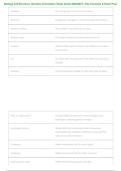
Neutron No charge (0); found in the nucleus.
Electron Negatively charged (-); found outside the nucleus.
Atomic number The number of protons in an atom.
Atomic mass The total number of protons and neutrons.
Isotope Atoms of the same element with different numbers
of neutrons.
Ion An atom that has gained or lost electrons and has a
charge.
Element A pure substance made of only one type of atom.
Why is water polar? Oxygen attracts electrons more strongly than
hydrogen, creating partial charges.
Hydrogen bonds Weak attractions between water molecules
responsible for cohesion, adhesion, high specific
heat, and surface tension.
Cohesion Water molecules stick to each other.
Adhesion Water molecules stick to other surfaces.
High specific heat Water resists temperature changes.
, Biology Cell Structure, Genetics & Evolution Study Guide 2026/2027 | Key Concepts & Exam Prep
Surface tension The strong attraction among water molecules at the
surface.
Acid Has a pH below 7 and releases H+ ions.
Base Has a pH above 7 and releases OH- ions.
Neutral pH A pH of 7.
Carbohydrates Main function is quick energy; made of
monosaccharides; examples include glucose and
starch.
Lipids Long-term energy storage, insulation, and cell
membranes; made of glycerol and fatty acids.
Proteins Made of amino acids; function as enzymes,
hormones, transporters, antibodies, and structural
support.
Nucleic acids Made of nucleotides; store genetic information;
examples are DNA and RNA.
Nucleus Contains DNA and controls the cell.
Ribosome Site of protein synthesis.
Rough ER Processes and transports proteins.
Neutron No charge (0); found in the nucleus.
Electron Negatively charged (-); found outside the nucleus.
Atomic number The number of protons in an atom.
Atomic mass The total number of protons and neutrons.
Isotope Atoms of the same element with different numbers
of neutrons.
Ion An atom that has gained or lost electrons and has a
charge.
Element A pure substance made of only one type of atom.
Why is water polar? Oxygen attracts electrons more strongly than
hydrogen, creating partial charges.
Hydrogen bonds Weak attractions between water molecules
responsible for cohesion, adhesion, high specific
heat, and surface tension.
Cohesion Water molecules stick to each other.
Adhesion Water molecules stick to other surfaces.
High specific heat Water resists temperature changes.
, Biology Cell Structure, Genetics & Evolution Study Guide 2026/2027 | Key Concepts & Exam Prep
Surface tension The strong attraction among water molecules at the
surface.
Acid Has a pH below 7 and releases H+ ions.
Base Has a pH above 7 and releases OH- ions.
Neutral pH A pH of 7.
Carbohydrates Main function is quick energy; made of
monosaccharides; examples include glucose and
starch.
Lipids Long-term energy storage, insulation, and cell
membranes; made of glycerol and fatty acids.
Proteins Made of amino acids; function as enzymes,
hormones, transporters, antibodies, and structural
support.
Nucleic acids Made of nucleotides; store genetic information;
examples are DNA and RNA.
Nucleus Contains DNA and controls the cell.
Ribosome Site of protein synthesis.
Rough ER Processes and transports proteins.


