

Written by students who passed Immediately available after payment Read online or as PDF Wrong document? Swap it for free 4.6 TrustPilot
logo-home
Document preview thumbnail
Preview 4 out of 194 pages
Exam (elaborations)

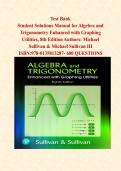
Test Bank Student Solutions Manual for Algebra and Trigonometry Enhanced with Graphing Utilities, 8th Edition Authors: Michael Sullivan & Michael Sullivan III ISBN: QUESTIONS

Document preview thumbnail
Preview 4 out of 194 pages

Comprehensive Practice Test Bank for Sullivan & Sullivan's Algebra and Trigonometry, 8th Edition This 600-question test bank is the ultimate companion resource for students using Algebra and Trigonometry Enhanced with Graphing Utilities, 8th Edition by Michael Sullivan and Michael Sullivan III (ISBN: 978-0135813287). Designed to reinforce core mathematical concepts and enhance problem-solving skills, this extensive question bank covers every chapter—from foundational algebra review through advanced topics like analytic trigonometry, polar coordinates, and sequences. Test Bank Student Solutions Manual for Algebra and Trigonometry Enhanced with Graphing Utilities, 8th Edition Authors: Michael Sullivan & Michael Sullivan III ISBN: QUESTIONS Student Solutions Manual for Algebra and Trigonometry Enhanced with Graphing Utilities, 8th Edition Companion Practice Test Bank ________________________________________ Introduction Welcome to the Companion Practice Test Bank for the Student Solutions Manual for Algebra and Trigonometry Enhanced with Graphing Utilities, 8th Edition. This comprehensive resource has been carefully designed to supplement your learning and reinforce the essential concepts presented in each chapter of the textbook. Purpose and Scope This question bank contains 600 multiple-choice questions distributed across all chapters of the Sullivan & Sullivan III textbook. Each question is crafted to test your understanding of key mathematical concepts, problem-solving techniques, and the practical application of graphing utilities—a hallmark feature of the Sullivan approach. Question Format Every question in this bank follows a consistent format: • Numbered sequentially (1, 2, 3, 4, ...) within each chapter • Four answer choices labeled A, B, C, and D • One correct answer clearly indicated • A detailed rationale explaining why the correct answer is right and, where helpful, why the distractors are incorrect How to Use This Resource 1. Self-Assessment: Test your understanding after completing each section or chapter. 2. Exam Preparation: Use these questions to simulate quiz and test conditions. 3. Concept Reinforcement: Read the rationales carefully to deepen your understanding of both correct and incorrect approaches. Chapter Title Questions R Review 1–50 R.1 Real Numbers 1–8 R.2 Algebra Essentials 9–16 R.3 Geometry Essentials 17–24 R.4 Polynomials 25–30 R.5 Factoring Polynomials 31–36 R.6 Synthetic Division 37–40 R.7 Rational Expressions 41–46 R.8 nth Roots; Rational Exponents 47–50 1 Graphs, Equations, and Inequalities 51–105 1.1 Graphing Utilities; Introduction to Graphing Equations 51–58 1.2 Solving Equations Using a Graphing Utility; Linear and Rational Equations 59–66 1.3 Quadratic Equations 67–74 1.4 Complex Numbers; Quadratic Equations in the Complex Number System 75–82 1.5 Radical Equations; Equations Quadratic in Form; Absolute Value Equations 83–90 1.6 Problem Solving: Applications 91–98 1.7 Solving Inequalities 99–105 2 Graphs 106–150 2.1 The Distance and Midpoint Formulas 106–113 2.2 Intercepts and Symmetry 114–121 2.3 Lines 122–135 2.4 Circles 136–143 2.5 Variation 144–150 3 Functions and Their Graphs 151–200 3.1 Functions 151–160 3.2 The Graph of a Function 161–168 3.3 Properties of Functions 169–176 3.4 Library of Functions; Piecewise-defined Functions 177–184 3.5 Graphing Techniques: Transformations 185–192 3.6 Mathematical Models: Building Functions 193–200 4 Linear and Quadratic Functions 201–245 4.1 Properties of Linear Functions and Linear Models 201–210 4.2 Building Linear Models from Data 211–216 4.3 Quadratic Functions and Their Properties 217–226 4.4 Building Quadratic Models 227–234 4.5 Inequalities Involving Quadratic Functions 235–245 5 Polynomial and Rational Functions 246–295 5.1 Polynomial Functions 246–253 5.2 Graphs of Polynomial Functions; Models 254–261 5.3 Real Zeroes of a Polynomial Function 262–269 5.4 Complex Zeroes; Fundamental Theorem of Algebra 270–277 5.5 Properties of Rational Functions 278–283 5.6 Graphs of Rational Functions 284–289 5.7 Polynomial and Rational Inequalities 290–295 6 Exponential and Logarithmic Functions 296–345 6.1 Composite Functions 296–303 6.2 One-to-One Functions; Inverse Functions 304–311 6.3 Exponential Functions 312–319 6.4 Logarithmic Functions 320–327 6.5 Properties of Logarithms 328–335 6.6 Logarithmic and Exponential Equations 336–340 6.7 Financial Models 341–345 7 Trigonometric Functions 346–395 7.1 Angles and Their Measure 346–353 7.2 Right Triangle Trigonometry 354–361 7.3 Computing the Values of Trigonometric Functions 362–369 7.4 Trigonometric Functions of Any Angle 370–377 7.5 Unit Circle Approach; Properties of the Trigonometric Functions 378–385 7.6 Graphs of the Sine and Cosine Functions 386–390 7.7 Graphs of the Tangent, Cotangent, Cosecant, and Secant Functions 391–395 8 Analytic Trigonometry 396–440 8.1 The Inverse Sine, Cosine, and Tangent Functions 396–403 8.2 The Inverse Trigonometric Functions (Continued) 404–408 8.3 Trigonometric Identities 409–416 8.4 Sum and Difference Formulas 417–424 8.5 Double-angle and Half-angle Formulas 425–432 8.6 Product-to-Sum and Sum-to-Product Formulas 433–436 8.7 Trigonometric Equations 437–440 9 Applications of Trigonometric Functions 441–480 9.1 Applications Involving Right Triangles 441–448 9.2 The Law of Sines 449–456 9.3 The Law of Cosines 457–464 9.4 Area of a Triangle 465–470 9.5 Simple Harmonic Motion; Damped Motion 471–475 9.6 Graphing with a Graphing Utility 476–480 10 Polar Coordinates; Vectors 481–520 10.1 Polar Coordinates 481–488 10.2 Polar Equations and Graphs 489–494 10.3 The Complex Plane; De Moivre's Theorem 495–502 10.4 Vectors 503–508 10.5 The Dot Product 509–514 10.6 Vectors in Space 515–520 11 Analytic Geometry 521–555 11.1 Conics 521–528 11.2 The Parabola 529–534 11.3 The Ellipse 535–540 11.4 The Hyperbola 541–546 11.5 Rotation of Axes; General Form of a Conic 547–550 11.6 Polar Equations of Conics 551–555 12 Systems of Equations and Inequalities 556–585 12.1 Systems of Linear Equations: Substitution and Elimination 556–563 12.2 Systems of Linear Equations: Matrices 564–571 12.3 Systems of Linear Equations: Determinants 572–577 12.4 Matrix Algebra 578–583 12.5 Partial Fraction Decomposition 584–585 13 Sequences; Induction; the Binomial Theorem 586–600 13.1 Sequences 586–591 13.2 Arithmetic Sequences 592–595 13.3 Geometric Sequences; Geometric Series 596–598 13.4 Mathematical Induction 599 13.5 The Binomial Theorem 600 4. Identify Weaknesses: Track which question types or topics challenge you most. Chapter Coverage The questions are organized to align with the textbook's structure, covering: • Chapter R: Review of foundational algebra concepts • Chapters 1–7: Core algebra and trigonometry topics • Chapters 8–14: Advanced topics including analytic trigonometry, applications, polar coordinates, and probability A Note on Graphing Utilities Consistent with the Sullivan approach, many questions integrate graphing utility concepts—using technology to visualize functions, solve equations, and interpret data. Pay special attention to these questions, as they reflect the modern emphasis on mathematical technology in the classroom. ________________________________________ We hope this question bank serves as a valuable tool in your journey toward mastering algebra and trigonometry. Good luck! MULTI CHOICE QUESTIONS 1. Which of the following is a natural number? A) -3 B) 0 C) 5 D) ½ Correct Answer: C Rationale: Natural numbers are the counting numbers: 1, 2, 3, 4, ... Thus, 5 is a natural number. -3 is an integer but not natural, 0 is a whole number but not natural (in most definitions), and ½ is a rational number but not an integer. ________________________________________ 2. The set of all numbers that can be expressed as a ratio of two integers, where the denominator is not zero, is called: A) Natural numbers B) Integers C) Rational numbers D) Irrational numbers Correct Answer: C Rationale: By definition, rational numbers are numbers that can be written in the form p/q where p and q are integers and q ≠ 0. Natural numbers and integers are subsets of rational numbers, while irrational numbers cannot be expressed as a ratio of integers. ________________________________________ 3. Which property is illustrated by: 3 + (5 + 2) = (3 + 5) + 2 A) Commutative Property of Addition B) Associative Property of Addition C) Distributive Property D) Identity Property of Addition Correct Answer: B Rationale: The associative property states that the way in which numbers are grouped when adding does not change the sum: a + (b + c) = (a + b) + c. The commutative property involves changing order (a + b = b + a), while the distributive property involves multiplication over addition. ________________________________________ 4. The additive inverse of -7 is: A) 7 B) -7 C) 1/7 D) 0 Correct Answer: A Rationale: The additive inverse of a number is the number that, when added to the original, gives zero. For -7, the additive inverse is 7 because -7 + 7 = 0. ________________________________________ 5. Which number is irrational? A) √4 B) 0.75 C) π D) -8 Correct Answer: C Rationale: An irrational number cannot be expressed as a ratio of two integers. π (pi) is irrational. √4 = 2 (rational), 0.75 = 3/4 (rational), and -8 is an integer (rational). ________________________________________

Content preview

Test Bank
Student Solutions Manual for Algebra and
Trigonometry Enhanced with Graphing
Utilities, 8th Edition Authors: Michael
Sullivan & Michael Sullivan III
ISBN:978-0135813287- 600 QUESTIONS

,Student Solutions Manual for Algebra and Trigonometry Enhanced with
Graphing Utilities, 8th Edition Companion Practice Test Bank


Introduction
Welcome to the Companion Practice Test Bank for the Student Solutions Manual
for Algebra and Trigonometry Enhanced with Graphing Utilities, 8th Edition. This
comprehensive resource has been carefully designed to supplement your learning
and reinforce the essential concepts presented in each chapter of the textbook.
Purpose and Scope
This question bank contains 600 multiple-choice questions distributed across all
chapters of the Sullivan & Sullivan III textbook. Each question is crafted to test
your understanding of key mathematical concepts, problem-solving techniques,
and the practical application of graphing utilities—a hallmark feature of the
Sullivan approach.
Question Format
Every question in this bank follows a consistent format:
• Numbered sequentially (1, 2, 3, 4, ...) within each chapter
• Four answer choices labeled A, B, C, and D
• One correct answer clearly indicated
• A detailed rationale explaining why the correct answer is right and, where
helpful, why the distractors are incorrect
How to Use This Resource
1. Self-Assessment: Test your understanding after completing each section or
chapter.
2. Exam Preparation: Use these questions to simulate quiz and test
conditions.
3. Concept Reinforcement: Read the rationales carefully to deepen your
understanding of both correct and incorrect approaches.

,Chapter Title Questions


R Review 1–50

R.1 Real Numbers 1–8

R.2 Algebra Essentials 9–16

R.3 Geometry Essentials 17–24

R.4 Polynomials 25–30

R.5 Factoring Polynomials 31–36

R.6 Synthetic Division 37–40

R.7 Rational Expressions 41–46

R.8 nth Roots; Rational Exponents 47–50

1 Graphs, Equations, and Inequalities 51–105

1.1 Graphing Utilities; Introduction to Graphing Equations 51–58

Solving Equations Using a Graphing Utility; Linear and Rational
1.2 59–66
Equations

1.3 Quadratic Equations 67–74

Complex Numbers; Quadratic Equations in the Complex Number
1.4 75–82
System

, Chapter Title Questions


Radical Equations; Equations Quadratic in Form; Absolute Value
1.5 83–90
Equations

1.6 Problem Solving: Applications 91–98

1.7 Solving Inequalities 99–105

2 Graphs 106–150


2.1 The Distance and Midpoint Formulas 106–113


2.2 Intercepts and Symmetry 114–121


2.3 Lines 122–135


2.4 Circles 136–143


2.5 Variation 144–150


3 Functions and Their Graphs 151–200


3.1 Functions 151–160


3.2 The Graph of a Function 161–168


3.3 Properties of Functions 169–176


3.4 Library of Functions; Piecewise-defined Functions 177–184

Connected book
 image
Publisher: 2020 ISBN: 9780135813287 Edition: Unknown

Document information

Uploaded on
August 11, 2026
Number of pages
194
Written in
2026/2027
Type
Exam (elaborations)
Contains
Questions & answers
$36.49

Wrong document? Swap it for free Within 14 days of purchase and before downloading, you can choose a different document. You can simply spend the amount again.
Written by students who passed
Immediately available after payment
Read online or as PDF

Seller avatar
Reputation scores are based on the amount of documents a seller has sold for a fee and the reviews they have received for those documents. There are three levels: Bronze, Silver and Gold. The better the reputation, the more your can rely on the quality of the sellers work.
TutorGeoff
3.9
(14)
Sold
57
Followers
2
Items
633
Last sold
3 days ago


Why students choose Stuvia

Created by fellow students, verified by reviews

Quality you can trust: written by students who passed their tests and reviewed by others who've used these notes.

Didn't get what you expected? Choose another document

No worries! You can instantly pick a different document that better fits what you're looking for.

Pay as you like, start learning right away

No subscription, no commitments. Pay the way you're used to via credit card and download your PDF document instantly.

Student with book image

“Bought, downloaded, and aced it. It really can be that simple.”

Alisha Student

Working on your references?

Create accurate citations in APA, MLA and Harvard with our free citation generator.

Working on your references?

Frequently asked questions
