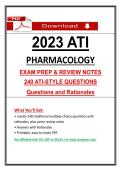
2023 ATI
PHARMACOLOGY
EXAM PREP & REVIEW NOTES
240 ATI-STYLE QUESTIONS
Questions and Rationales
What You’ll Get:
• mostly 240 traditional multiple-choice questions with
rationales, plus some review notes
• Answers with Rationales
• Printable, easy-to-study PDF
Not affiliated with ATI, VATI or NCLEX. For study purposes only.
, Preview Questions Below
Get the Complete PDF After Purchase
"If you require further clarification or in need of any
study resources, feel free to Message me."
,10. A nurse orienting a newly licensed nurse is reviewing the procedure for taking
a telephone prescription. Which of the following statements should the nurse
identify as an indication that the newly licensed nurse understands the process?
A. "A second nurse enters the prescription into the client's medical record."
B. "Another nurse should listen to the phone call."
C. "The provider can clarify the prescription when he signs the health record."
D. "I should omit the 'read back' if this is a one-time prescription
B. "Another nurse should listen to the phone call."
(A second nurse should listen to a telephone prescription to prevent errors in
communication.)
2. A staff educator is reviewing medication dosages and factors that influence
medication metabolism with a group of nurses at an in-service presentation.
Which of the following factors should the educator include as a reason to
administer lower medication dosages? (Select all that apply.)
A. Increased renal secretion
B. Increased medication-metabolizing enzymes
C. Liver failure
D. Peripheral vascular disease
E. Concurrent use of medication the same pathway metabolizes
C. Liver failure
E. Concurrent use of medication the same pathway metabolizes
C. Liver failure decreases metabolism and thus increases the concentration of a
medication. This requires decreasing the dosage.
E. When the same pathway metabolizes two medications, they compete for metabolism,
thereby increasing the concentration of one or both medications. This requires
decreasing the dosage of one or both
3. A nurse is preparing to administer eye drops to a client. Which of the following
actions should the nurse take? (Select all that apply.)
A. Have the client lie on her side.
, B. Ask the client to look up at the ceiling.
C. Tell the client to blink when the drops enter her eye.
D. Drop the medication into the center of the client's conjunctival sac.
E. Instruct the client to close her eye gently after instillation
B. Ask the client to look up at the ceiling.
D. Drop the medication into the center of the client's conjunctival sac.
E. Instruct the client to close her eye gently after instillation
(B. The client should look upward to keep the drops from falling onto her cornea.
D. The nurse should drop the medication into the
center of the conjunctival sac to promote distribution.
E. The client should close her eye gently to promote distribution of the medication)
4. A nurse is completing discharge teaching for a client who has a new
prescription for transdermal patches. Which of the following statements should
the nurse identify as an indication that the client understands the instructions?
A. "I will clean the site with an alcohol swab before I apply the patch."
B. "I will rotate the application sites weekly."
C. "I will apply the patch to an area of skin with no hair."
D. "I will place the new patch on the site of the old patch.
C. "I will apply the patch to an area of skin with no hair."
(The client should apply the patch to a hairless area of skin to promote absorption of the
medication.)
5. A nurse reviewing a client's medical record notes a new prescription for
verifying the trough level of the client's medication. Which of the following
actions should the nurse take?
A. Obtain a blood specimen immediately prior to administering the next dose of
medication.
B. Verify that the client has been taking the medication for 24 hr before obtaining
a blood specimen.
C. Ask the client to provide a urine specimen after the next dose of medication.
D. Administer the medication,and obtain a blood specimen 30 min late
A. Obtain a blood specimen immediately prior to administering the next dose of
medication.
PHARMACOLOGY
EXAM PREP & REVIEW NOTES
240 ATI-STYLE QUESTIONS
Questions and Rationales
What You’ll Get:
• mostly 240 traditional multiple-choice questions with
rationales, plus some review notes
• Answers with Rationales
• Printable, easy-to-study PDF
Not affiliated with ATI, VATI or NCLEX. For study purposes only.
, Preview Questions Below
Get the Complete PDF After Purchase
"If you require further clarification or in need of any
study resources, feel free to Message me."
,10. A nurse orienting a newly licensed nurse is reviewing the procedure for taking
a telephone prescription. Which of the following statements should the nurse
identify as an indication that the newly licensed nurse understands the process?
A. "A second nurse enters the prescription into the client's medical record."
B. "Another nurse should listen to the phone call."
C. "The provider can clarify the prescription when he signs the health record."
D. "I should omit the 'read back' if this is a one-time prescription
B. "Another nurse should listen to the phone call."
(A second nurse should listen to a telephone prescription to prevent errors in
communication.)
2. A staff educator is reviewing medication dosages and factors that influence
medication metabolism with a group of nurses at an in-service presentation.
Which of the following factors should the educator include as a reason to
administer lower medication dosages? (Select all that apply.)
A. Increased renal secretion
B. Increased medication-metabolizing enzymes
C. Liver failure
D. Peripheral vascular disease
E. Concurrent use of medication the same pathway metabolizes
C. Liver failure
E. Concurrent use of medication the same pathway metabolizes
C. Liver failure decreases metabolism and thus increases the concentration of a
medication. This requires decreasing the dosage.
E. When the same pathway metabolizes two medications, they compete for metabolism,
thereby increasing the concentration of one or both medications. This requires
decreasing the dosage of one or both
3. A nurse is preparing to administer eye drops to a client. Which of the following
actions should the nurse take? (Select all that apply.)
A. Have the client lie on her side.
, B. Ask the client to look up at the ceiling.
C. Tell the client to blink when the drops enter her eye.
D. Drop the medication into the center of the client's conjunctival sac.
E. Instruct the client to close her eye gently after instillation
B. Ask the client to look up at the ceiling.
D. Drop the medication into the center of the client's conjunctival sac.
E. Instruct the client to close her eye gently after instillation
(B. The client should look upward to keep the drops from falling onto her cornea.
D. The nurse should drop the medication into the
center of the conjunctival sac to promote distribution.
E. The client should close her eye gently to promote distribution of the medication)
4. A nurse is completing discharge teaching for a client who has a new
prescription for transdermal patches. Which of the following statements should
the nurse identify as an indication that the client understands the instructions?
A. "I will clean the site with an alcohol swab before I apply the patch."
B. "I will rotate the application sites weekly."
C. "I will apply the patch to an area of skin with no hair."
D. "I will place the new patch on the site of the old patch.
C. "I will apply the patch to an area of skin with no hair."
(The client should apply the patch to a hairless area of skin to promote absorption of the
medication.)
5. A nurse reviewing a client's medical record notes a new prescription for
verifying the trough level of the client's medication. Which of the following
actions should the nurse take?
A. Obtain a blood specimen immediately prior to administering the next dose of
medication.
B. Verify that the client has been taking the medication for 24 hr before obtaining
a blood specimen.
C. Ask the client to provide a urine specimen after the next dose of medication.
D. Administer the medication,and obtain a blood specimen 30 min late
A. Obtain a blood specimen immediately prior to administering the next dose of
medication.