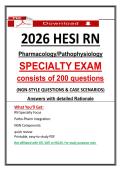
2026 HESI RN
Pharmacology/Pathophysiology
SPECIALTY EXAM
consists of 200 questions
(NGN-STYLE QUESTIONS & CASE SCENARIOS)
Answers with detailed Rationale
What You’ll Get:
RN Specialty Focus
Patho-Pharm Integration:
NGN Components:
quick review
Printable, easy-to-study PDF
Not affiliated with ATI, VATI or NCLEX. For study purposes only.
,PREVIEW QUESTIONS BELOW
GET THE COMPLETE PDF
AFTER PURCHASE
“ If you require further clarification
or in need of any study resources,
feel free to Message me.
”
,1. A client with peptic ulcer disease receives a new prescription for cimetidine.
Which statement provided by the client requires additional instruction by the
nurse?
A. "I will take this medication with meals."
B. "I will avoid taking antacids within 2 hours of this medication."
C. "Decrease cigarette use to a pack per day."
D. "I will report any black, tarry stools immediately."
Correct Answer: C
Rationale: Cimetidine is an H2-receptor antagonist used to reduce gastric acid
secretion. Smoking decreases the effectiveness of cimetidine by increasing gastric acid
secretion and reducing mucosal blood flow. The client should be instructed to quit
smoking entirely, not merely reduce it. Options A, B, and D represent appropriate
understanding of cimetidine therapy.
2. A client taking atorvastatin develops an increased serum creatine
phosphokinase (CK) level. The nurse should assess the client for the onset of
which problem?
A. Muscle tenderness
B. Jaundice
C. Peripheral edema
D. Visual disturbances
Correct Answer: A
Rationale: Atorvastatin is an HMG-CoA reductase inhibitor (statin) that can cause
myopathy, characterized by elevated CK levels and muscle tenderness. Severe cases
may progress to rhabdomyolysis. The nurse must assess for muscle pain, weakness, or
tenderness, as these are early indicators of statin-induced myopathy.
3. An increase in which serum laboratory value indicates to the nurse that a
prescription for atorvastatin is having the desired effect for a client at risk for
coronary artery disease?
A. Low-density lipoprotein (LDL)
B. High-density lipoprotein (HDL)
, C. Triglycerides
D. Total cholesterol
Correct Answer: B
Rationale: Atorvastatin primarily reduces LDL cholesterol (the "bad" cholesterol) and
modestly increases HDL cholesterol (the "good" cholesterol). An increase in HDL
indicates the medication is having a cardioprotective effect. While decreased LDL and
total cholesterol are also desired outcomes, the question specifically asks which
increase indicates effectiveness.
4. History and Physical: The client is a 36-year-old female with moderate persistent
asthma. She takes fluticasone/salmeterol 250mcg/50mcg 1 inhalation twice daily and
albuterol 90mcg/inhalation 2 inhalations every 4-6 hours as needed.
Nurse's Notes: The client states that she has had more severe asthma symptoms than
usual in the past week. Her forced expiratory volume has been 60-65% even with
multiple doses of albuterol for several days in a row. She came to the hospital feeling
dizzy, lightheaded, and complaining of "heart palpitations." Upon assessment, no
wheezes were found. Her oxygen saturation is 99%.
Which condition is the client most likely experiencing?
A. Status asthmaticus
B. Methemoglobinemia
C. Pneumothorax
D. Acute coronary syndrome
Correct Answer: B
Rationale: The client exhibits classic signs of methemoglobinemia: normal SpO2
(99%) despite symptoms of hypoxia (dizziness, lightheadedness, palpitations), absence
of wheezing despite severe asthma history, and excessive beta-agonist use. Excessive
albuterol use can cause methemoglobinemia. The normal oxygen saturation with clinical
cyanosis/hypoxia is pathognomonic—the pulse oximeter reads falsely normal because
methemoglobin absorbs light similarly to oxyhemoglobin.
5. For the client in Question 4, which two actions should the nurse take to
address this condition? (Select all that apply)
A. Administer 100% oxygen via non-rebreather mask
B. Draw blood for a CBC
Pharmacology/Pathophysiology
SPECIALTY EXAM
consists of 200 questions
(NGN-STYLE QUESTIONS & CASE SCENARIOS)
Answers with detailed Rationale
What You’ll Get:
RN Specialty Focus
Patho-Pharm Integration:
NGN Components:
quick review
Printable, easy-to-study PDF
Not affiliated with ATI, VATI or NCLEX. For study purposes only.
,PREVIEW QUESTIONS BELOW
GET THE COMPLETE PDF
AFTER PURCHASE
“ If you require further clarification
or in need of any study resources,
feel free to Message me.
”
,1. A client with peptic ulcer disease receives a new prescription for cimetidine.
Which statement provided by the client requires additional instruction by the
nurse?
A. "I will take this medication with meals."
B. "I will avoid taking antacids within 2 hours of this medication."
C. "Decrease cigarette use to a pack per day."
D. "I will report any black, tarry stools immediately."
Correct Answer: C
Rationale: Cimetidine is an H2-receptor antagonist used to reduce gastric acid
secretion. Smoking decreases the effectiveness of cimetidine by increasing gastric acid
secretion and reducing mucosal blood flow. The client should be instructed to quit
smoking entirely, not merely reduce it. Options A, B, and D represent appropriate
understanding of cimetidine therapy.
2. A client taking atorvastatin develops an increased serum creatine
phosphokinase (CK) level. The nurse should assess the client for the onset of
which problem?
A. Muscle tenderness
B. Jaundice
C. Peripheral edema
D. Visual disturbances
Correct Answer: A
Rationale: Atorvastatin is an HMG-CoA reductase inhibitor (statin) that can cause
myopathy, characterized by elevated CK levels and muscle tenderness. Severe cases
may progress to rhabdomyolysis. The nurse must assess for muscle pain, weakness, or
tenderness, as these are early indicators of statin-induced myopathy.
3. An increase in which serum laboratory value indicates to the nurse that a
prescription for atorvastatin is having the desired effect for a client at risk for
coronary artery disease?
A. Low-density lipoprotein (LDL)
B. High-density lipoprotein (HDL)
, C. Triglycerides
D. Total cholesterol
Correct Answer: B
Rationale: Atorvastatin primarily reduces LDL cholesterol (the "bad" cholesterol) and
modestly increases HDL cholesterol (the "good" cholesterol). An increase in HDL
indicates the medication is having a cardioprotective effect. While decreased LDL and
total cholesterol are also desired outcomes, the question specifically asks which
increase indicates effectiveness.
4. History and Physical: The client is a 36-year-old female with moderate persistent
asthma. She takes fluticasone/salmeterol 250mcg/50mcg 1 inhalation twice daily and
albuterol 90mcg/inhalation 2 inhalations every 4-6 hours as needed.
Nurse's Notes: The client states that she has had more severe asthma symptoms than
usual in the past week. Her forced expiratory volume has been 60-65% even with
multiple doses of albuterol for several days in a row. She came to the hospital feeling
dizzy, lightheaded, and complaining of "heart palpitations." Upon assessment, no
wheezes were found. Her oxygen saturation is 99%.
Which condition is the client most likely experiencing?
A. Status asthmaticus
B. Methemoglobinemia
C. Pneumothorax
D. Acute coronary syndrome
Correct Answer: B
Rationale: The client exhibits classic signs of methemoglobinemia: normal SpO2
(99%) despite symptoms of hypoxia (dizziness, lightheadedness, palpitations), absence
of wheezing despite severe asthma history, and excessive beta-agonist use. Excessive
albuterol use can cause methemoglobinemia. The normal oxygen saturation with clinical
cyanosis/hypoxia is pathognomonic—the pulse oximeter reads falsely normal because
methemoglobin absorbs light similarly to oxyhemoglobin.
5. For the client in Question 4, which two actions should the nurse take to
address this condition? (Select all that apply)
A. Administer 100% oxygen via non-rebreather mask
B. Draw blood for a CBC